



Oswald Spengler stressed the need to form a strong aristocracy based on intelligence and industrial capacity, and not necessarily on narrow and rigid national or racial evaluative criteria. Spengler’s views were in contrast to the doctrines of absolute purity espoused by the ruling Nazis, who were obsessed with their simplistic eugenics and their so-called racial hierarchies. Spengler openly questioned their oversimplified biological ideology, characteristically stating: “It is not the long skulls that are important but what is inside them.” He argued that the foundation of a true national renaissance lay in the state’s recruitment of the most capable minds and their ability to support industry in a diverse way, regardless of their racial background. This vision of an aristocracy of talent and intellect was a direct repudiation of the narrow and exclusive vision of the rulers of the time, emphasizing Spengler’s belief in a meritocracy rather than a purely hereditary racial elite.
A whole new realm of creation emerged from the concept of semi-artificial “reproduction,” particularly in the reproduction of plants and animals, where humanity takes on the role of nature, imitating nature, modifying it, and even surpassing it. In a similar way, the so-called “aristocrats” presented in today’s media are a distorted, artificial, distorted, and often hideous physical reflection of the true aristocratic spirit. This modern depiction has abandoned genuine aristocratic characteristics, transforming them into a pretentious bourgeois manipulation of the remnants of various historically important families.
The media often highlights superficial aspects, such as wealth and fame, while neglecting to mention the virtues of sacrifice and leadership that define true aristocracy. This modern “commodification” of aristocracy reflects a broader societal shift toward materialism and the exploitation of cultural symbols for profit, progressively eroding the traditional ground that once formed the essential foundation of aristocratic identity.
At its core, true aristocracy embodies the soul of a people, a soul characterized not by money or power but by a sense of true leadership. This type of government is characterized by a distinct disregard for personal gain, courage in the face of adversity, and a commitment to efficiency and moral integrity. In contrast to the bourgeois pursuit of personal advancement, true aristocracy is defined by a willingness to sacrifice personal freedom for the greater good, prioritizing the well-being of the community over individual desires. Certainly, this ideal of aristocracy challenges the modern emphasis on the acquisition of wealth, emphasizing the enduring importance of honor and responsibility in the governance of society.
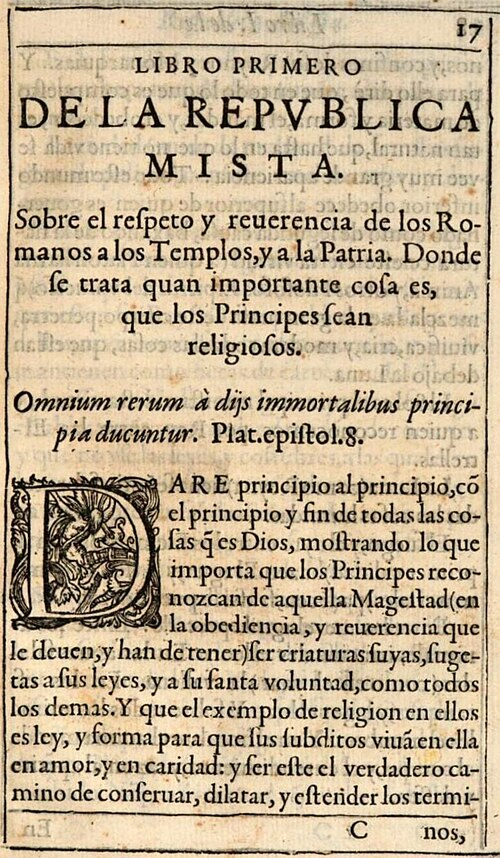
The first volume of the República Mista focuses on the constitutive political roles of religion, obedience, and justice. Without naming him, it aligns itself with the anti-Machiavellian tradition by rejecting Machiavelli’s position that religion serves a merely strategic function. For Medrano, religion is instead fundamental to the political order.
Although only the first part was printed, the República Mista significantly influenced early 17th-century understandings of royal power in Spain, shaping notably the 1617 treatise of Fray Juan de Salazar, who adopted Medrano’s doctrine to define the Spanish monarchy as guided by virtue and reason, but bound by divine and natural law.
In the preface, entitled “Princes, Subjects, Ministers,” Medrano refers to ambassadors from various ancient republics to introduce principles necessary for the maintenance of a strong and lasting democracy. Medrano attempted to unify twenty-one principles to highlight the diverse but essential principles that govern effective political art. He describes:
When Ptolemy, king of Egypt, was discussing matters with the most distinguished ambassadors of the most prosperous republics of that time, he asked each of them the three essential rules or laws by which their nations were governed.
- The Roman ambassador said: “We Romans have great respect and reverence for our temples and our country. We deeply obey the orders of our governors and judges. We reward the good and punish the bad with severity.”
- The Carthaginian ambassador states: “In our democracy, the nobles never stop fighting, the officials and common people never stop working, and the philosophers teach constantly.”
- The Sicilian ambassador states: “Among us, justice is strictly observed. Business is conducted honestly. Everyone is considered equal.”
- The Rhodian ambassador observes: “In Rhodes, the elderly are honest, the young men are modest, and the women are reserved and speak sparingly.”
- The Athenian ambassador declares: “We do not allow the rich to be partial, the poor to be idle, and those who govern to be ignorant.”
- The Lacedaemonian (Spartan) ambassador declares: “In Sparta, envy does not reign because there is equality; greed does not exist because goods are shared in common; and idleness is absent because everyone works.”
- The Sicyonian ambassador explains: “We do not allow anyone to travel abroad, so that he may not bring back new and subversive ideas on his return; nor do we allow doctors who could harm the healthy, nor lawyers and orators who would undertake the defense of disputes and lawsuits.”
Medrano concludes that if these customs were observed in a state, it would maintain its greatness for a long time. He encourages an in-depth study and thoughtful application of these principles, incorporating lessons from both sacred texts and historical narratives to guide governance and social harmony.
The República Mista begins with a foundational 16-page prologue, which establishes Medrano’s vision of governance through history, philosophy, and divine law. Antonio de Herrera y Tordesillas, Philip III’s historian, recognized its importance, advising the king that it was essential to understanding the work. The prologue explores the foundations of politics and society, including the evolution from the family to the commune, to the province, and to the kingdom. Medrano defines politics as “the soul of the city,” equating its role with prudence within the human body, as it “directs all decisions, preserves all benefits, and prevents all evils.” This opening sets a conceptual framework for understanding the complex balance of governance within a mixed democracy. Focusing on the three core pillars of religion, obedience, and justice, Medrano writes:
“Divine justice and human government are so closely connected that one cannot exist among men without the other.”
Based on this conceptual framework, Medrano introduces three virtuous forms of government: monarchy, aristocracy, and timorocracy, contrasting them with their corrupt counterparts: tyranny, oligarchy, and democracy in its degraded form. He explains that each virtuous form serves the public good, while corrupt forms develop into selfish government. By presenting these three opposites, Medrano reveals the need for a mixed democracy that combines monarchy, aristocracy, and timorocracy, creating a structure of government capable of resisting the vices of each individual system.
Drawing on historical and philosophical examples, Medrano demonstrates how this balance promotes social harmony and stability, while avoiding the pitfalls of purely singular forms of government. He argues that any system degenerates when it loses its fundamental virtues and is overwhelmed by selfishness or disorder. In the third chapter of República Mista, on justice, he writes:
“For if Kings, Councils, and Lords on earth are the image of God, they should also strive to imitate Him in goodness, perfection, and justice, as our superiors imitate Him to the best of their ability, in order to inspire true piety and virtue in those under their charge by their example (which is the most powerful thing). For as the heart in the body of animals is always the last to decay, because the last vestiges of life remain in it, so it seems expedient, if any disease should enter to corrupt the people, that the Prince and Masters should remain pure and unharmed to the end.”
Aristocracies dominated political and economic power for most of the medieval and early modern periods almost everywhere in Europe, using their wealth and landholdings to form a powerful political force. The English Civil War was the first sustained and organized attempt to reduce aristocratic power in Europe.
In the 18th century, the rising merchant class attempted to use money to buy off the aristocracy, with some partial success. However, the French Revolution in the 1790s forced many French aristocrats into exile and caused alarm and shock among the aristocratic families of neighboring countries. After Napoleon’s defeat in 1814, some of the surviving exiles returned, but their position in French society was not regained.
In America, the planter class, the owners of large-scale plantations where enslaved Africans produced crops to create wealth for a white elite, dominated political and economic affairs for over a century. The London School of Economics notes in a related study: “The dominant elite in the South before the Civil War was the wealthy landowners who held people in slavery, the so-called ‘planter class.’” Their influence on pre-war politics can best be illustrated by noting that of the 15 presidents before Abraham Lincoln, eight owned people as slaves while in office. While many former slaveholders retained control of their land and remained politically powerful, according to Comer Vann Woodward (1908–1999, an American historian who focused primarily on the American South and race relations), the Civil War weakened and in some cases destroyed the plantation aristocracy.
Beginning in what was then Great Britain, industrialization in the 19th century brought urbanization, with wealth increasingly concentrated in cities, which absorbed political power. However, until 1900, aristocrats retained political dominance in Britain, Germany, Denmark, Sweden, Austria, and Russia, but this dominance was increasingly precarious.
After 1900, in the 20th century, liberal and socialist governments imposed heavy taxes on landowners, resulting in a loss of their economic power. The First World War resulted in a dramatic reduction in the power of aristocrats in all major countries. In Russia, aristocrats were imprisoned and murdered en masse by the Bolsheviks.
Since the abdication of Tsar Nicholas II the previous year and the subsequent collapse of the old regime, the country had descended into chaos and lawlessness. Armed gangs roamed the streets at night, robbing, looting, and killing at will, mainly representatives of the Russian aristocracy.
For nearly a millennium, the aristocracy, what Russians called “bélaya kost,” literally “white bone” (the “blue bloods” in the West), had supplied Russia’s political, military, cultural, and artistic leaders. The aristocracy had served as advisors and officials to the tsars, as their generals and officers. The aristocracy had produced generations of writers, artists, and thinkers, scholars and scientists, reformers and revolutionaries. In a society that was slow to develop a middle class, the aristocracy played a dominant role in the country’s political, social, and artistic life, a role disproportionate to its relative size. The end of the aristocracy in Russia marked the end of a long and justifiably proud tradition that created much of what we still consider quintessentially Russian today, from the magnificent palaces of St. Petersburg to the beautiful country estates around Moscow, from the poetry of Alexander Sergeyevich Pushkin to the captivating novels of Leo Nikolayevich Tolstoy and the enchanting music of Sergei Vasilyevich Rachmaninoff.


