
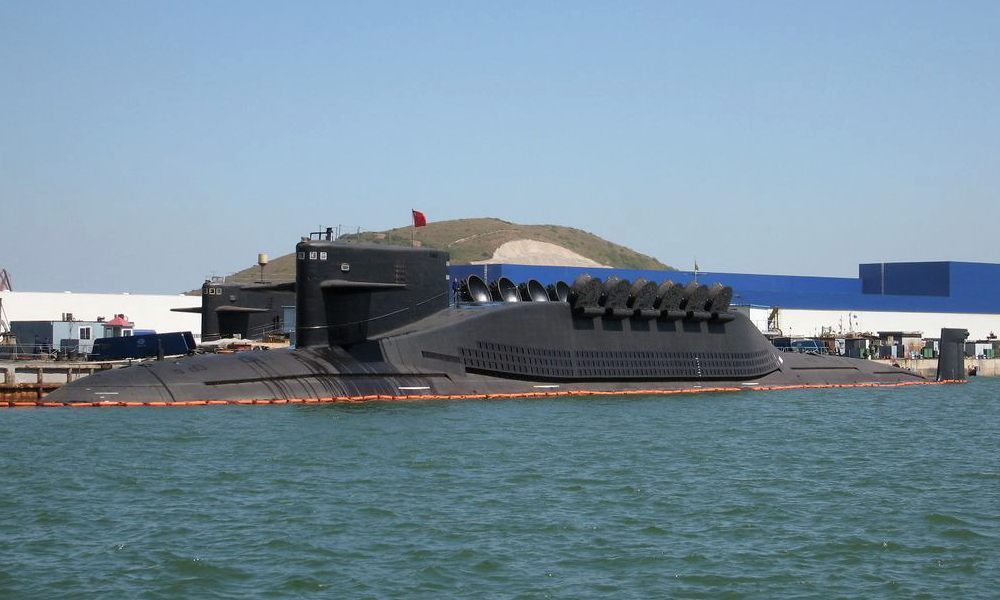
The evolution of Chinese submarine power over the past fifteen years is now clearly documented. According to estimates for 2026, the Chinese Navy has about 12 active nuclear-powered submarines, but with an increased rate of shipbuilding. The fleet includes both strategic ballistic missile submarines (SSBN) and strike submarines (SSN), in order to combine power projection at a strategic level, along with deterrence and sea control capabilities.
At the core of the strategic deterrence are six Type 094 and 094A Jin-class submarines. The vessels have a displacement of about 11,000 tons when submerged, a length of about 135 meters and carry 12 vertical launchers for ballistic missiles. Their armament includes the JL-2 missiles and the newer generation JL-3. The JL-3 is estimated to have a range of over 9,000 kilometers, allowing for intercontinental strikes on the US or even Europe from patrol areas in the western Pacific. In this way, China now has a credible second-strike nuclear sea component.
Despite the higher acoustic signature levels compared to the American Ohio or the Russian Borei-A, the operational value of the Type 094 lies in their continuous presence at sea, an element critical for strategic deterrence.
In the area of attack submarines, China has six Type 093 and 093A Shang-class, plus 3 older Type 091, Han-class. The Shang have a displacement of approximately 6,500–7,000 tons, a maximum speed of over 30 knots submerged, and an operational depth estimated at 300+ meters. Their armament includes heavy-duty torpedoes and cruise missiles launched from torpedo tubes, covering anti-submarine warfare, escort and offensive strike missions against US aircraft carrier battle groups.
The qualitative upgrade of the Chinese fleet is reflected in the development of the Shang, in the 093B version, with at least 4 vessels under construction (perhaps more in the initial stage of material collection), where electronics improvements and lower noise levels are expected.
Next-generation programs are also underway. The Type 095 attack submarine is expected to exceed 8,000 tons and incorporate a new nuclear reactor, improved hydrodynamic characteristics and a significantly reduced acoustic signature. Meanwhile, the strategic Type 096 is intended to gradually replace the Type 094, with a larger number of ballistic missiles and increased survivability in an environment of intense anti-submarine threat.
By comparison, the Russian submarine force is estimated to number 25 to 28 active nuclear-powered vessels, including the Borei SSBN and the Yasen/Yasen-M SSGN. Although the Yasen-M are highly advanced platforms, Russia faces limitations in the rate of shipbuilding and the availability of older classes, which affects the overall operational capability of the fleet.
The United States remains at the top, with 71 nuclear-powered submarines in service at the end of 2025, of which 53 SSN, 14 SSBN and 4 SSGN (cruise missile launchers).
Here, however, China, although still lagging behind Russia in numbers, has superiority in shipbuilding infrastructure, so it will gradually approach it in both quantity of vessels and quality.

How quiet are Chinese submarines?
Submarine superiority only becomes meaningful when combined with acoustic survivability. In underwater warfare, noise levels determine who detects first, who chooses the time and place of engagement, and who imposes its rules without revealing its means. The Chinese evolution of submarine designs over the last fifteen years has clearly aimed to reduce its acoustic signature, even if the distance from the most mature Western standards remains.
Early versions of the Type 093 Shang were noted by Western agencies as noticeably noisier than modern SSNs. Assessments in the 2010s placed them on a par with Soviet vessels of the 1980s. This picture is gradually changing with the 093A version and especially the 093B under construction, which adopt improved rubber engine mounts, a redesigned low-cavitation propeller and extensive anechoic cladding. Several sources agree that the 093B will approach the noise levels of the Russian Akula I improved versions, but not match the top Western SSNs.
Russia’s Yasen-M class is the benchmark for comparison with China. Public statements by Russian officials and assessments by US agencies indicate that the Yasen-M has an acoustic footprint comparable to early versions of the US Virginia Block I/II. This performance is achieved through complete reactor isolation, advanced hydrodynamic lines and the integration of large-area sonar in the nose, sacrificing conventional torpedo tubes forward. In purely acoustic “terms”, however, the Yasen-M maintains an advantage over the Chinese 093B.
However, the newer American Virginias have an acoustic footprint even lower than the Improved Los Angeles. The use of pump-jet propulsion, extensive automation and the continuous upgrading of noise-absorbing materials create a level that no other country has reached. The Chinese Type 095 programs aim precisely to bridge this gap.
In the strategic sector, the Chinese Type 094/094A have a higher acoustic signature than the Borei-A and Ohio, which limits safe patrol areas. China addresses this issue with a “bastion” doctrine, i.e. concentrating its submarines in a relatively safe sea zone in the western Pacific, as a “castle” from which they can launch their missiles. The upcoming Type 096 class is intended to drastically reduce noise, with a larger displacement and a new, lower-vibration reactor, thus allowing for a wider geographical dispersion of patrols.
Overall, in strategic terms, the undersea balance between the three superpowers is transforming from a qualitative monopoly to a competition of mass and efficiency. The comparison of submarines shows that China has not reached the highest level of performance of the US, or the Russian, but it has reached the critical threshold where the combination of numbers, sensors and weapons is sufficient for a credible projection of power, with long-term durability over time.