



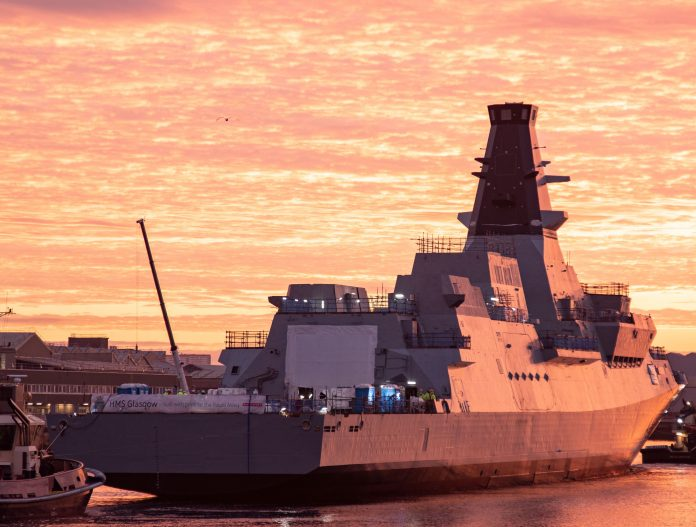
The recent launch of HMS Glasgow, the first frigate of the Type 26 class (or as it is called in Britain, City Class, due to the fact that the ships will be named after cities), proved that the program is progressing normally, even with delays, due to no in design, but for other minor reasons (e.g. supply chain).
The photos of HMS Glasgow are impressive, and reveal the “massiveness” of the ship, and its enormous volume. It is a sign of the times that warships have a very large displacement, in order to be Future Proof, i.e. to withstand developments. What to do with a very expensive ship, if after 20 years of service it cannot incorporate new technologies? And with many innovations just around the corner, the safest method of hosting them is the large displacement, which also has many other advantages, the most important being that the ship is much more “relaxed” on long voyages.
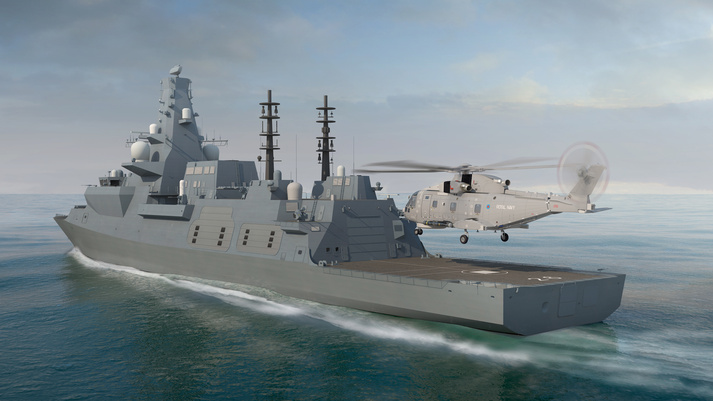
So, with all navies worldwide moving to larger ships, the British, one of the few with real war experience, planned to replace the already “big” Type 23s of 5,000 tons, with Type 26s of 8,000 tons. This means that the Type 26 is only 300 to 1,200 tons smaller than an Arleigh Burke, while its combat capability begins to approach the well-known American destroyer. How is this possible?
First off, the Type 26’s armament is impressive, carrying 48 CAMM or CAMM-ER anti-aircraft missiles. CAMMs probably found a place on the ship instead of CAMM-ER, as they are already in the Royal Navy’s arsenal, on Type 23s (which are retired, but keep their guns). The CAMM and CAMM-ER wiring is exactly the same, so there is no compatibility issue. CAMM-ERs may not be deployed immediately for cost reasons, but they will certainly replace regular CAMMs in service (as they complete their life cycle). There are also plans for the even longer-range CAMM-EER, which will approach ASTER 30 in radius.
One should not think that CAMMs have close range protection (CIWS) use, they may, but they are primarily an anti-aircraft weapon. As CIWS on the ship will be used 2 Phalanx Block1b which will be installed.
The impressive thing is that the ship will also carry a Mk41 launcher with 24 cells. This means that the 48 CAMM/CAMM-ERs can be added, if necessary, by others… 96 CAMM-ERs. In short, the Type 26 will be able to carry up to 144 CAMM/CAMM-ER/CAMM-EER, a massive anti-aircraft firepower. Of course, we doubt if the ship will fill all 24 cells with 96 anti-aircraft missiles of the same family, but it will have a load of BGM-109 Tomahawk cruise missiles as well as VL-ASROC anti-submarine missiles, in order to participate in naval strike missions if necessary.
In theory, the Mk41s will be used for some future anti-ship missile. However, the Royal Navy’s recent choice to equip ships with NSM means that the Mk41 will have fewer “customers”, so they will receive some quantity of CAMM-ER. The NSM uses its own launcher, and the weapon has not yet been certified in a Mk41 (and probably won’t be, the NSM launcher is cheap and light enough to fit into an “expensive” Mk41 cell).
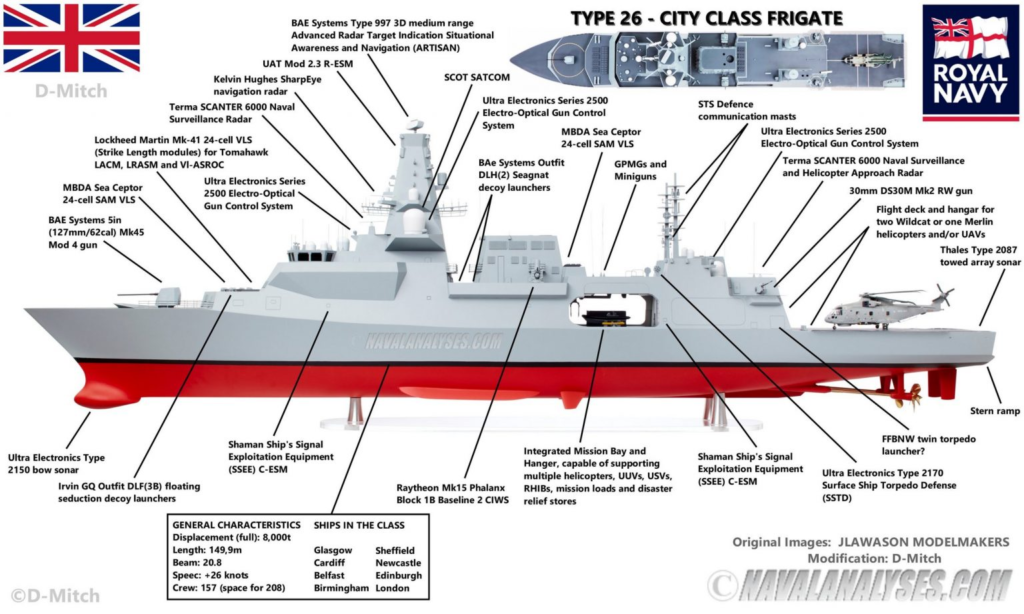
To all this, let’s add the state-of-the-art Mk45 Mod 4 cannon, which means that the ship will be able to engage targets at a very long distance with guided missiles. The 62 caliber barrel allows shooting at distances of up to 100 kilometers with excellent accuracy.
The helipad and the hangar will accommodate 2 helicopters (a rare feature on modern warships), while CH-47 Chinooks will also be able to be deployed. The 2 helicopters will be able to carry up to 40 Martlet missiles, a very large firepower, capable of countering even saturation attacks from UAVs/USVs.
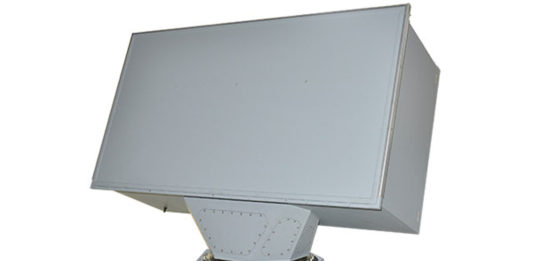
The Arleigh Burke, of course, has a powerful SPY-1D solid state radar, while the Type 26 has “only” a rotating Artisan 997. Rotator radars also have advantages, such as the higher placement so they can reveal their targets earlier.
So the Artisan 997, besides the fact that it is a GaN AESA radar, has excellent performance against targets with a small footprint, weighs only 700 kg (which is why it is placed very high), and is very reliable.
The Type 26 will likely also receive the advanced electronic warfare suite developed by Elbit UK, although we do not rule out that another, even more advanced solution from BAe Systems (manufacturer of the Type 26, Artisan 997, CMS, Mk45 etc.). In general, the British Navy gives special importance to the subject of Electronic Warfare, as do most militaries today.
Of course, we must not forget that the frigate is also top-notch in an anti-submarine role, as it is equipped with electric propulsion (CODLOG, a Rolls-Royce MT30 turbine, 4 MTU Type 20V 4000 M53B diesels and 2 electric motors). In terms of sensors, it carries the sliding sonar 2087. It also carries the Ultra Electronics Type 2150, a fin sonar with very “strong” performance. In short, the Type 26 is one of the world’s leading anti-submarine ships, combining top sonars, two helicopters, and VL-ASROC.

And we come to the subject of price… The Type 26 certainly costs “a lot”, or so we knew! The first 3 ships, together with development and infrastructure costs, cost 3.7 billion pounds, a relatively high sum. However, the recent activation of the option for another 5 ships had a cost of “only” 4.2 billion pounds, which means a cost of 840 million pounds per ship, obviously without the weapons (but with the launchers). That is, without weapons, each ship costs 980 million euros, a great price if you think about it!
