



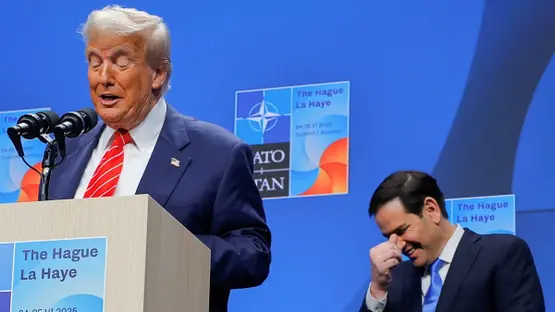
Spectators or participants in the same play? The reason for Donald Trump, who in the global turmoil, once again declares that he is considering the withdrawal of the United States from NATO, describing the Alliance as “obsolete” and “unfair” to America. Can Trump do such a thing, that is, withdraw the United States from NATO, within the political system of his country?
Legally, the founding North Atlantic Treaty, in Article 13, allows each member to withdraw from the alliance with a one-year notice, which will be addressed to the United States, which is also its guardian.
This is where the big issues begin: As of 2023, the US defense spending law, NDAA 2024 (in section 1250A), explicitly prohibits the US President from “suspending, terminating, denouncing, or withdrawing” from the NATO founding treaty without the consent of the Senate – by a two-thirds majority – or without a corresponding new law. This provision, promoted by Senators Tim Kaine (Democrat) and Marco Rubio (Republican and current Secretary of State of Trump…), was of course intended to put a “brake” on unilateral actions by the President in question, but it was also clearly a bipartisan preparation for Trump, who seemed to have a serious chance of being re-elected.
However, the US executive branch maintains – based on a 2020 opinion of the Department of Justice – that the President has exclusive authority to terminate international treaties, based on Article II of the Constitution. Trump has already ordered the withdrawal from other international agreements (such as the Open Skies Treaty), so if he decides to “exit NATO” he can announce it, but this will certainly start a huge political and legal conflict, which will most likely end up in the Supreme Court of the country, while it will also be considered a constitutional crisis.
However, the current composition of the Senate has 53 Republicans, 45 Democrats and 2 Independents, but they usually align with the Democrats – practically 53-47 in favor of the Republicans. So, based on the NDAA 2024, a two-thirds majority (66 votes) is required to approve withdrawal from NATO. So even if all Republicans vote in favor, at least 13 Democrats are needed, which is impossible. The Democrats consider NATO a pillar of national security and will block any related effort, while the “old guard” of Republican legislators, who have been nurtured in the shape of “US global hegemony, with the NATO Alliance as a key tool, will join them. Overall, securing consensus from American legislators is extremely difficult to impossible without major political turmoil.
Already within the Republican party, the tremors about the whole issue are obvious. The “MAGA” wing, that is, the most fanatical Trump supporters, supports withdrawal or a drastic reduction in involvement, seeing NATO as a “Cold War relic” that burdens the US. On the contrary, the traditional “hawks” openly declare that they will not support such a move. For example, Republican Representative Don Bacon, from Nebraska, recently stated that such a move to exit NATO would “destroy” the party for years, as it would become a “civil war” within it. While already in Congress, with a Republican majority, there are decisions that prevent the reduction of American Armed Forces in Europe.
Trump’s “partial exit” option
However, Trump could seek a “silent” withdrawal from NATO without formal notice. As Supreme Allied Commander, he could drastically reduce US participation: withdraw troops from Europe, cut all related funding, not fill vacant command positions in NATO, and most importantly, declare that the US “nuclear umbrella” no longer applies to Europe. Such a stance would therefore weaken the Alliance administratively, defensively, and above all politically, leaving Article 5 on “common defense” empty of content.
But here too, we cannot ignore the “unstable” nature of the Trump administration. That is, the already established patois of criticism, verbal attacks, and crude threats, which the next day can be canceled with a deluge of flattery, only to repeat the scene the next day. Clearly, however, Trump’s logic wants the US to be released from any “obligation” at the international level, putting forward the “America first” euphemism. But even within the Trump circle (excluding the President himself), there is a reluctance to radically overturn some institutions as long-standing as the NATO alliance, which remains to the benefit of the US, and even this is naively questioned. So we conclude the obvious: That the formal withdrawal of the US from NATO is legally questionable and politically almost impossible. However, a punitive stance by Trump towards his allies in Europe, which is already directly threatened (with Trump declaring that “we will remember that you did not help us in Iran”) is possible and more likely. Especially as the American maximalism of Iran-style war adventures increases, which finds no response from the allies who no longer feel like “allies” nor are they even “aware” of what is being planned in Washington.

