
It takes the average worker in the United States almost twice as long to gain the same purchasing power as someone working in Germany, France or the United Kingdom, according to a new method of measuring poverty developed by Olivier Sterk, an associate professor of economics at the University of Oxford, which takes into account differences in the cost of living between countries, so that the comparison is meaningful and not just monetary.
Key Aspects of the New Approach:
- No Poverty Line: The method moves away from assigning a fixed monetary threshold (e.g., $2.15/day) that classifies people as “poor” or “non-poor,” which can misrepresent the nuances of poverty.
- Focus on Deprivations: The approach prioritizes direct, multi-dimensional indicators of poverty, such as access to essential services, assets, and living conditions, rather than relying solely on income or expenditure data.
- Context-Specific Accuracy: By moving beyond a single line, this method aims to better reflect the diverse realities and capabilities of households in different regions, addressing the limitations of monetary-only measures.
The findings based on the new measurement show that the US is lagging behind Europe, as poverty there has been increasing almost continuously since 1990, not due to recession but due to inequality.
The findings based on the new measurement show that the US is lagging behind Europe, as poverty there has been increasing almost continuously since 1990, not because of a recession but because of inequality.
Sterk’s methodology – which he calls “average poverty” -, comparing economies and poverty levels remains complex, as different indicators lead to different conclusions. In terms of purchasing power parity (PPP), the US is clearly stronger than most EU countries, with the exception of Luxembourg and Ireland.
However, the professor notes, “average poverty is significantly higher, even though average incomes exceed those of most Western European countries.” When comparing GDP per capita with Europe, a striking conclusion emerges: the poorest state in the US rivals Germany. In the third quarter of 2024, Mississippi recorded a GDP per capita of €49,780 ($53,872), compared to €51,304 in Germany, a difference of only around €1,500.
What is “average poverty”?
Olivier Sterk emphasizes that poverty is not simply yes or no, above or below the threshold, but a scale with gradations that reveals the true extent of inequality. This difference in perspective completely changes the public debate.
According to his research, published in SSRN under the title “Poverty Without Poverty Line” “average poverty” is defined as the average time it takes to earn a dollar. “The index is comprehensive, takes into account income distribution, can be broken down into individual components, and is consistent with how both experts and the general public understand poverty,” he notes.
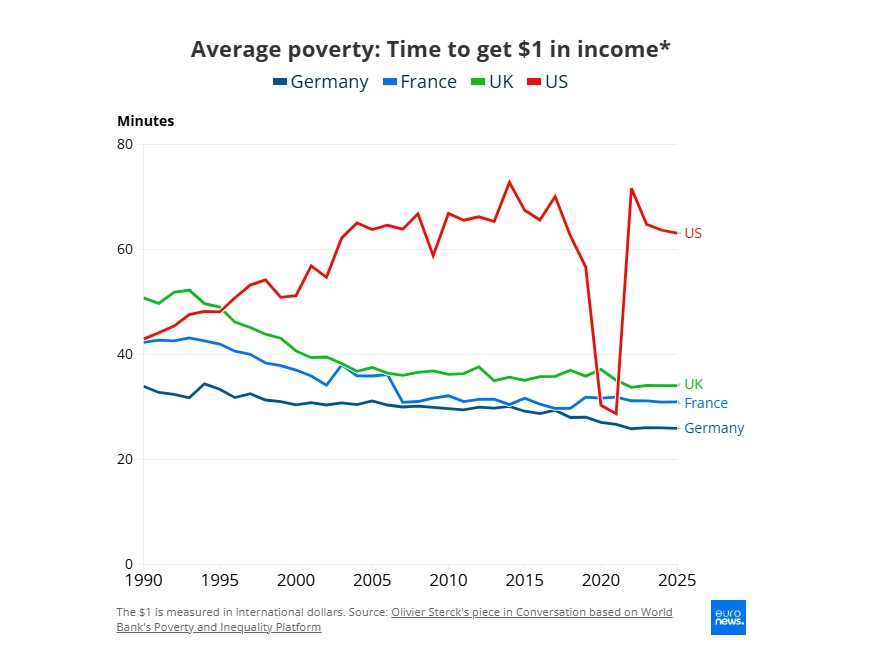
A dollar is measured in international dollars. This means that it buys the same amount of goods and services in any country as a U.S. dollar does in the United States. It is often used in conjunction with purchasing power parity (PPP) figures. The “time” refers to a day in the life of anyone, of any age and under any circumstances, not just during working hours.
What did the measurements show?
In 2025, it will take 63 minutes to earn a dollar in the United States. In Germany, the equivalent time is 26 minutes, in France 31 minutes, and in the United Kingdom 34 minutes. The figures suggest that the average poverty rate in the United States is about twice as high as in these three European countries.
Globally, the index shows a 55% reduction in poverty since 1990, as the time it takes to earn a dollar has fallen from about half a day to five hours.
In the US, however, the picture is reversed. According to the new measure, average poverty has been increasing almost continuously since 1990, despite a significant increase in average incomes. In contrast, most high-income countries have seen a decline.
Notably, in 1990, it took 43 minutes to earn a dollar in the US, almost the same time as in France (42 minutes) and less than in the UK (51 minutes), while Germany recorded the best performance with 34 minutes.
The time it takes to earn a dollar has increased by 20 minutes (47%) over the past 35 years. In contrast, the three European economies have seen a decline, with the largest decline in the United Kingdom.
As noted, average incomes have risen in all countries by just over 1% per year over the past few decades. However, in the United States, inequality has increased by about 2.2% per year, outpacing income growth. Average poverty has increased in the United States because inequality has grown faster than incomes.
In contrast, in the United Kingdom, France and Germany, inequality has remained relatively stable, with rising incomes leading to a decline in average poverty.
The Inequality Behind Poverty
One might ask how a rich economy can grow while at the same time becoming poorer. According to Sterk, the answer is simple: inequality.
Poverty can change either because incomes increase or decrease or because of changes in their distribution. In the case of the United States, average poverty is increasing even in conditions of growth, because inequality is widening faster.
The United States has one of the most unequal economies in the world and by far the most unequal among developed countries. In all 50 states, inequality has increased sharply since 1990, regardless of political orientation, demographic composition, or economic structure.