The “black hole” in the American defense economy risks swallowing the economy of the superpower, and the role of the “global policeman” is called into question…
So far, the White House has justified its unwavering support for Ukraine by citing principles such as defending democracy and freedom — both in Ukraine and in the West. But with the American public — bearing the cost of the war in Ukraine — already appearing to have lost enthusiasm, several Republican senators questioning its purpose and affordability, and the election looming, the Biden administration has shifted its narrative to the Ukrainian.
The new line is that sending weapons to Ukraine is actually an investment in American industry, boosting the economy and creating new jobs.
Keynesian logic
Joe Biden’s new argument fits the flawed Keynesian logic of ‘Bidenomics’, in which economic prosperity is based on generous public spending on infrastructure, semiconductors and clean energy rather than free markets.
It is not only unethical to think that a country should use foreign wars and human suffering to boost its economy, but also patently wrong from an economic point of view. One cannot increase wealth by providing free goods—that is what the United States’ military aid to Ukraine is anyway. Furthermore, if military spending and wars have such a positive effect on the economy, then the US economy should be thriving after the trillions of dollars spent on it over the past two decades. In fact, the opposite seems to be the case.
A boost to American manufacturing?
When the Iron Curtain fell in 1989 and socialism seemed defeated, the world moved into a “monopolar” phase with the US as the undisputed leader, creating high expectations for a long period of world peace and prosperity.
Instead of being drastically cut, however, excessive U.S. defense spending—more than that of the next 10 largest militaries combined—has remained nearly constant at $300 billion for a decade. After the 9/11 attacks and as the US became involved in countless wars and military operations, the defense budget grew to more than $800 billion by 2023.
What is true despite the propaganda
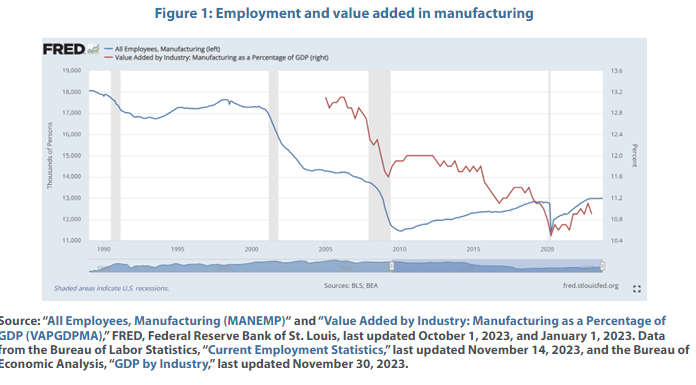
According to President Biden’s argument, this massive investment in the defense industry should have led to a revival of manufacturing in the US. This is definitely not the case.
American manufacturing experienced a nightmare between 2000 and 2010, when the number of jobs, relatively stable at about eighteen million since 1965, fell by 1/3 to under twelve million, while output in the sector as a share of gross domestic product (GDP) also fell.
This was not due to productivity growth and automation, but to the loss of competitiveness caused by financial and real estate bubbles, which raised production costs. American companies accelerated their offshore activity, while jobs shifted to services, manufacturing and the financial sector.
More and better paying jobs?
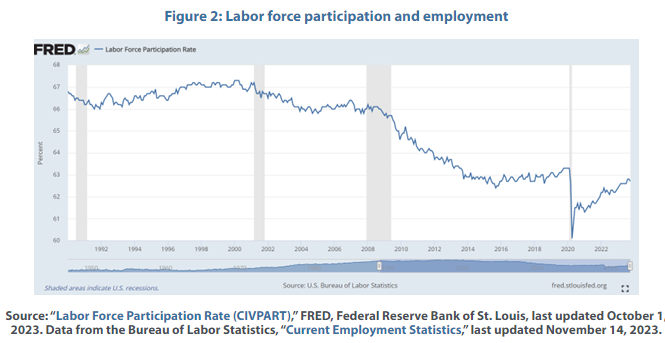
As American manufacturing declined, well-paying jobs for lower-skilled people also disappeared, reducing incentives for employment. Along with the exponential growth of welfare programs and government intervention in the economy, the decline of these incentives has contributed to a steady decline in the participation of Americans in the labor market.
Both labor force participation and employment rates have been declining for nearly three decades. Although Trust Economics partly attributes the long-term decline in labor market participation to demographic changes, this is certainly not the main explanation, as shown by the very low and declining participation rate of young men.
Only Italy among developed countries has seen a larger decline than the US in the labor force participation of men aged 25 to 54 since 1990. Wages and incomes have also been hit by slowing productivity growth and declining manufacturing activity. The average wage of low-skilled high school graduates declined not only in real terms, but also in nominal terms by about 10% from 1990 to 2022. Despite significant ups and downs, average real wages in the US have maintained roughly the same purchasing power over the past four decades – increased by less than 10%.
Weak growth in productivity and investment
The main reason for the problems in job creation and the quasi-stagnation of real wages – according to Trust Economics – is weak productivity growth and shrinking investment.
Despite huge advances in digital technology, productivity growth has slowed to just 1.4% over the past fifteen years, well below the long-term average of 2.2% since World War II. As productivity growth is a function of both technological progress and capital accumulation, it means that the issue is mainly one of insufficient or inefficient investment.
Indeed, the U.S. investment environment has been on a clear downward slope since 1980. As residential investment has remained nearly constant at 4% of GDP over the period, it means that the decline in investment has taken place in equipment, intellectual property, and industrial structures, which are the main contributors to labor productivity.
Moreover, these investment rates probably overestimate the amount of productive investment that leads to healthy capital accumulation, because the two major economic cycles recorded since the early 1990s were also accompanied by a significant proportion of bad investment.

Rising debt and financial crises – At 8 trillion the cost of wars
One thing that took off in the US economy along with the increase in military spending was the amount of public debt.
The fiscal cost of the post-9/11 wars in Iraq and Afghanistan—as well as related operations in Somalia, Libya, and Syria—is estimated at about $8 trillion. This had a major direct contribution to the US public debt jump, from $6 trillion in 2001 to $33 trillion in 2023. As a percentage of GDP, US public debt jumped from 55% in 2000 to 123% in 2023.
The US today ranks among the top 12 most indebted countries in the world, far exceeding the eurozone’s public debt at around 90% of GDP. US debt is expected to rise further.
According to the International Monetary Fund’s recent World Economic Outlook, the US budget deficit is expected to soar to 8.2% of GDP this year and average around 7% of GDP by 2028, when projections end. At the same time, total public debt will rise further to nearly 140% of GDP.
By comparison, euro area budget deficits will likely average around 2.5% of GDP and public debt will fall to around 85% of GDP by 2028.
They are getting rid of the US debt
The US may have entered a debt spiral with the sharply rising cost of servicing it, and there are concerns that the risk of failed US government bond auctions is becoming real in the medium to long term.
Treasury bond auctions have already seen weaker demand—especially from foreign investors—and the yield on the 10-year Treasury note has soared above 5 percent, the highest since 2007. Even if the Federal Reserve steps in to buy bonds , will do so with… printed money, leading to higher inflation.
As an indirect result of rising military spending, the Fed’s record low interest rates in the early 2000s paved the way for the boom and bust cycle that culminated in the global financial crisis.
In addition to public debt, private debt also soared.
Between 2000 and 2022, the total balance of public and private debt across all sectors nearly tripled from $29 trillion to $93 trillion. Meager productivity growth indicates that much of this debt is unproductive and weighs on future growth.
Real GDP growth has already slowed to less than 2% per year on average since 2000, after averaging more than 3% every decade since World War II.
The unbearable cost
President Biden’s claim that greater military spending to equip Ukraine will boost US manufacturing and the economy is unfounded. After more than two decades of very high military spending, public debt has soared while productivity and economic growth have suffered a severe blow.
The rich subsidies that the Biden administration is providing today in the hope of attracting high-tech industries to the US show that militarism carries a serious economic cost – the role of the global gendarme has now led to prohibitive costs.