




Often, in the history of warfare, a new weapon or tactic turns the tables, making everyone question everything they knew about operations. The introduction of the horse and chariot in Middle Eastern battles, the use of the shield and spear wall in classical antiquity, the use of liquid fire in the Middle Ages, and the introduction of gunpowder, machine guns, tanks, and missiles are all tangible examples of such a reversal.
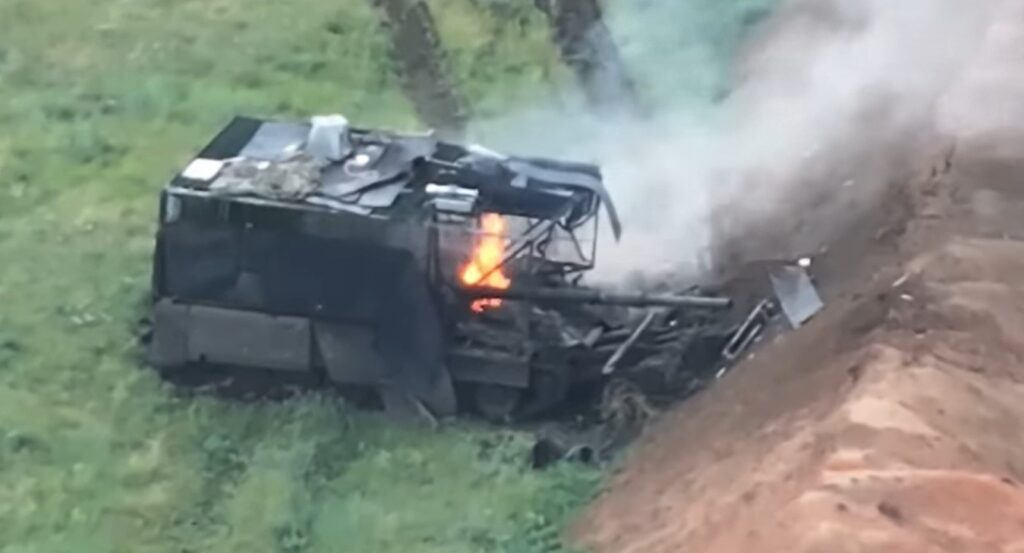
In Ukraine, what radicalized the way operations were conducted was the use of drones as guided weapons, inflicting numerous losses on the enemy (now used extensively by both sides), especially on armored vehicles.
Based on Russian analyses, we publish a cost comparison that highlights the growing role of offensive UAVs on the modern battlefield.
According to the data presented, the unit cost per “heavy” FPV drone is estimated at around $1,200. Based on this assumption, an attempt is made to match the cost of the main Russian armored vehicles and the number of drones that could be acquired for the same amount.
- A BTR-82A armored personnel carrier, with an estimated value of around $360,000, is equivalent to about 300 heavy FPV drones.
- A BMP-3 TOMA, with a cost of around $1.04 million, is equivalent to about 870 drones,
- A BMD-4M airborne combat vehicle, at $1.4 million, is equivalent to about 1,170 drones.
- A T-90M main battle tank, with an estimated value of $3.84 million, is compared to about 3,200 drones.
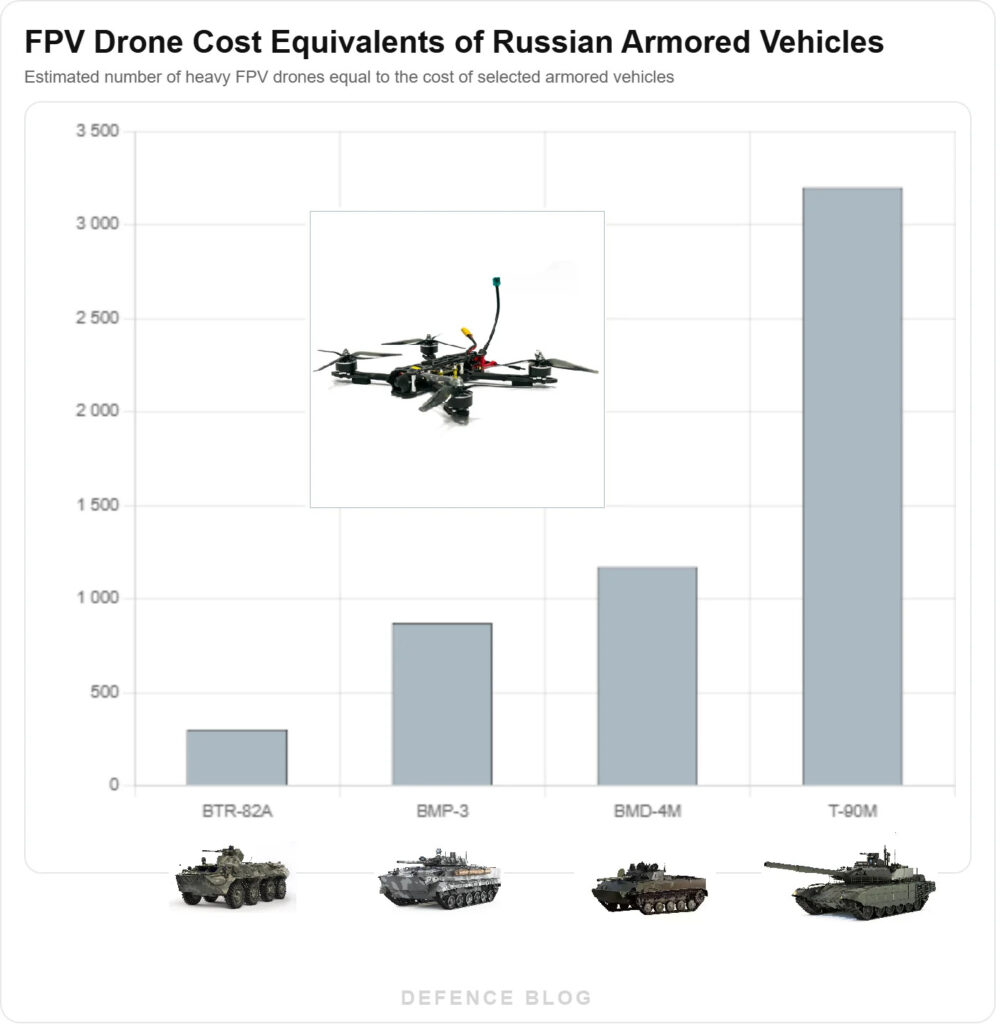
This approach highlights the significant cost differential between armored vehicles and low-cost unmanned offensive systems. The argument is that even the cataclysmic use of heavy FPV combat is infinitely preferable to the use of armored vehicles, whose destruction by the former proves that the modern battlefield has found its new master. Thus, mechanized offensive operations are becoming increasingly demanding, with armored vehicles exhibiting limited survivability in a high-threat environment. In this context, drones, capable of carrying out many successful strikes, excel.
However, the analysis is limited to purely economic terms and does not take into account critical operational factors such as the survivability of each asset, training and availability.
At a technical level, heavy FPV drones are remotely controlled systems with real-time image transmission to the operator (FPV: First Person View), allowing for high precision strikes. They can carry a payload of more than 10 kg and operate at distances of up to 40 km, depending on the configuration.
However, our comment on the above analysis is that it does not take into account the great technical unreliability of drones (many are shot down, fall, are disabled by countermeasures, etc.) or how many FPV strikes are required to put an armored vehicle out of action, but also how much trained personnel is required to effectively handle the drones.
So the perception that drones have rendered combat vehicles obsolete resembles the 100-year-old argument that battles are won only by artillery, or the 70-year-old view that the missile has completely replaced the airplane. Views, however, that have proven to be unsuccessful. Clearly, drones have revolutionized the battlefield, but we will see their balancing at a later stage. While battles and especially ground occupation need much more to be won.


