
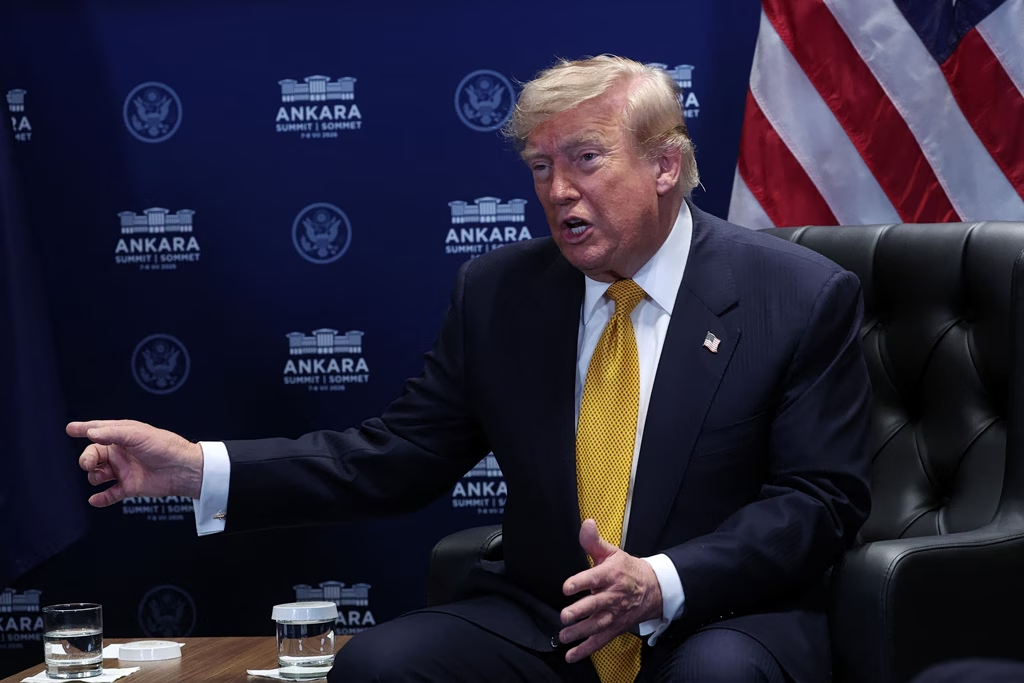


When Donald Trump decided to start a conflict with Iran, Washington reacted as it often does when a new war begins. First with a brief political agreement and then with questions. Even within the White House, there were hesitations. Trump himself admitted that his vice president, J.D. Vance, had a “slightly different philosophical approach” when the decision to strike was discussed. “Maybe not as enthusiastic,” he explained characteristically.
The phrase went almost unnoticed in the flurry of developments. But in reality, it described a deeper reality in American politics. Behind the military escalation, a broader and quite motley “front” of reservations has begun to take shape in Washington. This is not a unified anti-war alliance but rather a mosaic of different voices. Democrats in Congress who talk about constitutional subversion.
New-school Republicans who fear another Iraq-style war. Think tank analysts who warn of a strategic stalemate. And an American public that worries about inflation and seems deeply weary of Middle Eastern wars. What they have in common is a distrust of yet another war with no clear end.
When Donald Trump decided to start a conflict with Iran, Washington reacted as it often does when a new war begins. First with a brief political agreement and then with questions. Even within the White House, there were hesitations. Trump himself admitted that his vice president, J.D. Vance, had a “slightly different philosophical approach” when the decision to strike was discussed. “Maybe not as enthusiastic,” he explained characteristically.
The phrase went almost unnoticed in the flurry of developments. But in reality, it described a deeper reality in American politics. Behind the military escalation, a broader and quite motley “front” of reservations has begun to take shape in Washington. This is not a unified anti-war alliance but rather a mosaic of different voices. Democrats in Congress who talk about constitutional subversion.
New-school Republicans who fear another Iraq-style war. Think tank analysts who warn of a strategic stalemate. And an American public that is worried about inflation and seems deeply tired of the Middle East wars. What they have in common is a distrust of yet another war with no clear end.
The “resistance” in Congress
In Congress, the reaction was expressed almost immediately in institutional terms. Six Democratic senators called for urgent hearings on the administration’s strategy towards Iran, demanding that Defense Secretary Pete Hegseth and Secretary of State Marco Rubio testify. At the same time, they warned that they would use all parliamentary means to pressure the White House to explain.
In the House of Representatives, the Democratic minority leader on the Foreign Affairs Committee, Gregory Meeks, followed suit, saying that “the president is not a king. If he believes that war is in the national interest, he should come to Congress.” Similarly, Democratic Representative Jamie Raskin, a constitutional scholar, put the issue even more clearly, emphasizing that “the Constitution leaves no room for misinterpretation. The decision to go to war belongs to Congress.”
This conflict is not simply institutional, as it also seems to reflect the broader mood of society. According to a Quinnipiac poll, nearly six in ten Americans believe that the president should have sought congressional approval before any military action against Iran.
But the objections are not limited to Democrats. Within the Republican Party itself, there is a small but persistent group that views the conflict with suspicion. Senator Rand Paul has warned that the war could become a political problem for Republicans. “If the goal is unconditional surrender of Iran or regime change, then we are talking about a war with no clear end,” he said. In the House, Republican Thomas Massie was one of the few members of his party who supported the effort to limit the president’s war powers.
This group remains small in Congress. But it reflects a broader trend within the electorate of the new Trump Right, which on this issue converges with the left wing of the Democrats. Of course, many Trump voters still support a robust foreign policy, but they set a clear limit. No ground intervention, no new multi-year war and, above all, no regime change that has unpredictable consequences and often leads to more unfavorable situations.
At the same time, several think tanks in Washington are facing the escalation with obvious caution.
- The Quincy Institute, which promotes the school of “strategic restraint”, argues that the conflict risks turning into a regional war without a clear strategic outcome.
- At the Carnegie Endowment, experts warn that air strikes rarely produce political results and that regime change without a clear plan can create greater instability.
- An analysis by the Council on Foreign Relations moves along the same line, raising the question of what the next day will be even after a successful conclusion of military operations.
Beyond politicians and analysts, the most decisive parameter remains the attitude of the American public. A Reuters–Ipsos poll shows that only 27% of Americans support the strikes against Iran, while 43% disapprove of them. Other surveys record even stronger distrust.
According to Quinnipiac, 53% of Americans oppose military action, 77% fear that the conflict could lead to terrorist attacks within the United States, while 74% are concerned about the impact on energy prices. In 2024, the economy brought Trump back to the Oval Office. 2026 may be the one that will derail him politically in the November midterm elections. And everything indicates that in a country that has spent almost two decades at war, the prospect of another open front in the Middle East is viewed with intense caution.
The Post-Iraq Generation
In this context, J.D. Vance’s stance reflects the political experience of a younger generation of Americans who were shaped in the shadow of two wars in the Middle East. Of course, the vice president not only does not lead an anti-war movement but in fact publicly defends the White House’s policy. Moreover, there is no room for internal opposition or public expression of disagreement in the Trump administration.
However, Vance’s political path reflects a deeper current in modern American politics. Vance belongs to a generation of politicians who came of age in the shadow of the wars in Iraq and Afghanistan. The experience of that period has left many of them with a strong instinct for distrust of military interventions that begin as “limited.”
Shortly before the conflict with Iran began, Vance predicted that “there is no chance that the United States will get into another endless war.” In Washington, many would like to believe that this time the prediction will prove correct. But the history of American foreign policy shows that wars often begin with confidence and end with more questions than they began with. This is precisely what the skeptics fear.


