



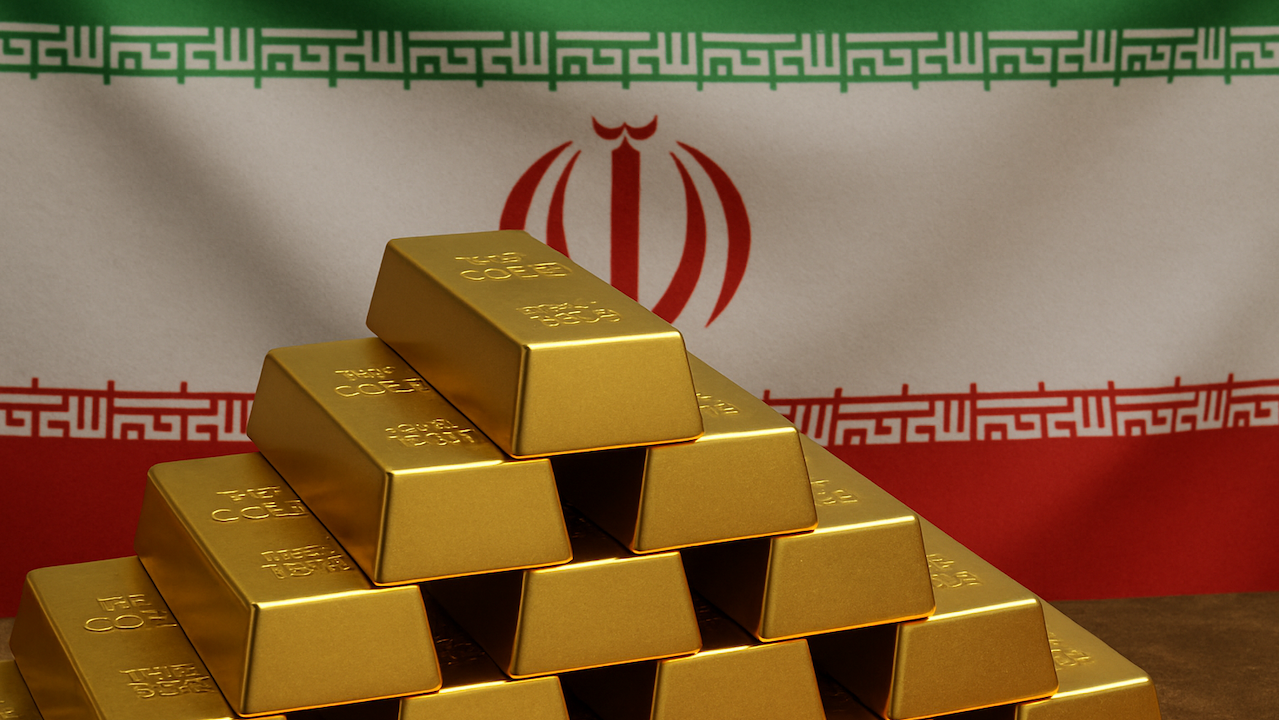
Gold represents financial security – even when the whole world is against you. Russia has used its vast gold reserves to prop up its economy amid aggressive Western sanctions after its invasion of Ukraine.
Recent reports suggest that Iran is doing the same. In the first half of the Iranian calendar year (March 21 – September 20), Iran imported 43 tons of gold worth $2.5 billion, according to a customs report. That represents a six-fold increase over the same period last year.
According to the World Gold Council, Iran’s gold imports exceeded 100 tons, worth more than $8 billion in 2024, accounting for about 11% of the country’s total imports.
The safe haven
The increase in gold imports “may reflect the country’s broader efforts to cushion its economy against foreign exchange shortages and manage international trade amid sanctions.” Gold has become a key safe haven in Iran as the country faces sanctions, currency instability and political uncertainty.
The former head of Iran’s central bank, Hossein Mehri, said gold “provides immunity” to the Iranian economy from international sanctions, dismissing concerns that sanctions could be reimposed under the 2015 nuclear deal.
“Even if this mechanism is activated, it does not mean the collapse of the country’s economy. For 46 years, we have withstood Western pressure and the country, in a way, is immune to it.”
Iran’s government has encouraged the flow of gold into the country
Authorities have allowed some exporters to import gold instead of repatriating foreign exchange. Normally, exporters receive payments in foreign currency, often dollars. These currencies are held in the Iranian banking system as reserves.
Instead, the government allows exporters to use foreign currency to buy gold, which is then held in place of foreign fiat currencies. This allows Iran to more easily circumvent sanctions and manage its reserves.
It also creates financial security. While foreign governments can freeze assets denominated in their own currencies, they cannot freeze gold.
Gold is money – recognized and accepted worldwide. Iran has also used gold to conduct transactions. A drone deal to Russia was paid in part in gold bullion. According to documents obtained by hackers, Russia paid Iran about $1.75 billion for a deal for Shahed-136 drones. Part of the payment was made in several tons of gold bullion.
Gold coins and jewelry
People are also buying gold in droves, coping with the currency’s devaluation. According to the World Gold Council, purchases of gold coins and bars in Iran rose by 20% in the second quarter of the year, while demand for gold jewelry rose by 12%.
It was the only market to report an increase in gold jewelry sales. Globally, gold jewelry sales fell by 14% year-on-year in the same period, due to record prices.
Gold jewelry is often used as an investment in Asian and Middle Eastern countries and is generally of higher purity than that sold in the West. Despite Western efforts, it has proven difficult to prevent countries such as Iran and Russia from using gold, due to its ease of exchange and global demand for the precious metal.
Gold is money and is recognized as such everywhere. Even if they don’t want dollars or other fiat currencies, everyone wants gold. This underscores the nature of gold as money and its important role in the global economy. When fiat currencies lose value or collapse, gold always remains a viable alternative.
That’s why so many countries are accumulating gold at a rapid pace. Official demand for gold by central banks topped 1,000 tons for the third consecutive year in 2024. To put that in perspective, annual reserves increased by an average of just 473 tons between 2010 and 2021.
The pace of central bank gold purchases accelerated after aggressive Western sanctions on Russia. Other countries have noticed the “weaponization” of the dollar and have taken steps to reduce their dependence on the US currency.
According to a report by the Atlantic Council, “in recent years, and particularly since Russia’s invasion of Ukraine and the G7’s escalation in the use of economic sanctions, some countries have signaled their intention to diversify away from the dollar.”

