The recent international situation is increasingly reminiscent of the historical period of the interwar period, when the gradual collapse of the international order that had been created after World War I led to the rise of Nazism and fascist regimes and, ultimately, to World War II, the greatest catastrophe ever known to humanity, with over 75 million dead in East and West.
Today, almost a century later, the world seems to be entering a similar phase: the transition from a unipolar international order, which prevailed after the end of the Cold War, to an unstable multipolar reality, where great powers such as the United States, Russia and China compete for geopolitical influence and access to raw materials.
Russia’s invasion of Ukraine, Israel’s genocidal destruction of Gaza, the US and Israeli attack on Iran and Tehran’s response, the US military intervention in Venezuela with the kidnapping of the country’s president, the complete embargo of Cuba and the threat of invasion, as well as the discussion of the conquest of Greenland, are indications that we have entered a period of dangerous destabilization of international legal rules.
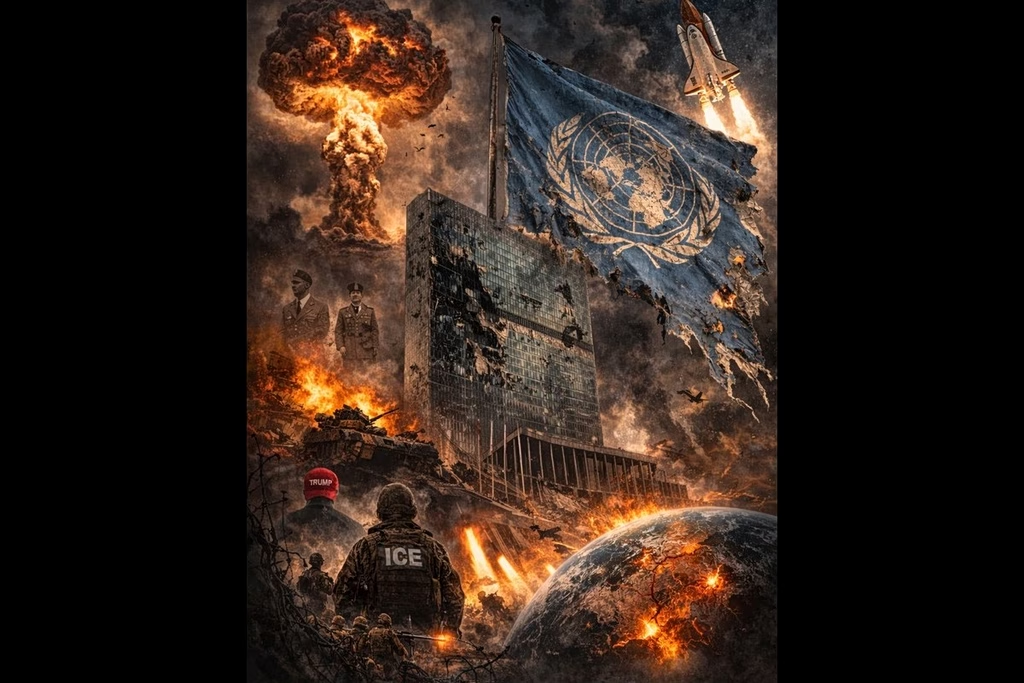
After the devastation of World War I, the international community attempted to create an institution that would prevent new wars: the League of Nations. This attempt, however, failed. The League of Nations had neither the mechanisms to enforce its decisions nor the real political will of the great powers to implement them. Thus, when Nazi Germany, fascist Italy, and imperial Japan began their expansionist policies, the organization proved incapable of preventing the collapse of the international order.
Of course, it should not be overlooked that the post-war order that was created after World War I itself contained seeds of destabilization. The humiliating terms imposed on Germany by the Treaty of Versailles and the economic suffocation that followed cultivated a deep sense of humiliation in German society. At the same time, in Italy – despite being among the victors of the war – the perception of the so-called “mutilated victory” was formed, as it did not receive all the territories it believed the Allies had promised it. These feelings were systematically exploited by nationalist and fascist circles, fueling the rise of regimes that promised to overthrow this post-war order. All this led to World War II, the most destructive war that humanity has ever known.
Precisely to prevent the repetition of such a global tragedy, the United Nations (UN) was founded after the end of World War II. Its founding was a historic attempt to create an international system of rules that would limit the arbitrary use of military force. The UN Charter established fundamental principles: equality of all states regardless of size, religion or political system, prohibition of the use or threat of force, non-interference in the internal affairs of other states, respect for national sovereignty, collective security and peaceful settlement of international disputes.
For many decades, these principles – despite their occasional violations – have been a fundamental foundation of the international order. Today, however, we are witnessing a rapid dismantling of this post-war architecture. When great powers, most notably the United States, systematically bypass the UN, when military interventions are carried out without the approval of the UN Security Council, and when the use of unilateral force is masqueraded as “legal” or “morally justified” by those with the power to impose it, then international law ceases to function as a universal framework for regulating international relations and becomes a tool for selective invocation.
A world in which international rules are applied only when they serve the interests of the powerful inevitably becomes unstable, and the history of the interwar period shows how dangerous such a development can be. At the same time, this geopolitical situation is accompanied by worrying political developments within many Western societies.
The rise of authoritarian political practices, the cultivation of fear of immigrants, racism, religious fundamentalism and the strengthening of repressive mechanisms are strongly reminiscent of the political climate that prevailed in Europe between the wars. In the United States, the Trump administration has used ICE as a violent mechanism to intimidate immigrants, as well as American citizens. Mass arrest operations, raids on communities and the creation of a generalized climate of fear compose a picture that cannot but be reminiscent of the practices of intimidation used in Europe between the wars.
In Nazi Germany in the 1930s, the paramilitary organizations of the Sturmabteilung – the infamous SA – and Mussolini’s “blackshirts” functioned as a mechanism for terrorizing vulnerable social groups, minorities, and political opponents, creating the political environment in which the Nazi and fascist regimes, respectively, were established. Although the historical conditions are not identical, the experience of the 20th century shows that when authoritarian policies within sovereign countries are combined with intense geopolitical competition between great powers, the chances of generalized conflict increase dramatically.
However, today there is a crucial difference compared to the interwar period: humanity lives in the nuclear age. A generalized war between great powers would not simply result in millions of deaths. It could lead to the collapse of global civilization and possibly the extinction of the human species.
And here this geopolitical reality meets the Fermi Paradox (Fermi was a Nobel Prize-winning Italian nuclear physicist). If the Universe is full of billions of planetary systems, at least some of which would have had the conditions for intelligent life to develop, why haven’t we been visited by any more advanced technological civilizations, which undoubtedly exist?
When one considers the evolution of humanity and the tug-of-war it has gone through to develop, the most likely answer is the hypothesis of the “Great Filter,” that is, that at some point in the evolutionary path of civilizations there is a critical obstacle that prevents their long-term survival to reach the point of space expansion.
Probably, technological civilizations, before they have time to expand into space, self-destruct from the very contradictions they produce: the development of technological power on the one hand and the exacerbation of inequalities and competitions for the limited resources of the mother planet on the other, which inevitably lead to generalized wars and ecological collapse.
If this hypothesis is based, then humanity is probably right on the verge of this dramatically critical turning point in its history. The erosion of international law, the undermining of the UN, the return of intense geopolitical rivalries between major nuclear powers, the growth of religious, racial and nationalist fundamentalism and the implementation of authoritarian political practices show that the planet is moving dangerously towards a historical turning point of major dimensions.
The crucial question is therefore: can a technological global civilization overcome its internal contradictions and develop the collective instinct of self-preservation required for its survival, before being led to self-destruction? Or is the “Great Filter” a necessary teleological phase in the evolution of technological civilizations?
The answer to this question may determine not only the future of human civilization, but also whether intelligent life will ever manage to leave its mark on the Universe.