

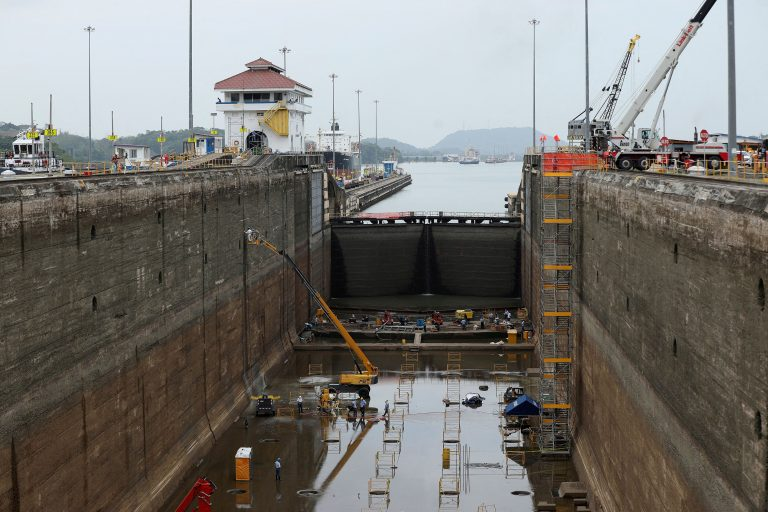
The number of ships allowed to pass through the Panama Canal on a daily basis is expected to decline in the coming months as climate change further disrupts global trade.
More than 3% of world trade passes through the nearly 110-year-old Panama Canal. Its operation is based on the fresh water that fills its various reservoirs. However, the canal region is experiencing one of the worst droughts ever recorded.
This year, for the first time, the Canal Authority has reduced the number of ships that can pass through each day, down to 31 per day, from a roughly average of 36. On Tuesday, October 31, the Canal Authority announced that it would to limit crossings to 25 a day later this week, with that number expected to drop further to 18 ships a day from February next year.
According to the picture provided by the channel authorities, October was the driest in the region since 1950, partly fueled by the El Nino phenomenon, which warms the Pacific Ocean and affects temperature and rainfall around the world. The system of reservoirs feeding the canal also provides drinking water for almost half of the population of the country of Panama.
Minimum water supply
Although the Canal has experienced other droughts in the past, it is highly unusual for restrictions to be in place during Panama’s wet season – which runs from May to December.
In August, authorities were already concerned about a possible disruption to container traffic caused by the drop in crossings, and the latest restrictions will come into effect ahead of the Christmas season when ship traffic increases and therefore demand for crossings.
The most significant demand for passage through the canal comes from Asian countries such as China, but also from the US East Coast, and a huge range of goods are traded, including from petroleum products to vehicle parts and grain.
2.7 day delays
Some operators, such as those that run container ships, are more likely to book slots to cross the channel in advance. Those without reservations wait about 2.7 days to get through, according to Canal Authority figures.
According to its estimates, delays will move to the level of two to three days, which means that it would still be faster to go through the Suez Canal for most Asian shipments. “Companies with heavy loads should consider routing via the US West Coast or Canada, or using rail or road services.”
The lower number of crossings comes at a particularly difficult time for Panama, which relies on the more than $4.6 billion in revenue the Canal brings in each year. In recent weeks, large protests have broken out in the capital of Panama against a large copper mine that accounts for about 4% of the Gross Domestic Product.