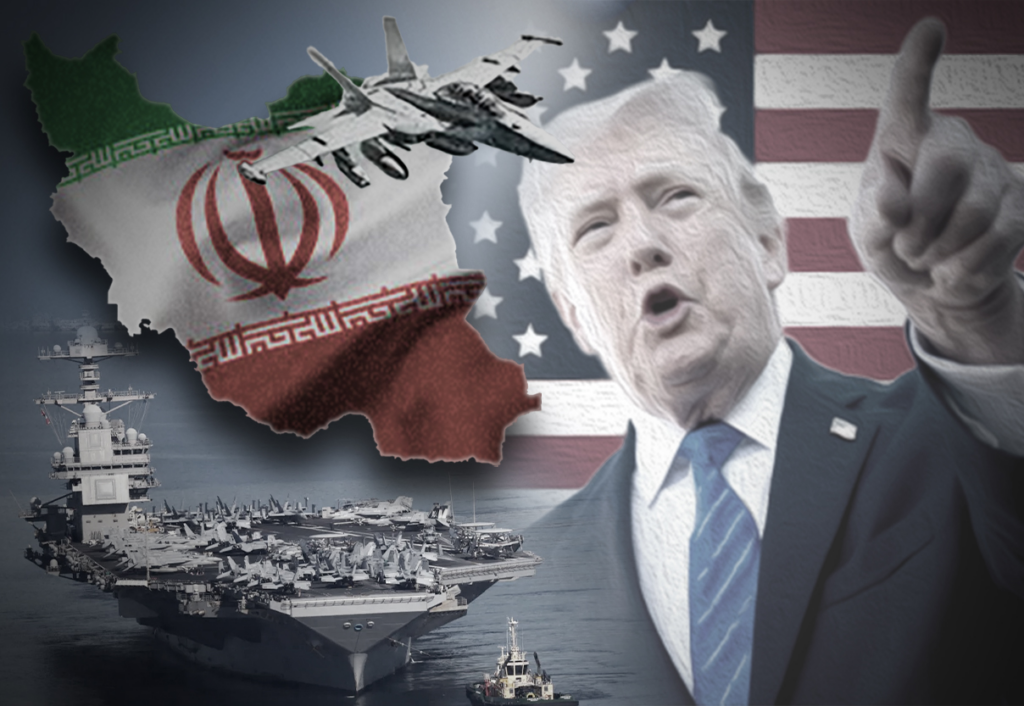
The chances of war in the Middle East are rising, and this time it will be different from a regime change operation. Two aircraft carrier strike groups, the USS Abraham Lincoln and the USS Gerald Ford, are in the region, accompanied by Arleigh Burke-class destroyers and other warships. According to the US Pentagon, the operations against Iran will last several weeks. The US is marshalling its war machine against a nation of 90 million people whose main “crime”, in Washington’s eyes, is its refusal to surrender its sovereignty.
Washington has made demands that go beyond disarmament and the dismantling of Iran’s economic dominance. Iran must definitively end its nuclear program, an energy and research infrastructure essential to the country’s development, destroy its entire ballistic missile arsenal, and sever all ties with the Palestinian, Lebanese, and other resistance forces to Israel in the Middle East and Arabian Peninsula. Iran must abandon both its path to economic independence and any means of defense, leaving it at the mercy of the same power that destroyed Iraq, Libya, and Syria!!!
The stated reason for the entire standoff is uranium enrichment, something Iran has offered to negotiate on. But the issue of enrichment was never the issue. The point is that Iran maintains an independent foreign policy, supports the Palestinian resistance, and refuses to submit to the regional dominance of the United States and Israel. Tehran’s missile program cannot but be “non-negotiable,” as it is the reason why Iran has not already been flattened as Baghdad and Tripoli have been.
The U.S. carrier groups in the region appear extremely powerful, but in reality they are a massive strike force with limited defenses. The USS Abraham Lincoln and the USS Gerald Ford can apparently launch “punitive” air operations, but their accompanying warships reveal a structural weakness. For example, an Arleigh Burke-class destroyer carries about 36 to 46 “air defense interceptors.” Against Iran’s drone and missile saturation tactics, these defenses can be quickly exhausted. The imbalance is mathematical.
Range compounds the danger. The carrier-based F-35C Lightning IIs have a combat range of about 600 nautical miles, meaning the carriers would have to get close enough to launch sustained attacks, meaning they would be within range of anti-ship missiles like Tehran’s Khalij Fars, which can reach speeds of Mach 3-4.
Washington talks of a “weeks” campaign. But against an asymmetric defense, this operation cannot be short; it will likely evolve into a war of attrition where supply constraints, geography, and time dictate the terms. Recall that the June 2025 conflict, the “12-Day War,” was supposed to cripple Iran’s defenses for years. It apparently failed.
In the meantime, China has supplied Iran with HQ-9B long-range surface-to-air missiles and YLC-8B anti-stealth radars designed to track the B-2 bombers and F-35s that will be at the center of US strike planning. Beijing has also helped Iran switch from the US-controlled GPS to China’s Beidou satellite navigation system, reducing the effectiveness of US jamming against Iranian precision weapons. Russia has delivered Mi-28NE attack helicopters and reportedly MiG-29 SMT fighters and Iskander ballistic missiles. The air defense and strike architecture that Washington faces today is significantly more capable than it was last summer.
Satellite images show reinforced tunnels in Natanz and Isfahan, along with a new reinforced facility on Mount Kulang Gazla. Critical nuclear infrastructure has been buried deeper and more thoroughly shielded. The country Washington will attack today is not the one it struck in June.
The military buildup in the region is one front. Covert destabilization is another. After anti-regime protests in January 2026, the State Department diverted funds from other programs to buy nearly 7,000 Starlink satellite terminals. About 6,000 were smuggled into Iran to give anti-government groups access to the Internet, a regime-change infrastructure disguised as “Internet freedom.” The same playbook was used from Cuba to Venezuela and, previously, in Hong Kong.
Iran countered many of the terminals by spoofing GPS signals, feeding them false location data that prevented the hardware from connecting to satellites. Within the U.S. government, officials disagree about whether Starlink’s operation is actually more accurate than cheaper VPN tools that dissidents have had for years. The sabotage campaign by followers of Shah Reza Pahlavi’s descendant appears to be stumbling over its own feet.
Economic warfare is a third front. US Treasury Secretary Scott Bessent, who is mentioned frequently in the Epstein files, took credit for the collapse of Iran’s currency in December 2025. During a congressional hearing in early February 2026, Bessent stated explicitly: “What we did at the Treasury Department was create a shortage of dollars in Iran. The shortage of dollars forced the Central Bank of Iran to print money to bail out a failing commercial bank, accelerating inflation and destroying the purchasing power of Iranians.”
What could Tehran do in the event of war?
It could close the Strait of Hormuz, through which a fifth of the world’s oil passes every day, causing a global energy shock. Swarms of low-cost armed drones could target US bases in Kuwait, Qatar, Bahrain and the United Arab Emirates.
The war would not be limited to Iran. US bases throughout the region would become targets, and the consequences would spread to countries whose populations have no interest in fighting on behalf of US oil companies and Israeli settler expansion.
A prolonged conflict that would cause even modest US casualties would be a political disaster for the Trump administration. A war on Iran would obviously make Lockheed Martin, Raytheon and Northrop Grumman richer. The war would tighten Washington’s grip on the world’s oil supply and enrich energy giants already lining up for the spoils.
At the American Petroleum Institute’s “State of American Energy” summit in Washington on January 16, industry consultant Bob McNally of Rapidan Energy Group told attendees that Iran was “the biggest opportunity” for the oil industry. McNally, a former energy adviser to George W. Bush, urged American companies to return to Iran after regime change: “We would get a lot more oil, a lot sooner than we would get from Venezuela.” A regime change war, he said, would be a “great day for the oil industry and advance Washington’s plan for unchallenged military dominance in West Asia.”
What is actually happening, a story that is not reported in the Western media, is that Washington’s decision to attack Tehran has nothing to do with Iran’s nuclear or ballistic missile programs. The attack on Iran has everything to do with China. The US is trying to choke off oil supplies to the world’s largest industrial economy. Since the fall of Nicolas Maduro in Venezuela, China’s dependence on Iran for oil has skyrocketed, as the US puppet government that replaced Maduro has cut off all oil exports to Beijing.
Depriving China of the oil it needs to run its economy is tantamount to a declaration of war that will almost certainly require an equally belligerent response from Beijing. Whether it’s China exerting its economic influence on the US by withholding vital exports, or China deciding now is the time to make a military move on Taiwan, we need to prepare for some big changes, most of which will not be good for our way of life in the so-called West.
Either way, it looks like this war will start in the next few days. What we need to keep in the back of our minds is that once wars start, no one can predict how they will end.