



One of Vladimir Putin’s “closest associates,” according to a Bloomberg report, has submitted proposals for expanded economic cooperation with the White House, including Russia’s return to the dollar payments system.
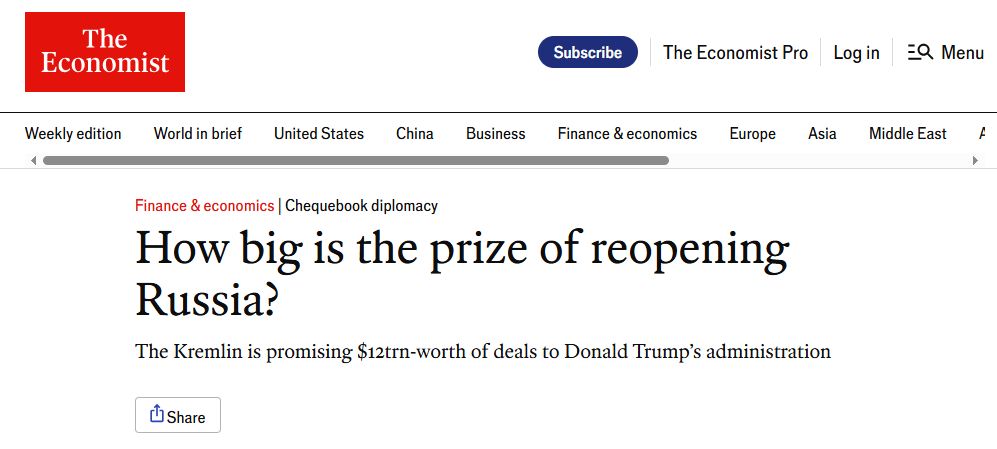
The memorandum in question, which was supposedly made public, refers to a $12 trillion megadeal between the U.S. and Russia for hydrocarbon production, joint investments in natural gas, oil projects and other major raw materials, which promise additional profits for American companies.
The peace agreement with Ukraine
Furthermore, it is supposed to outline Moscow’s basic position on possible economic agreements with Washington linked to a future peace treaty in Ukraine, which is described – not coincidentally – by Bloomberg as “a striking reversal of the Kremlin’s policy and a dramatic change in the global financial system”.
This scenario of course
(a) ignores the shift of Russian policy towards Eurasia – a direction that has been repeatedly confirmed by the Russian leadership.
(b) the “unlimited alliance” with China demonstrated during the military operation in Ukraine by selling cheap Russian oil to Beijing but also by importing critical dual-use goods such as processors for the operation of drones that were critical for the attacks on Ukraine’s energy and defense infrastructure (for more analysis on this topic, please read the articles titled “Economic pragmatism leads Russia to cooperate with the US” & “The EU will implement the Draghi Report for competitiveness, while Russia returns to the Dollar Payment System“).
The geopolitical game
This “narrative” certainly serves the purpose of creating a rift on the Russia-China front. Who, apart from the US, benefits from the revival of the Bretton Woods system?
In fact, it served everyone as long as it functioned smoothly: For the most part, this system has been dead for half a century, since 1971, but its institutions remain beneficial to those who fear change and the redistribution of spheres of influence.
In addition to the US, a number of global actors have an objective interest in the revival of the Bretton Woods system, or simply in the hegemony of the dollar, the institutions of the IMF and the World Bank.
First of all, these are the largest holders of US government debt, such as Japan. For them, the collapse of the dollar system means an immediate write-off of trillions of dollars in reserves. They are tied to the dollar system not because of ideology, but because of balance sheets.
For global corporations and first-world banks, a single settlement currency and predictable rules of the game allow them to enter any market without risk. This would be their natural environment.
There are also the so-called “rentier countries”, the oil monarchies of the Persian Gulf, whose budgets have been expressed in dollars for decades after the agreement with the US in the 1970s on the “petrodollar” that it secured.
The transition to a multi-currency system will force them to redefine the value of everything from oil to London real estate.
It should be clarified that Bloomberg is an instrument of the global financial elite and wants to review Trump’s project to transform the US economy and the international economic system.
The goals of Trump’s policy are to reduce the trade deficit with all US partners and to rebuild the country’s productive base after the mass migration of businesses to Asia (for more analysis on the subject, read the article titled “To solve the Economy’s twin deficits & compete with China, Trump will suspend elections indefinitely“).
The owner of the news agency is Michael Bloomberg, a leading figure of the Democrats, a billionaire and former mayor of New York.
Thus, this is not just about informing the reader about certain negotiating positions, but about a deliberate attempt to use the news platform for a dirty geopolitical move.
The main focus here is on Russian-Chinese relations and, secondarily, on US-EU relations. The main message is that Moscow is ready to sacrifice its strategic partnership with Beijing for the sake of restoring relations with Washington.
The reference to de-dollarization, which the Kremlin is apparently ready to limit with some meager concessions from the US, is a direct provocation. It sends a signal to Beijing about Moscow’s unreliability as a partner, which is temporarily forced to rely on China, but will return to the dollar zone at the first opportunity.
Targeting a breach in trust
The reproduction of such “secret memoranda” creates a breach in trust in the information sphere, forcing both sides to spend political resources on denials and public assurances of loyalty along the way.
The second blow is aimed at transatlantic unity. European elites will see in the article confirmation of dark fears: Trump, they say, is ready to negotiate with Moscow behind their backs.
The narrative that Russia is luring the US President with “far-fetched promises of large sums” and appeals to his dislike of “green” technologies presents the agreement as special.
In this narrative, Europe remains not only out of action, but in the role of a party whose interests are deliberately sacrificed. This works to divide the already difficult dialogue between Brussels and Washington, reinforcing Euroscepticism, on the one hand, and questioning American guarantees, on the other.
References to “Ukrainian intelligence” (not Estonian) and “Western officials” create the illusion of inside information and documented accuracy, but all the key assessments are given anonymously or in hypothetical form.
Finally, Bloomberg functions as a tool for conveying messages: to someone to disrupt potential negotiations, to someone to cool allied ties, to someone for internal American confrontation.
As a result, the text provokes a confrontation of all against all, while the interests of the agency are identified with the needs of those forces for whom military conflict and chaos are more profitable than any rational diplomacy.

