




Basing our analysis below partly on the book “Fourth Turning” by William Stauss and Neil Howe (1997), Publisher Broadway Books (for more analysis on this topic please read the article titled “How can a country (USA) with huge debt be saved by restarting its Economy without causing Social chaos?” & “The End of the World as we knew it was written in Davos! Global Power is being redistributed“), it is clear that we understand that we are experiencing the final stage of the so-called Fourth Wave referred to in the above book and of the major social, economic and monetary transformations that are already underway.
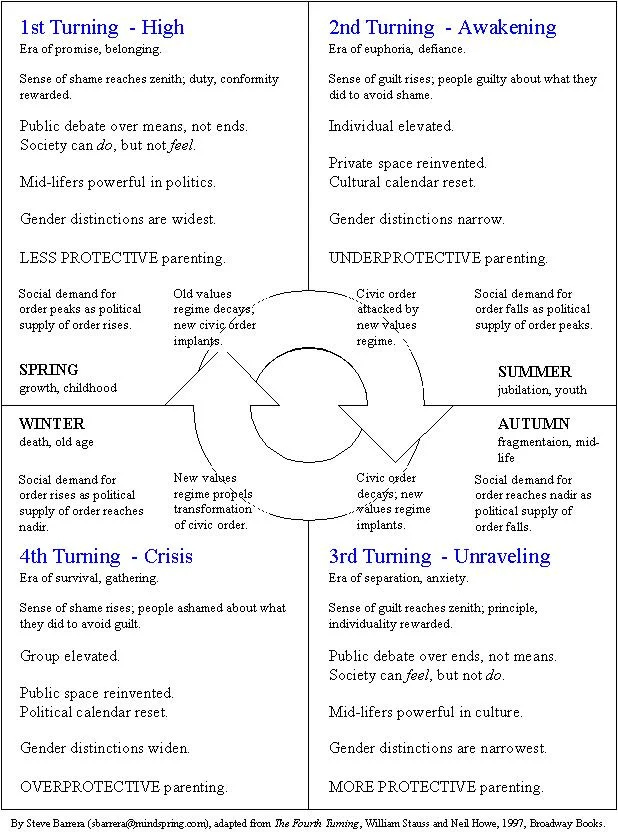
In this specific theoretical framework, the Fourth Wave is the fourth and final phase of a historical cycle of approximately 80–100 years, which corresponds to a period of flowering, crisis, overthrow and rebuilding of institutions followed by a new, in terms of the age of Democracy (state). In the economy, states (Democracies) follow – developmentally (always at a proportional level) the phases of life that the human organism follows immediately after its birth. More specifically,
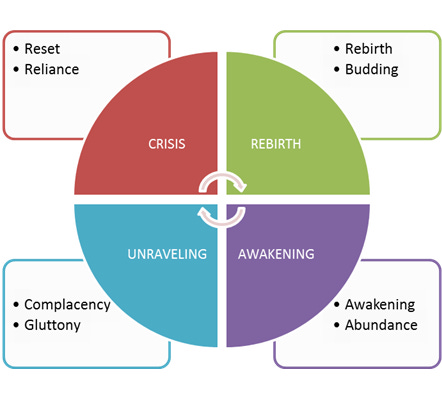
For a newly founded democracy (state) in old age, the following four phases are followed in the course of its evolution:
- High → Peak Period
- Awakening → Spiritual/Social Awakening
- Unraveling → Disintegration / Disintegration
- Fourth Turning → Crisis Period / Great Turning
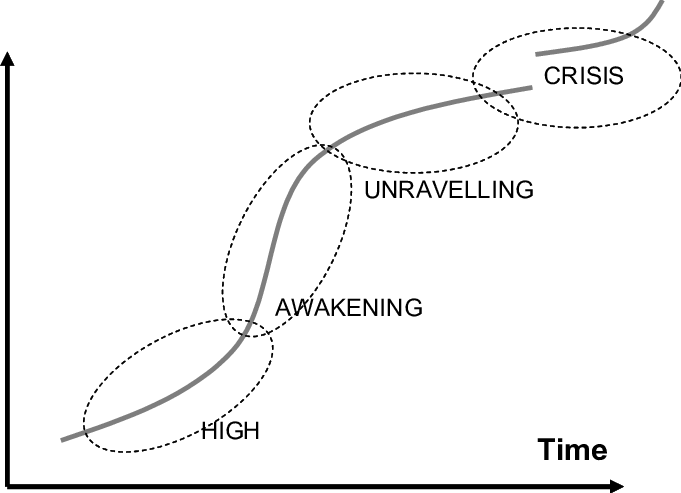
The transition from democracy to an authoritarian regime
We are living in the final, defining years of a world order that has existed for about 85 years — a monetary architecture that was formed in 1944 with Bretton Woods and today seems to be disintegrating, leading rather to a multipolar system with uncertain foundations.
Whether this transition – from democracy to an authoritarian regime – will be inevitable, this will depend on specific factors.
The great Ancient Greek Philosopher, Plato, in his masterpiece political work, the Republic, states that democracies are eroded by wealth inequalities, social tensions and the questioning of the legitimacy of institutions. When citizens cease to believe that the system – by which a society operates – is fair and, specifically, when they consider that the judiciary, elections or institutions are “rigged” – then the order of things itself is called into question.
Polarization is deepening, the legal order is being instrumentalized by all sides, and the de-escalation of political hostility seems unlikely before further tension and a quasi-civil war regime prevail.
As 2026 progresses, the political thermometer in the US seems to be rising dangerously, culminating in the November midterm elections.
The conclusion that we can draw from the above observations is that if Donald Trump wants to defeat Xi Jinping and Vladimir Putin on the geopolitical chessboard, he must overcome the significant disadvantage he has against these leaders, and always based on the current situation that appears in American society.
The latter have managed, due to domestic political history, to work in the long term – Putin, for example, had been preparing the invasion of Ukraine since 2014, as we now know – having secured social alliances and institutional armor that go beyond the circumstantial assurance of electoral victories as Donald Trump seems to be led to do in the USA.
To achieve the total economic transformation such as the one he is attempting by imposing tariffs and devaluing the dollar in order to reduce the huge “twin” deficits of the US and change the geopolitical paradigm, we predict – as The Liberal Globe – that he will be led to his choice to free himself from the shackles of electoral contests and not to call midterm elections – citing extraordinary economic and geopolitical conditions.
This is easy to say and difficult to do of course… But a “lame duck” president for the next two years until his term is completed without the control of Congress with the “deep state” of Washington strengthened, the only certainty is that he will not be able to proceed with any major reforms and will be a weak interlocutor abroad.
The failure of his presidency will be more than certain – especially if changes in the economy, such as customs revenue, do not flow properly by the end of 2026 or if other economic factors combine with a surge in unemployment or inflation.
Monetary Transformation and the Reign of Gold
Based on our analysis above, the Final Stage of a Democracy in the situation described above represents the dissolution of the monetary and social order.
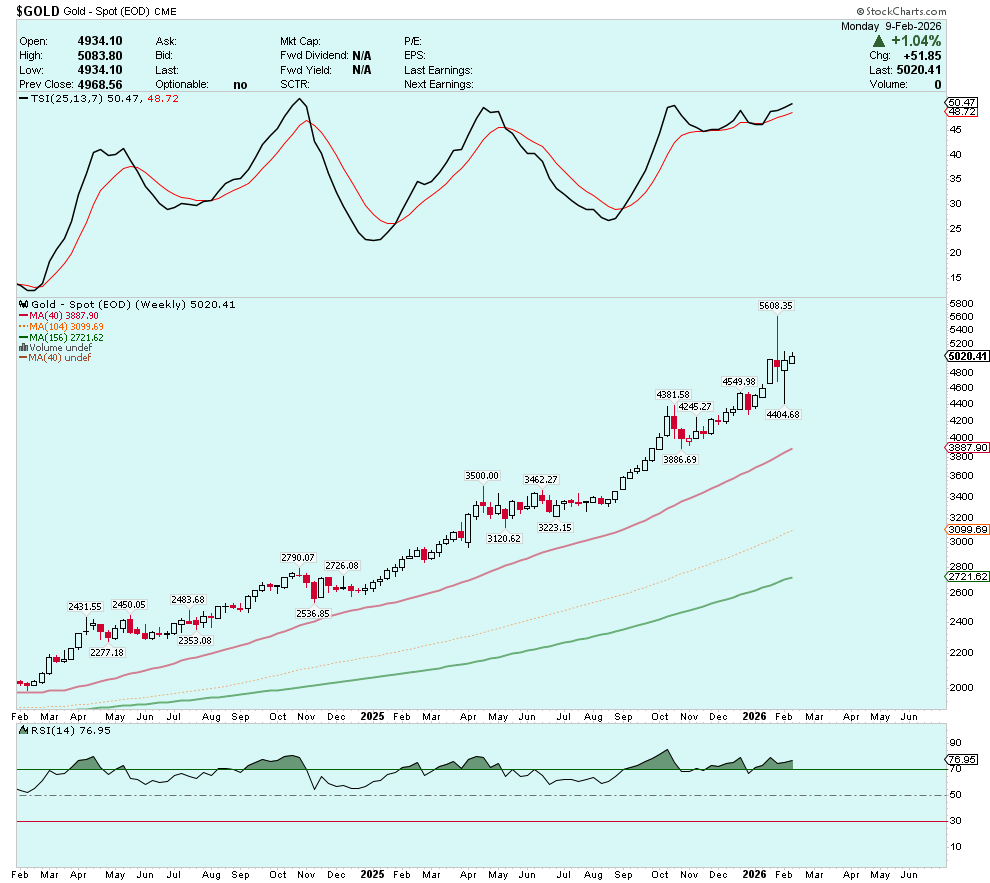
The rise in the price of gold is considered — in this context — a symptom of the increasing risk of transitioning to this final stage. Gold is the one asset that is not someone else’s obligation. That is, it is not a debt, it is not a promise of a third party; it is an ultimate asset.
In the book “The Fourth Turning” by Strauss-Howe, the final phase of the Fourth Wave, societies enter a period of increasing pressure. Institutions lose their legitimacy faster than they can be reformed.
The political system becomes polarized, financial structures creak, and trust in the “establishment” collapses. What begins as widespread anxiety culminates in decisive conflict—often triggered by a catalyst: war, economic collapse, or systemic failure.
Compromise is rare. History is accelerating. The key feature is not chaos but forced choice: what is worth saving, what must be dismantled, and what new rules will govern collective life. Real Assets and Productive Capacity.
Who benefits in this phase?
Certainly not those who are tied to the existing, over-indebted and financially bloated order of things. The elites of financial engineering, bureaucratic mechanisms and systems based on over-leverage usually lose power and credibility.
On the contrary, those who are connected to real assets, productive capacity, energy, food, metals, defense — and the practical ability to operate in an environment of instability — gain.
Socially and psychologically, time is “compressed”. Moral clarity replaces ambiguity. Sacrifice becomes socially acceptable. Extreme individualism gives way to collective action.
Freedoms may be temporarily curtailed, but at the same time grand plans that were previously considered impossible become possible.
At the end of the crisis, according to the aforementioned book by Strauss-Howe, there is not simply a collapse but a reorganization. A new political and economic order emerges.
Institutions are being rebuilt — or replaced — on principles forged in the crisis. The new system tends to be more disciplined, more production-oriented, and less dependent on financial “illusions.”
In other words, the Fourth Wave does not end in chaos, but in a reboot. A “hard reset” that clears the ground for a new cycle of growth.
And if history repeats itself, even in part, then “hard” assets — and gold in particular — are not just an investment option, but the foundation of the next era.

