


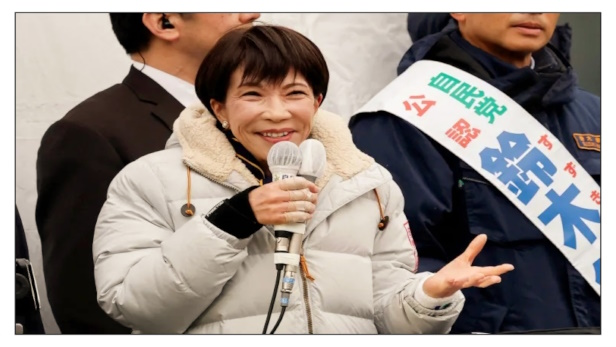
Sanae Takaichi was born in 1961 in Nara and studied political science at Kobe University. She entered public life early and was first elected to the Diet in 1993. She gradually assumed key government positions, including Minister of Internal Affairs and Communications, gaining a reputation for her strict, security-oriented political line. She supports strengthening national defense, demographic reconstruction and the preservation of Japan’s cultural identity. Finally, Takaichi is a political child of the assassinated Shinzo Abe.
The February 8, 2026, snap election in Japan was one of the most defining moments in the country’s modern political history. Prime Minister Sanae Takaichi, the country’s first woman to hold office, and the Liberal Democratic Party (LDP) achieved an impressive, almost historic, victory, securing two-thirds of the House of Representatives — 315 of the 465 seats. This result was not just an electoral victory; it was a clear affirmation of the Japanese people’s trust in a political line that emphasizes national cohesion, security, and stability. The paradox here is that the LDP, as a liberal party, has never before had such a clear national political vision.
In the public debate that followed, many analysts attributed the extent of the victory to a factor that often characterizes Japan: the country’s extremely high ethnic homogeneity, which reaches 98.5%. This homogeneity, according to several readings, allows the development of a common patriotic direction, reduces social friction and strengthens the government’s ability to implement coherent policies, particularly on issues such as immigration, national security and social cohesion.
Takaichi’s campaign capitalized on this reality, projecting a message of stability and unity. The official photo of the Prime Minister, widely circulated in the media, was accompanied by the narrative that Japan remains an example of a country that, thanks to its social cohesion, can draw up long-term strategies without the intense internal conflicts observed in other parts of the world.
The comparison with Europe was inevitable. Many commentators, adopting a more nationalist perspective, have shown that multiculturalism and ethnic diversity have led many European societies to fragmentation, political instability and difficulty in formulating common policies. In this context, Japan has been presented as the antithesis: a country where political will can be expressed in a unified way, without stumbling upon deep social divisions.
This debate is not new. International research has extensively examined the relationship between ethnic diversity and social trust. One of the most frequently cited works is Robert Putnam’s study, published in 2007 in Scandinavian Political Studies (“E Pluribus Unum: Diversity and Community in the Twenty-first Century The 2006 Johan Skytte Prize Lecture“. Putnam concluded that increased ethnic diversity can reduce social trust and civic participation. People tend to withdraw, trust institutions less, and participate less in collective activities.
This finding was used by many of Takaichi’s supporters as an argument for the need to maintain a coherent national identity and a strict immigration policy framework. Japan, they argued, should not repeat the mistakes of other countries that opened their doors without ensuring social integration and cultural cohesion.
In the case of Japan, Takaichi chose to prioritize security and social cohesion. Her campaign focused on issues such as strengthening defense, addressing demographic challenges, protecting borders, and preserving cultural identity. The message was clear: in a rapidly changing world, Japan must remain stable, united, and oriented toward its own values.
Her landslide election victory showed that a large part of the Japanese electorate shares this approach. The mandate that the Prime Minister received now allows her to promote an ambitious reform program, aiming to shield the country from geopolitical challenges in the region and ensure social stability in the long term.
At the same time, this victory opens a broader discussion about the future of democracies in a world where immigration, technology and global crises are reshaping societies. Japan, with its own unique model, offers an interesting example.
In any case, Sanae Takaichi’s electoral victory is a turning point. The next four years will show whether Japan will be free to follow the national orientation that the vast majority of the country seeks. Whether Sanae Takaichi truly believes in the policy she proposes or is simply exploiting the popular will.
If Japan truly follows the policy of protecting the Nation, it will be interesting to see whether it will remain the beloved Asian country of the West or will suddenly be called fascist and, for example, Japanese cars will become anti-Semitic…
