




It is not just Greenland. It is not just Kosovo. It is not just Venezuela. The case of the Chagos Islands is one of those stories that Western governments would prefer to leave buried under the tropical sun of the Indian Ocean. An archipelago small, isolated, almost invisible on the world map — but huge as a symbol of the hypocrisy that characterizes “liberal democracies” when their strategic interests are threatened.
US President Donald Trump’s recent outburst against the London-Mauritius agreement on the transfer of sovereignty over the islands is but the latest episode in a long history where might trumps justice, and morality gives way to the need to maintain an American base that functions as a “black hole” of international law.
A ghost archipelago serving real empires
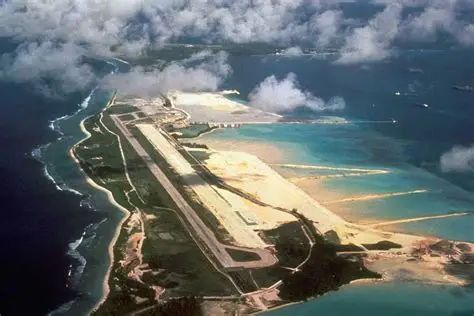
The Chagos Islands have been under British control since 1814. In 1965, shortly before Mauritius gained independence, London snatched the archipelago away as if it were a piece of furniture that didn’t fit in its new home. Three years later, the expulsion of the inhabitants began — about 2,000 people who had lived there for generations. It wasn’t “relocation.” It was uprooting. And it was done for one reason: to build the American base on Diego Garcia, one of the most important US military platforms in the world. Operations in Vietnam, Iraq, Afghanistan, and even secret flights transporting terrorist suspects passed through there. The West talks about the rule of law. But on Diego Garcia, law stops at the base’s gate.
The deal that was presented as “justice” but reeks of political expediency
In 2025, Britain and Mauritius reached an agreement: London would transfer sovereignty over the islands, but would lease back Diego Garcia for 99 years. On paper, it looks like a correction of a historical injustice.
In practice, it is a legal shield for the American presence. Britain did not “recognize” its mistake. It simply found a way to maintain it without risking international appeals. And then comes Trump, who—despite the fact that his administration had supported the deal—now denounces it as “an act of great stupidity.” Not because he cares about the Chagossians. But because he fears that the transfer of sovereignty will open a window of influence for China and Russia. The irony? He links it to his old obsession with “buying” Greenland. The colonial mentality does not die. It simply changes accounts on Twitter and Truth Social.
Britain talks about security, but avoids talking about responsibility
In London, the opposition—mainly the Conservatives—complain that the agreement “weakens the security of the United Kingdom.” Security for whom? For the 2,500 American soldiers stationed on Diego Garcia? Why certainly not for the 10,000 Chagossians who live scattered across three countries, with no homeland, no right of return, no certainty that their story will ever be heard. Human Rights Watch talks about “crimes against humanity.” Britain talks about “strategic stability.” The distance between the two phrases is the distance between reality and political expediency.
The Chagossians: the invisible people of a visible injustice
The Chagossians were not involved in the negotiations. They were not consulted. They were not informed. The agreement provides for a “resettlement fund”, but without clear terms, without a timetable, without guarantees. Two women of Chagossian origin have appealed to the British courts, arguing that the transfer of sovereignty will make it even more difficult to return. And they are right: when the interests of the big players are locked in, the small ones disappear from the table.
The conclusion that the West does not want to hear and that you do not want to hear
The Chagossian case is not just a dispute over an archipelago. It is a mirror. And in this mirror, the West does not see itself as it wants to present itself — a defender of rights, democracy and international law.
He sees something more uncomfortable: A world where colonialism never died. It just wears camouflage and speaks the language of “security.”
