A few hours before appearing at the World Economic Forum in Davos, Donald Trump chose a stance that leaves no room for misinterpretation. Cold tone. Public irony. Targeted insults. Not towards opponents, but towards allies. Europe is not treated as an equal partner, but as a place to exert pressure, and at any time and without the slightest sanction or countermeasure.
The first element that is striking is what he did not say. In his message for one year in office, foreign policy was almost absent. No extensive reference to Ukraine. No strategic declaration for NATO. No attempt to “tie” alliances. This is not negligence. This is a choice.
Trump is investing in the image of the president who does not explain – imposes. Foreign policy, in his own terms, is not announced in anniversary messages. It is exercised piecemeal, through power moves, economic threats and public humiliation. Silence on the message is tantamount to a warning: decisions will not go through consultation.
Greenland as a test of discipline
Greenland is not a geopolitical whim. It is a tool. Trump knows that the issue borders on the absurd for European public opinion. That is precisely why he chose it. He is not interested in immediate implementation. He is interested in the reaction.
Europe found itself seriously discussing something that would normally be rejected with a glance. And that alone constitutes a success for the White House. Greenland functions as a test of reflexes. How quickly Brussels reacts. How united. And, above all, how decisively.
The picture so far is not encouraging. Statements of concern. Summits without a clear line. And a widespread anxiety that Trump will shift the pressure elsewhere – to NATO, to Ukraine, to trade.
Why are allies being targeted?
Trump does not need to pressure opponents. He takes them for granted. Russia, China, Iran operate at a different level of balance. With Europe, however, there is an asymmetry of dependence. And that is his real strength.
European leaders depend on the American security umbrella. On access to the American market. On political support on critical fronts. Trump knows that he can pressure without direct cost. And he does it publicly, to maximize the effect.
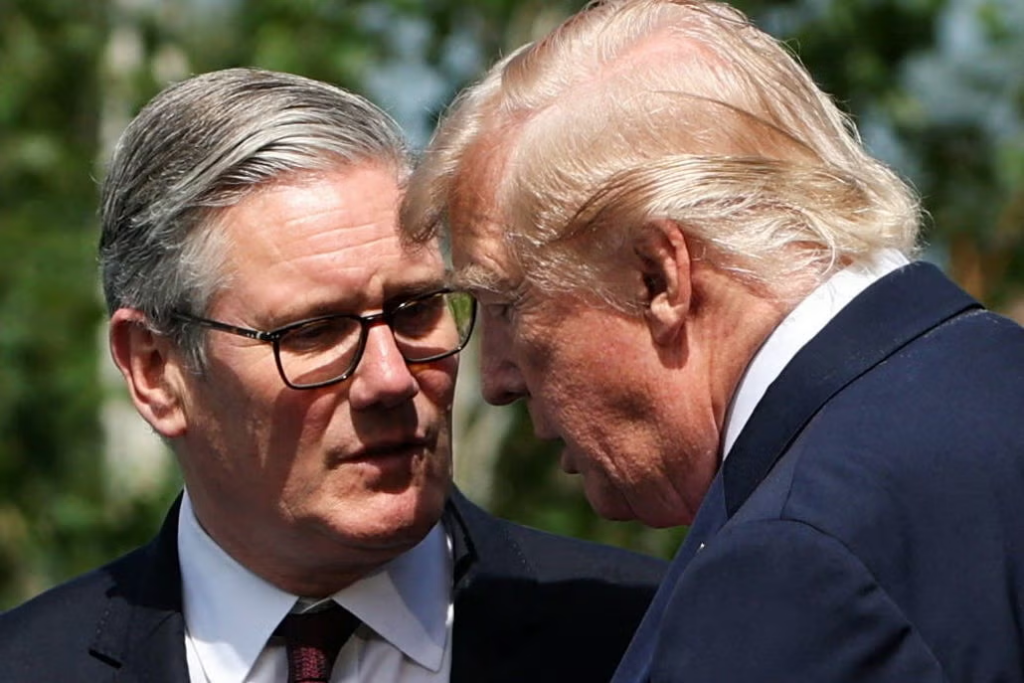
The irony towards Emmanuel Macron, the insinuations about Keir Starmer, the flattering messages he republishes from Mark Rutte are not contradictions. They are part of the same pattern. It separates, prioritizes, rewards and exposes.
Davos as a framework setting, not a forum
In Davos, Trump is not going to convince. He is going to measure. To see who can withstand the pressure. Who rushes into contacts. Who offers in return before they are even asked.
Europe, so far, is playing defense. It talks about “strategic autonomy,” but it moves with fear. It hopes that the tension will ease. That Trump will turn elsewhere. But this is a misreading. As long as there is no reaction, the pressure will increase.
Trump is not preparing a rupture – not immediately, at least – with Europe. He is preparing a realignment. He wants a continent that is more disciplined, more dependent, less ambitious. The limited reference to foreign policy does not mean retreat. It means that decisions will come without warning for Trump, after all, helicopters – guns and the Delta team may not be required to conquer an important target in one night – such as Venezuela, for example.
For Europe, the question is not whether it will disagree. It is whether it can withstand the conflict it has been avoiding so far.
To this day, 365 days after returning to the Oval Office, there is not a single tangible proof of resistance to anything, however extreme, vain or even offensive, that has been articulated by the US. This in itself is the greatest proof not only that Europe is sick, and seriously so, but mainly the answer to why Trump insists almost obsessively – or as a hobby – on hitting this decades-old allied wing and not Beijing, Moscow or Tehran.
In the end, Trump’s behavior will unite European leftists and rightists of all shades under a common anti-American umbrella, accelerating the federalization of Europe. This is the so-called “heterogeneity of purposes”: other events are planned by those in power, and very different consequences emerge in the end.