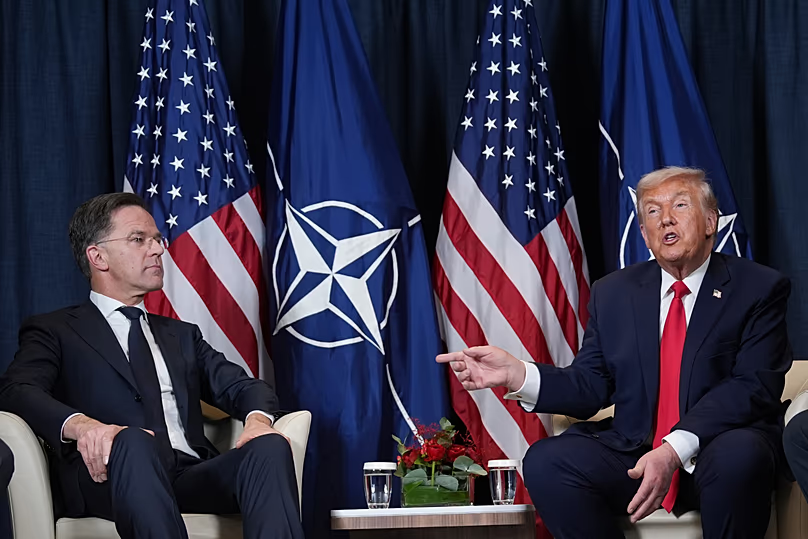
The current US government is one of the most cynical that has ever existed. President Trump himself has never minced his words and has always provoked with crude rhetoric.
Within this context, if we change the perspective we look at a little, we could accept that it is one of the most honest governments! Perhaps not from a sense of justice or honesty, but from a sense of power. And at the same time from the creeping panic of the realization that this power is decreasing daily. Hour by hour. Minute by minute. Second by second. Just as, in contrast, the US debt increases second by second and minute by minute by approximately 180,000 dollars…
This system of economic pressures, imperial power and realistic fear drives the actions of the US today. And in such a logic, President Trump included BlackRock CEO Larry Fink in the negotiating team to achieve peace in Ukraine.
BlackRock is a special case of a business. The wealth it accumulates is so significant that it certainly surpasses many countries. BlackRock does not “own” companies in the sense of full ownership; it is the largest asset manager in the world and invests in thousands of listed companies through stocks and mutual funds. Its largest positions today are in technology and financial giants such as Nvidia (Semiconductors / Artificial Intelligence) $301 billion, Microsoft $298 billion, Apple $235 billion, Amazon $156 billion, Alphabet (Google) $76 billion, Meta (Facebook etc.) $122 billion, Tesla $65 billion and JPMorgan Chase $60 billion.
That is, BlackRock is an institutional investor: it holds shares on behalf of clients (pension funds, insurance companies, private investors). It does not run the companies, but it has a very strong influence through voting at general meetings. In addition to the top positions mentioned above, its portfolio includes over 5,000 companies internationally, including Visa, Mastercard, Exxon Mobil, Chevron, Coca Cola, PepsiCo, Johnson & Johnson, Pfizer, Oracle, Netflix, Lockheed Martin, Boeing, 3M, McDonald’s, Nestlé and many others. It invests in all sectors — technology, health, finance, energy — in order to reduce risk and ensure stable returns. One could compare it to the Lernaean Hydra of capitalism, but that would be a very weak presentation. It is something like a large herd of Lernaean Hydras.
Larry Fink, who is one of the co-founders of BlackRock, does not appear to be deafeningly rich himself, his fortune is estimated at around $1.2 billion. But he is the CEO of a company that has over 10 trillion dollars under management and co-chairman of the World Economic Forum. Thus, he is considered a businessman with a significant impact on people’s lives and corresponding influence.
The other key members of the “negotiation team” are Scott Bessent – US Secretary of the Treasury, Jared Kushner – Senior advisor and son-in-law of Trump, involved in shaping the negotiating course and Steve Witkoff – Real estate investor and special envoy of the President.
The US, therefore, in its cynicism and its unique need for money in its history, clearly declares that the peace process in Ukraine is mainly a negotiation of businessmen aimed at dividing the “spoils” of war. If the US reaps the profits it expects, the war will stop. If not, then it will continue, most likely through the useful idiots of the EU who for months now have been telling the stupid European citizen-victims a fairy tale, talking about the Russian danger and the Glorious Victorious War March that Europe will take in its resistance to evil Russia. Of course, if the agreements are favorable to the US, then the European Warlords, instead of the front, will go for espresso…
It is, however, an unprecedented historical phenomenon for the power that is waging the war against Russia by proxy to no longer invoke “democracy” or “justice” or the “historical role of the good” but to openly admit that the negotiations on the Ukrainian are not purely diplomatic peace talks, but discussions about economic recovery linked to the peace negotiations. The US links the reconstruction plan to the broader peace framework, arguing that long-term stability depends on a reliable post-war economic recovery. And the involvement of important financial and business figures such as Fink and Witkoff shows how economic power is integrated into the peace process.
As the American allies say: “when money talks bullshit walks”.