



“To live alone, one must be a beast or a God,” says Aristotle.
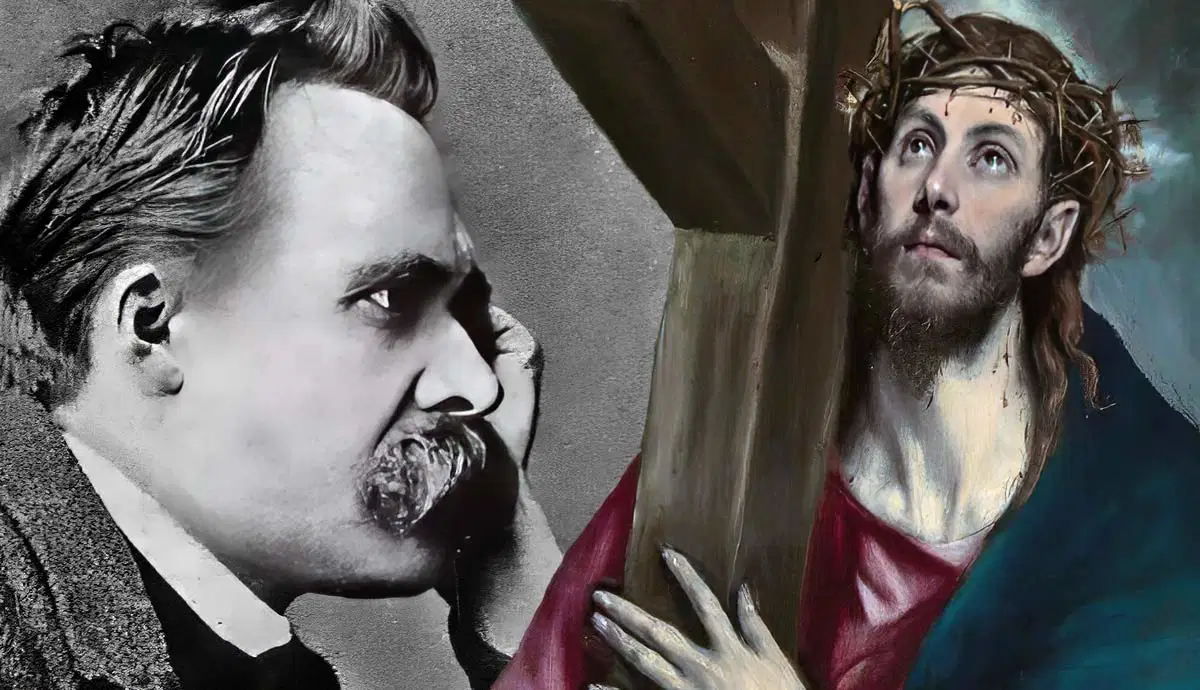
Nietzsche’s work and ideas are characterized by their harsh and unyielding unconventionality, their subversive character and the nihilistic way in which he judged and rejected the ethics of traditional cultures, especially Christianity.
For the first time in the history of human thought and thoughtful questioning, Nietzsche dares to proclaim the Death of God. Through this aphorism, Nietzsche proclaims the freedom of man. In other words, he believed that the attachment of believers to the Ethics of Christianity formed herds of people without will and creativity.
“Have you not heard of that madman who lit a lantern in the bright morning and began to shout incessantly “I am looking for God!”… “Where is God?” he shouted. “I’ll tell you where he is! We killed him! You and I! We are all his murderers! But how did we do it… God is and remains dead! We killed him!”
For the philosopher, the traits of slaves and believers were propagated as virtues by the system and this resulted in the world being dominated by the soft justice of the peaceful and not by force, the meek gentleness and not by the revolutionary spirit. Thus, societies became stagnant, and consequently all of man’s creative powers were emasculated.
Strictly judging Socrates and Jesus, Nietzsche in “Twilight of the Idols” trumpets the conquest of freedom and the bliss of people, but through the experience of the drive for power and not through the “ethics of frustrations” imposed by the Christian view of life.
Overturning the old ethics and traditional stereotypes of equality, Zarathustra emphatically proclaims the inequality of superior people. “Now, however, this God is dead. Before the crowd we do not want to be equal. O superior people, avoid the market!”
In the context of the deconstruction of the old system of ethics and standards, Nietzsche considers, through Zarathustra, that the death of God was the main source-cause of man’s slavery, the greatest danger to his authentic life.
“Before God! – But God is dead! O superior men, this God was your greatest danger… Forward! Forward, then! O superior men! Only now will the mountain of the future of men give birth. God is dead: Now we want the Superman (Ubermensch) to live.”
A necessary condition for the transition from man to the Superman is the death of God. When Nietzsche refers to God, he means the Christian God, that is, an external omnipotent entity that functions as a cosmic regulatory authority and to whose moral imperatives all people must submit. It is, therefore, a relationship of authority, from whose bonds man struggles to escape. However, the death of God should not be perceived as an act of religious disrespect, but as a step towards man’s self-realization and liberation from hetero-determination. The rupture with God marks a new starting point, in which man is the absolute master of himself and seeks meanings, starting from scratch and driven strongly by an inner activation, not by addressing a higher power.
With the death of God, the conditions are created for the transition from man to the Superman, in a self-transcendence towards ontological superiority. Nietzsche believes that man does not exist essentially, but is the intermediate between animal and Superman and must in every way aim at his exaltation. Man, starting from scratch, takes the place of God and, now having the responsibility for his actions, directs his will in any direction he wishes. Within this freedom, the conditions are created for the revision of moral and social values and their transformation, so that they aim at the development of man and his happiness. This is exactly Nietzsche’s Superhuman.
Zarathustra – The Superhuman
“I teach you the Superhuman. Man is something that must be overcome. What did you do to overcome him?” “Thus spake Zarathustra”
This visionary text presents the story of the philosopher Zarathustra, who, when he was thirty years old, distanced himself from human civilization and became a hermit on a mountain. After ten years of isolation, during which he composed his philosophical biotheorem, he decided to leave his mountain and convey to people the content of his thought, teaching them the Superhuman and trying to prepare people for the transition to this higher spiritual stage. He preaches, therefore, the death of God and the need for a revision of values that will result in an ontological upgrade. The central core of the text is also the idea of the “eternal return”, which is one of Nietzsche’s leading concepts.
In this enormous work of his, Nietzsche cites precisely the idea of the superman, where a spiritually superior being tramples on man, leaves him behind, and ultimately surpasses him. Nietzsche argues that our evolution has not been completed by making a parallel based on Darwin’s evolutionary theory. “The ape is to man, what man is to the superhuman”. Stating that what we are now is a bridge, a taut string, where we must cross, with boldness and courage, with danger and virtue, until we reach the “High Noon” that is, halfway from man to something higher.
In his first speech, Zarathustra gathers the crowds, in order to express their ideas. Which, as one would expect, does not go so well. With a touch of bitterness, Nietzsche at that point wants to show the “power of the wild” and the inflexibility of the mass, in the face of everything new. Suddenly, while the world mocks Zarathustra, above the crowd, a tightrope walker decides to walk on a tightrope supported by two towers. But without success, as he falls from the rope while another juggler gracefully and flexibly passes over him, and throws him down, leaving him dying. With this allegorical parable, Nietzsche once again emphasizes the journey of man, likening our current situation to a tightrope and setting parameters for the superhuman’s endeavor.
“First you must learn to walk, then to run, and finally to fly. But always remember to be grounded,” he states below, identifying the brave tightrope walker with the creator. The creator who escapes from the “dog and the scoundrel” tramples on his fears, surpasses himself and walks towards something higher. At the same time, however, the tightrope walker must die, must “set” for the superhuman to be born. Showing us that destruction is always necessary for creation, “you need chaos in your life, to give birth to a dancing star,” Nietzsche emphasizes, showing us that the toughest personalities, and the steeliest wills, emerge from the darkness and the abyss.
But what are the traits that make up the superhuman? What is the model of the superhuman in Nietzsche’s mind? And most importantly: Can we ever get there?
To start from the beginning, the superhuman has nothing to do with a necessarily huge IQ, with the ability to perform enormous arithmetic operations or play the piano from… infancy. The values that are indicated are completely different. By starting this enormous analysis, Nietzsche found himself in deadly confrontation with the classical values of Christianity, since all the suffering of today’s society, according to him, begins and ends there. In the genealogy of morality, Nietzsche reexamines all values by making “A moral reassessment” reaching the root of good and evil.
Starting from the dawn of the establishment of values by (superhumans) he states (perhaps a little cynically and absolutely) that values such as success, glory, victory, creation and love success were values of the few, the aristocrats, the superhumans.
Very soon, however, the rabble and the plebs, wounded by the shadow of the titan superhumans, filled their hearts with envy, as they could not in any natural way reach the creators of values. Thus Nietzsche tells us that the mass, that is, the many, gave birth to Christianity, that is, the establishment of new false values. Through the infancy of a society that resembles an open wound, an ideology that took the form of retaliation was born to hurt the superhumans through guilt. Thus, values such as creation, pioneering, money, success, glory, sexual attractiveness, and leadership were demonized through the envy of the poor.
In this way, the many succeeded in condemning their living values by establishing their opposite values, which were possible for the many. The “last men” as he characterizes them. Thus, for the vagabond, poverty was transformed into humility and eternal kingdom, while wealth into eternal condemnation. Erotic attractiveness into lust that one must renounce through virginity. The cultivation of the body and spirit into vanity, which must be punished with fasting and exertion. The love of life and creation, into love and worship of death and contempt for life. And finally, the competitive jealousy that elevates us and takes us across the bridge of the superman, into something that we must exorcise from within ourselves and be ashamed of.
After the reassessment, Nietzsche closes with a famous saying, declaring his deep atheism, but at the same time his belief in the power and destiny of man, the so-called “Amor Fati” (love of fate). “God is dead! He must be dead, for if the gods were alive, how could I bear not to be a god myself? Until now there was a god, but now I have taught you the superhuman!”
So, listing all the values that make up the superhuman, we see that the sayings of Christianity teach the complete opposite, keeping us “anchored” at the bottom of existence, far from any ascension. Turning a little to our time, we will see that Nietzsche’s prophetic words are not far from reality. While Christianity teaches the denial of ourselves, Nietzsche tells us that the secret to the path of the creator-superhuman is acceptance, in other words the Greek “gnothi sautton”. Just as a tree takes root in the soil, deep in the darkness, in the abyss, in evil in order to rise high, so too must man embrace the darkest corners of his soul, and overcome them in order to reach Nietzsche’s standards. Embracing the envy that gives us breath, and transforming it into creation. Only then will we truly be able to cross the rickety bridge over the rabid dogs of the street that lurk in the darkness below.
Friedrich Nietzsche’s Thus Spoke Zarathustra analyzes central philosophical concepts such as “God is dead,” the Superhuman, the “Will to Power,” and the “Eternal Return.” Nietzsche uses allegorical, vivid poetic language to express his critique of traditional moral and metaphysical thinking, proposing the need to transcend the “perfect man” and adopt a new morality based on self-realization and life affirmation.
Key Concepts
- “God is dead”: Nietzsche proclaims the death of God, signaling the loss of the traditional foundation of values and morality. This, while creating “chaos,” makes room for the birth of the Superhuman.
- The Superhuman (Übermensch): This is the ideal type of human that Nietzsche envisions as transcending the existing human type. The Superhuman embraces earthly life and its challenges, creating his own values rather than following ready-made rules.
- The Will to Power: This is the fundamental force of life, an inherent desire for growth, self-mastery, and the expansion of power. It is not limited to dominion over others, but also includes self-mastery and creation.
- The “Eternal Return”: A cosmological and ethical idea where everything that exists will return again and again, eternally. Zarathustra urges us to live our lives in such a way that we desire it exactly as it is, without any change, thus affirming the value of earthly life. The idea of eternal return, although not encountered for the first time in Thus Spoke Zarathustra, nevertheless inspires the entire work. It is about the fundamental principle of all things, the circular movement of “being”. Everything that is now, was in the past and will be so in the future, since it is governed by a circular necessity. Therefore, man must live his life guided by his willingness to repeat it, without the slightest change. Our world, then, is the only possible world, since everything that exists returns at some point and, if something were different, everything else would necessarily be different. Therefore, man comes to the center and must seek his redemption and exaltation in the earthly world, instead of postponing it to the perpetuity of any afterlife.
“Thus Spoke Zarathustra” is perhaps one of the few cases in which the work tends to surpass its creator in glory and readability or even recognizability. Desymbolization is a dangerous process because Zarathustra, as a poetic and philosophical symbol, has all the characteristic contradictions of his creator. He is, in other words, an alloy of the Dionysian and Apollonian elements.
With this work, the philosopher tends to incorporate his poetic quality by resorting to the use of images and allegories. Nietzsche, this hierophant of the new “imperative morality” of the Masters, presents the Superhuman as a poetic symbol of infinity and of the human will, which eternally tends towards an ideal and approaches it incessantly, without, ultimately, ever reaching it, as emphasized in the introduction to the book.
The best way to record and present the “hidden meanings” of Zarathustra is to let the philosopher himself reveal them to us: Nietzsche considers “Thus Spoke Zarathustra” as a separate text and offers it as a gift to humanity “With him (Zarathustra) I have given humanity the greatest gift that has ever been given to it until now…).
At another point in his letter to the Saxon from Chemnitz, the publisher of the book (as well as others), Ernst Schmeitzner characterizes the book as “a poem or a fifth Gospel”. Zarathustra is for Nietzsche ““a dithyramb in solitude”, “a nullifier of morality…“half saint”, “half genius””.
Somewhere Nietzsche sees Zarathustra as an object of hatred by the people, since it was very difficult for the crowd to understand him. “But he who is hated by the people, like a wolf by dogs: He is the free spirit, the enemy of chains, he who worships nothing…”.
The hatred of the crowd is channeled to the superior and the special “They hate the creator the most: He who crushes the tablets and old values, the destroyer, he is called a criminal…”.
The philosopher, a champion of power, believes that society should be dominated and governed by the strong, because otherwise “There is no greater misery in all human destinies than for the strongest on earth not to be the first among men. That is why everything becomes false and crooked and monstrous”
In the same spirit of “The Will to Power” and in the exhortation for the value and necessity of the Superman, he denounces modern social intolerance due to the power of the “little ones”.
“Because, today, the little (in abilities) people have become rulers…”.

Significance and Aim of the Work
Critique of Modernism: Through “The Last Man,” Nietzsche criticizes the “domesticated man” of his time, who seeks comfort and security in society instead of embracing creativity and individual authenticity.
Transcending Traditional Ethics: The work criticizes traditional ethics, which prevents the full expression of vitality and the autonomy of the individual, proposing a new ethical framework.
“Philosophical Libretto”: “Thus Spoke Zarathustra” is a philosophical-literary work that imitates the language of the Bible, but uses wordplay and “non-existent” words to express its philosophical ideas in a unique, allegorical way.
Zarathustra and His Disciples
Perhaps the most revealing part of “Thus Spoke Zarathustra” that outlines the contradictory figure of Zarathustra is the one in which he himself addresses his disciples and urges them to question him and search for themselves, leaving their teacher in his Solitude.
This oxymoron, the poet-prophet himself advising his disciples to be wary and critical of his authority, indicates the deeper meaning of his teaching and what it symbolizes. The constant suspicion and questioning of any authority that tends to become a habit or even normality.
- “I am leaving alone now, my disciples! You also leave now and be alone. This is how I want it to be!
- Get away from me and beware of Zarathustra! Better yet: be ashamed of him! Perhaps he has deceived you.
- The man of knowledge must not only love his enemies, he must also hate his friends.
- One shames one’s teacher when one remains forever only a disciple. And why do you not want to pluck my wreath?
- You respect me: but what if one day your respect is overthrown? Beware lest some statue crush you!
- You say that you believe in Zarathustra? But how much does Zarathustra matter! You are my believers, but how much do believers matter in general!
- Had you not yet sought yourself? Then you found me. That is what all believers do, that is why any faith is worth so little.
- Now I call upon you to abandon me and find yourselves. And only when you have all renounced me will I return to you”.
- “Only where there is life, there is also will: but not will for life, but – this I teach you – Will for power!”
(“Thus Spoke Zarathustra”).


