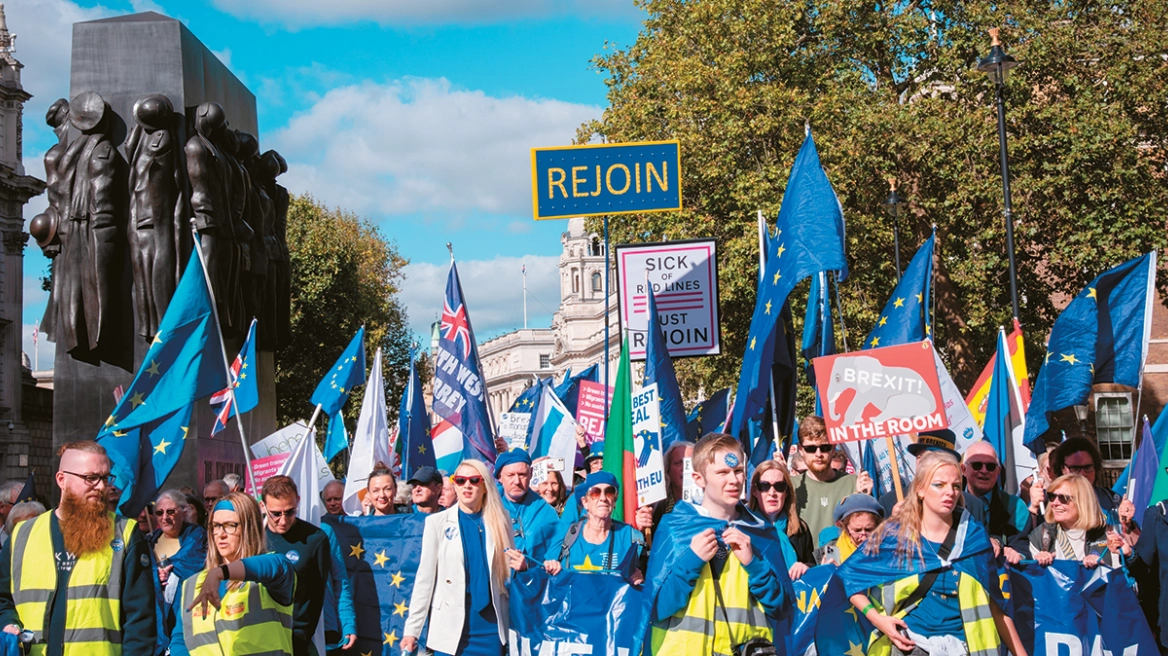
Promises that were not kept, wounds that were not calculated, debts that were not budgeted for, black holes that are opening up. Five years after Brexit, the British continue to feel the consequences of the “divorce” with the European Union, as they had decided nine years ago.
“Brexit has significantly affected our economy,” says British Prime Minister Keir Starmer, emphasizing that they are still facing the consequences, which will worsen, with the cost of this divorce becoming gigantic in the coming five years.
London School of Economics, concludes that migrants, small businesses, young people and, above all, the poorest households have been most adversely affected.
The LSE cites the Joseph Rowntree Foundation’s poverty figures (“UK Poverty 2025“), according to which millions of people were suffering from poverty or were on the verge of it before the Brexit waters. When we add in the effects of leaving the EU, namely higher food prices, weaker wage growth, unemployment and slower-growing local economies, we see how the poorest households are being hit hardest.
- Five years after Brexit, the British economy has shrunk by £140 billion, with trade falling by 15% and taxes rising to the highest level since World War II.
- British Prime Minister Keir Starmer admits that Brexit has hit the economy hard, predicting that its costs will increase further over the next five years.
- A new study estimates that the damage to the British economy from Brexit is double that initially predicted, with tax revenue losses reaching £90 billion a year.
- The NHS is facing serious problems due to brain drain, with more than 4,000 doctors leaving the country last year, while hundreds of thousands of British citizens have emigrated.
- The most vulnerable groups, such as the poorest households, migrants and small businesses, have been hit hardest by the consequences of Brexit, with rising food prices and falling disposable income.
Bank of England Governor Andrew Bailey, speaking at an international forum of central bankers and investors in Washington (Group of 30), said that Britain’s exit from the European Union will have a negative impact on the country’s economic growth “in the immediate future.”
This is of course assuming that British businesses can only partially adapt to the changes resulting from Brexit, something Bailey is optimistic about (although businesses themselves are not so optimistic).
The research by economists and analysts at Cambridge Econometrics, which was requested by the Mayor of London, Sadiq Khan, (“Greater London Authority: Impacts of Brexit on London’s Economy“) has found, however, that both the short-term and long-term consequences will be negative. “Look what I have in store for you later,” is the best description, as the study found that Brexit has cost the UK £140 billion by 2023, but could cost £311 billion more by the middle of the next decade.
By 2035, the same study predicts three million more unemployed people, 32% lower investment, 5% lower exports and 16% lower imports than the UK would have had if it had never left the EU.
Why have British governments failed to make the UK prosperous after Brexit?
Britain has always been America’s pawn. It was the country that reacted to everything, the spirit of contradiction, the agitator within the EU… Of course, due to its geographical position, it had a powerful economy and believed (*along with the “brainwashing” by the Americans) that by leaving the EU, it would become even stronger and that Europe -perhaps- would even collapse.
This was basically America’s goal, these were their orders and the arrogant English followed them to the letter..
However, with the announcement of Brexit alone, the giant companies began to abandon Britain, taking with them their huge accounts, as well as their human resources, leaving behind empty banks, lost billions in taxes and revenues, thousands of rented buildings/houses and an economy with uncontrollable bleeding.
And when Brexit came, it found Britain severely injured and economically weakened. On the other hand, Europe, which not only did not collapse, but became stronger, since as is known – to everyone now – it absorbed all the fugitives from England, along with their billions.
The Americans’ plan with Brexit failed miserably and then, they immediately proceeded with plan b (Ukraine war in 2022, which again aimed to weaken/destroy Europe).
You know everything else. It’s still fresh. Europe was forced, but it stood up! And life goes on. Fortunately, since Trump is currently in power, there is logic and so we will not experience plan C (World War III), at least at this stage.