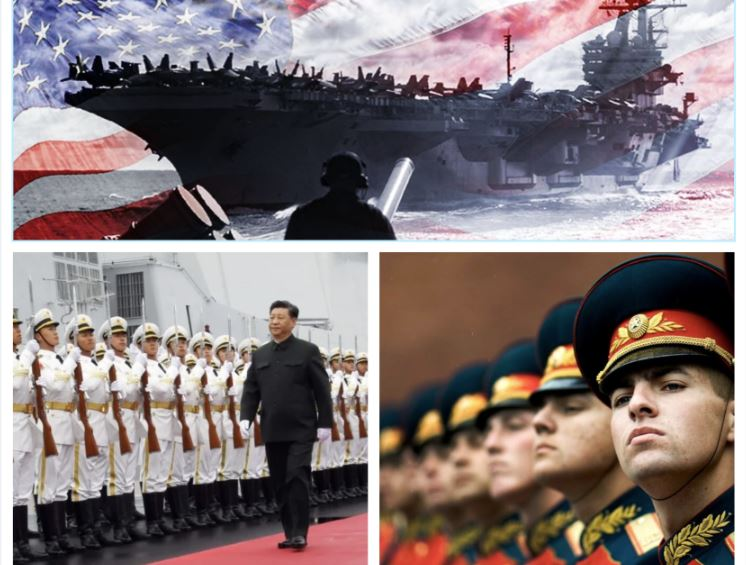
Because wars have been in fashion in recent years, some anxious analysts – hawks – in the US are wondering whether their country is ready for major conflicts with rivals in their “cubic” size. For the first time since the Cold War, the answer is a big no.
The negative answer bears the seal of the Congressional National Defense Strategy Committee and has been published since the summer of 2024, without gaining momentum.
In particular, the Committee’s report finds that, in many ways, China surpasses the US and has largely negated the US military advantage in the Western Pacific through two decades of focused military investments.
Without significant changes from the US, the balance of power will continue to shift in China’s favor. The committee even denies that China has only 222 billion for defense, estimating the amount at… 711 billion. dollars based on calculations by the commander of the US Indo-Pacific Command, Admiral Samuel Paparo.
Russia will devote 29% of its federal budget this year to national defense as it continues to rebuild its military and economy after its invasion of Ukraine in 2022. Russia has significant strategic, space, and digital forces and, under Vladimir Putin, is seeking to return to its Cold War-era global leadership role.
The “borderless” China-Russia partnership, forged in February 2022, just days before Russia’s invasion of Ukraine, has only deepened and broadened to include a military and economic partnership with Iran and North Korea, each of which poses its own significant threat to U.S. interests.
This new alignment of states opposed to U.S. interests creates a real risk, if not the possibility, of conflict anywhere escalating into a multi-front or global war, the report said.
China (and, to a lesser extent, Russia) is merging military, diplomatic, and industrial power to extend power globally and coerce its neighbors.
The American army is far behind
- According to the Department of Defense, the US has only 19,000 unmanned aerial systems, while Ukraine is losing 10,000 a month.
- China is subsidizing its shipping industry, with 20 major shipyards building military and civilian merchant ships and 140 docks to allow for rapid expansion and a huge capacity for maintenance and repair of damage.
- One Chinese shipyard has more capacity than all the US shipyards combined, reports the Center for Strategic and International Studies.
- The US produced only 14,000 155mm artillery shells per year. After Russia invaded Ukraine, Kiev consumed 8,000 shells per day. The US military invested billions of dollars to increase artillery production to between 70,000 and 80,000 rounds per month.
$1.4 trillion in defense
If the incoming administration of Donald Trump implements in the US what it is asking for in other NATO member countries, namely, an increase in defense spending to 5% of GDP, then we are talking about a mammoth amount of over 1.4 trillion dollars for defense alone.
Some inaccuracies
But the authors of the Congressional Report are missing – perhaps intentionally – some facts:
- The US has been spending for 25 years amounts that China and Russia could not even imagine. If we take the World Bank figures seriously and not the inflated American reports, Washington’s problem was not that it did not have money, but that it wanted to control everything. The level of spending reflects the level of ambition.
- The “boundless” partnership between China and Russia, which supposedly threatens the US, as the American report says, did not come out of nowhere. It was the aggressive policies of the US and NATO that led to the East rallying. Surely Thucydides has been translated into English so that the authors of the report can read it.
- The US is cutting off, showing itself to be “concerned” both about its neighborhood – they fear a Chinese presence in Panama – and about China’s neighborhood (Pacific Ocean, Yellow Sea, etc.). Washington behaves as if the planet is theirs and is threatened by the evil “Easterners”.
In short, hawks smell money and only if comparable opponents exist or are created can the pockets of think tanks, defense industries, and political mouthpieces be filled.