



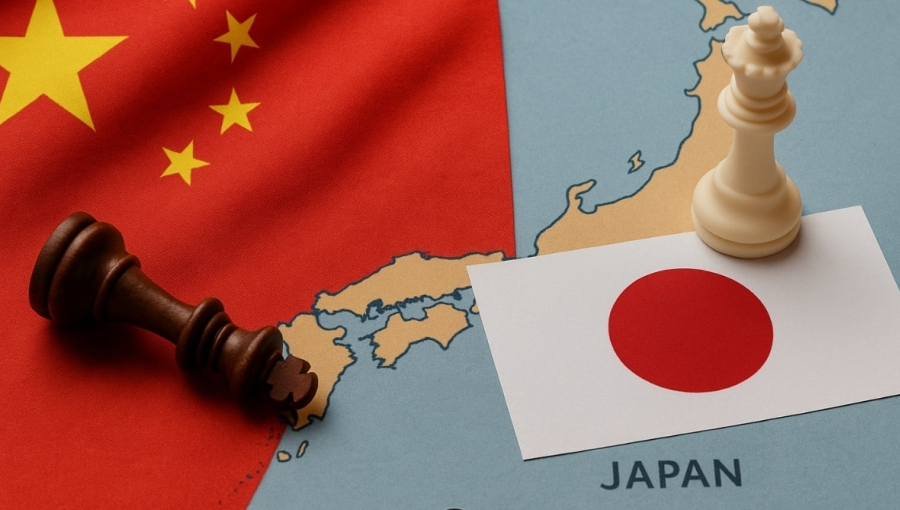
When Japan’s new prime minister, Sanae Takaichi, took office, she pledged to make improving the Japanese economy her top priority. But her previous statements on Taiwan, and any further missteps, could have significant costs not only for Japan but also for the Asia-Pacific region and even the world.
On October 21, Takaichi, chairwoman of the ruling Liberal Democratic Party (LDP), was elected as the country’s 104th prime minister, the first woman to hold the top job. Just a month later, in her first speech to parliament, Takaichi, 64, said that Japan might become militarily involved in a conflict between China and Taiwan. Her statements sparked a diplomatic crisis, with Japan-China relations sinking to their lowest point in years. This crisis, of course, did not come suddenly. Takaichi needs a geopolitical conflict to shift attention away from Japan’s deep, long-standing, and structural economic problems.
Political shift to the hard right
Instead of maintaining a partnership with the centrist Komeito party, Takaichi formed a coalition government with the center-right Nippon Ishin party. After 26 years, the LDP’s coalition with Komeito came to an end, leading the LDP to a clear strategic and ideological shift to the right. Initially, Takaichi’s government’s popularity was at exceptionally high levels, from 65% to 85%, recording one of the best starts for a Japanese government in the last two decades, especially among young and middle-aged voters.
Citizens overwhelmingly prioritize issues of inflation (84%), economic support (64%), social benefits and security (53%), and national security (47%). Everyday issues far outweigh military issues. Only 17% of Japanese people approved the appointment of Hagiuda Koichi as executive deputy cabinet secretary.
He had previously been at the center of a “black money” scandal, while after Abe’s assassination, the LDP’s ties to the controversial Unification Church were reexamined. Hagiuda maintained close ties with the organization, which caused negative reactions. At the same time, both Takaichi and Hagiuda are members of the nationalist and far-right non-governmental organization Nippon Kaigi. The organization promotes the revision of Japan’s post-war history, the re-deification of the role of the emperor, the downgrading of gender equality, official visits to the Yasukuni Shrine, but also denies historical crimes such as the forced prostitution of “comfort women” during World War II.
Nippon Kaigi has a strong presence in the Japanese parliament and six Japanese prime ministers have been members. Takaichi’s ultimate goal is to fully normalize Nippon Kaigi and deepen military cooperation with the United States.
Sell off in Japanese bonds
After all this, the shocks are big, especially in Japanese government bonds, amid growing speculation of an early interest rate hike by the Bank of Japan. The yield on the 10-year government bond rose to 1.875%, the highest level since June 17, 2008. At the same time, the yen strengthened to 155.37-37 per dollar, from 156.28-31 at the same time last Friday.
In a speech, BOJ Governor Kazuo Ueda stressed that the central bank would make an “appropriate decision” on whether to raise interest rates at its policy meeting on December 18-19. In a subsequent press conference, he warned that a delay in raising rates could fuel inflation and cause market confusion.
Structural economic illness
The Japanese government recently approved a $135 billion stimulus package to address the recession and boost growth, with strategic investments in semiconductors and artificial intelligence. Takaichi has been pushing for “responsible fiscal policy,” but it is unclear how he will balance fiscal prudence with new spending.
Japan has the world’s largest public debt, approaching $10 trillion, more than twice the size of its economy. The reason the economy has not collapsed so far, despite the staggering public debt, is that most of it is held by domestic investors and interest rates have remained low. Although the debt-to-GDP ratio has declined since the early stages of the pandemic, Takaichi’s new fiscal moves could reverse the trend.
Economic stagnation, a shrinking population, and an aging population, combined with years of stimulus packages and increased social benefits, have further increased debt pressure. The new fiscal expansion carries serious risks: rising interest rates and a weak yen, resulting in a new wave of inflation, loss of investor confidence, or even capital flight, with broader economic side effects.
The LDP’s persistent contradiction
Early signs are of heightened stress in Japanese markets. 10-year JGB yields recently rose to 1.835%, their highest since 2008. The yen temporarily weakened to $157.90 against the dollar, while bets on a rate hike by the BOJ show a deferral despite inflation at 3%.
If the credibility of monetary and fiscal policy erodes, a weaker yen could trigger a new wave of price increases, reducing the effectiveness of the stimulus packages. This would force the Takaichi government to push for more stimulus, putting pressure on economic and financial stability in the medium to long term. This is the great contradiction that Abe had managed to control, but Takaichi is starting from a more fragile base, with obvious signs of currency weakness.
Takaichi’s ultra-conservative profile
Coming from a middle-class family with two working parents, Takaichi grew up in a very conservative environment. She studied at university and worked in the US as a congressional fellow for Democratic congresswoman Pat Schroeder. Returning to Japan, she developed a career at TV Asahi and entered politics in the early 1990s. Although initially elected with a liberal background, after the election she moved to the LDP.
Shinzo Abe’s support put her in the position of political succession as early as 2010. Her right-wing identity was symbolically linked to visits to the Yasukuni Shrine, while in 2011 she was even photographed with the leader of a small Japanese neo-Nazi party, Kazunari Yamada. After three failed bids, the fourth made her the first female prime minister of Japan, at a time when the US-Japan alliance is considered by Takaichi as a pillar that could enter a “golden age”, as she herself has stated at the US naval base in Yokosuka.
Three possible scenarios
Today Takaichi is faced with three possible developments.
In the first scenario, she will seek a cautious de-escalation of tensions through dialogue. Japan remains deeply dependent on Chinese tourism, seafood exports, and raw materials such as rare earths, while China is its largest trading partner, accounting for more than 20% of Japanese trade flows in 2024. De-escalation would be supported by the US for reasons of regional stability, but it is not Takaichi’s ideological goal, but rather an economic necessity of public opinion.
In the second, prolonged instability would be sustained by waves of small tensions and confrontational rhetoric without a full rupture. This would allow China to maintain economic pressure, Takaichi’s government to normalize increased military spending and alignment with Washington, while markets would punish the country with persistent uncertainty and GDP pressures.
The third scenario, full escalation, would mean further breakdown of diplomatic relations and increased military presence, with possible naval operations in disputed waters. Takaichi would be even more deeply committed to the Taiwan issue, crossing China’s red line. Although the Trump administration tends to regionalize conflicts, a full escalation would drastically hurt Japanese growth, reduce the effectiveness of the economic package, undermine business and investor confidence, and increase the risk of capital flight.
