



The European Commission, desperate and divided over how to finance the war in Ukraine, is calling on Western allies to speed up payments from a $50 billion loan to Ukraine, as Belgium continues to block EU efforts to support Kiev’s war effort through a larger financing scheme using Russian state assets.
In an interview with Euractiv on Friday, November 28, 2025, Economy Commissioner Valdis Dombrovskis said countries should speed up disbursements to Ukraine from the G7 loan, agreed in June last year (2024), to help the war-torn country close to a looming financial gap early next year.
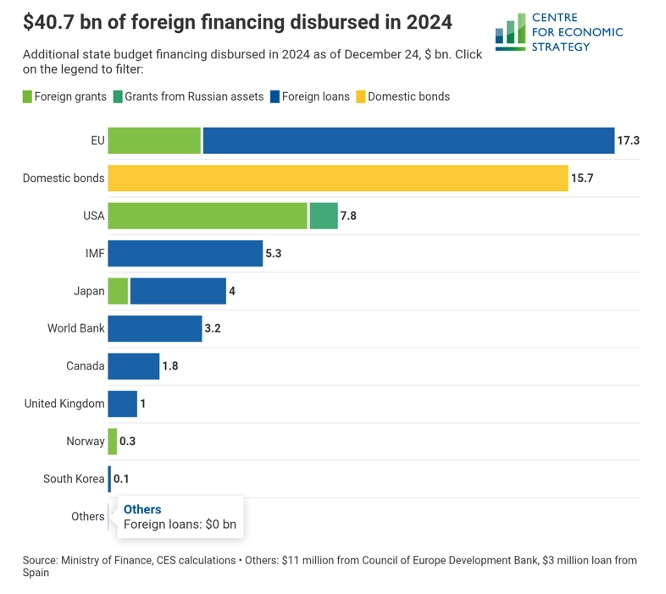
Donors include the UK, Canada, Japan and the US. This “may be enough … to cover Ukraine’s financing needs in the first quarter of next year,” although that “remains to be seen,” the Latvian commissioner said. The EU has already disbursed its share of the G7 loan, totaling €18.1 billion.
But around €14 billion of the package has yet to be disbursed by other countries, notably the US, Canada, Japan and the UK. Kiev is expected to face a budget deficit of $12 billion (€10 billion) in the first quarter of next year.
Dombrovskis’s comments come as the EU is divided over a separate €185 billion “reparations loan” ahead of a crucial summit of European leaders on December 18-19, where the Commission hopes to persuade Belgium to back the plan. But those efforts appeared to be falling short on Thursday (November 27), when Prime Minister Bart De Wever strongly criticised the plan in a letter to Commission President Ursula von der Leyen. The reparations loan aims to use cash balances linked to Russian state assets held at Euroclear, a Brussels-based clearing house, which the EU “froze” after Russia’s invasion of Ukraine in 2022. The G7 loan, by contrast, taps into the income generated by those assets.
Belgium’s Bypass
Belgium refuses to support the compensation loan unless the legal and financial risks are shared and other EU member states make use of Russian assets held in their own jurisdictions. Euroclear has expressed similar reservations about the plan and is threatening to sue the European institutions – as it is at serious legal risk of having to repay Russia “in full” for the funds. Dombrovskis said that securing Belgian consent was not a “prerequisite” for publishing a detailed legal proposal on how it would work in practice – but that Belgium’s agreement would be “ideal”.
While there has been “technical progress” in talks between EU and Belgian officials, he admitted that there has been little political progress.
Transitional solution
The experienced commissioner also warned that a separate “transitional” EU solution to cover Ukraine’s budget gap for the time being “may be necessary” if negotiations with Belgium do not “advance quickly” by the end of the year. Such schemes, outlined in an “options text” circulated to member states last week, would envisage the use of joint EU debt and bilateral grants from member states as alternative ways of temporarily covering Kiev’s budget gap.
The document estimates that Ukraine will need military and economic support of €72 billion in 2026 and a further €64 billion in 2027. Ursula von der Leyen suggested earlier this week that these alternatives would not be feasible if financed entirely by European taxpayers’ money. Dombrovskis, a former prime minister of Latvia, stressed that the EU needs to “move forward, because Ukraine’s financial needs are not only significant, they are urgent.”
A “black hole” for the European economy
At the same time, a peace plan for Ukraine that would leave the country crippled by the territories already occupied by Russia would have a heavy economic cost for Europe. All of the ceasefire proposals put forward in the past two weeks, whether by the US government or by Europeans, involve Kiev accepting that Russia retains, at least temporarily, control over all or part of two regions it has annexed – Donbass and Luhansk.
This would create a hotbed of uncertainty that would weigh on the European economy for years.
First, peace would highlight the fact that President Vladimir Putin, as the victor of the war, will never accept that his country’s “frozen” reserves – some $300 billion in the US, Japan, the UK and Europe – can be used to rebuild Ukraine, as EU governments demand.
A proposal being discussed within the EU and supported by German Chancellor Friedrich Merz would see at least the assets held by the Union’s central bank – some $210 billion – used as collateral for a “war reparations loan” to Ukraine.
But EU leaders need to act much more quickly for this solution to be effective, something that is not in sight, given the differences in views and the asymmetric risk-sharing. Nearly a year ago, the World Bank estimated that the country’s reconstruction would cost $524 billion over the next decade.
A year later, the bill is now approaching $600 billion. Instead of Russia shouldering half the cost by releasing its frozen reserves, Ukraine’s allies may have to shoulder almost all of the burden.
According to the World Bank, Ukraine’s reconstruction will need to be financed by a mix of foreign governments, international organizations, and private investors. But unless the territorial status is settled, Ukraine will not be able to rely on the flow of private foreign capital that would help its economy recover.
Even if both sides accept a shaky status quo, the fear of renewed fighting – and a new Russian invasion – will deter investors for years. Ukraine’s economy has proven resilient since the war began in 2022. But its GDP this year will remain 20% below 2021 levels, according to an International Monetary Fund estimate.
Both Donbass and Luhansk accounted for about 15% of the country’s output at the time, according to the World Bank. So rebuilding will take time. Some of the more than 5 million Ukrainian refugees who have found refuge in the rest of Europe – about 75% of whom are women and children – may choose to return home, even as the ceasefire with Russia looks fragile.
This could help boost the country’s growth prospects by boosting its workforce. Germany has taken in 1.3 million refugees since the start of the conflict, and Poland more than 1 million, according to the UN Refugee Agency.
The EU will still need to help Kiev train returnees and fund their social support as they adjust to the country’s reconstruction needs. And the estimated 200,000 soldiers who will return to civilian life – if the size of the Ukrainian armed forces is set at 800,000, according to an EU proposal – will need similar support.
Ukraine’s accession to the European Union will also be hindered by the violation of its territorial integrity, if the international status of the two regions, which is under “suspension”, is not definitively settled.
Border control within the framework of national sovereignty is seen by the EU as a guarantee that its laws and regulations will be enforced by national governments. If the shaky ceasefire now under consideration is declared in eastern Ukraine, Western Europeans will, if anything, have to increase their defense spending even faster than they plan.
Other countries close to Russia will need to bolster their defenses – and so will the rest of Europe. Investors who sent European defense stocks as much as 5% lower after the announcement of Trump’s first peace plan – with shares such as Germany’s Rheinmetall falling as much as 13% – seem to fail to realize that Ukraine is not the only destination for European weapons.
The growing defense budgets in the region are to be spent on preparing for a possible future war with Russia.
Pressure mounts on Belgium
Brussels is increasing pressure on Belgium to release 140 billion euros of frozen Russian assets in Brussels, accusing the government of Bart De Wever of not fully disclosing what it does with the tax revenue generated from them. The European Commission wants an agreement from the 27 EU countries on sending Russian funds for compensation to Kiev, in an effort to save the Ukrainian economy – for more information on this issue please also read the analysis titled (“Belgium sues EU for theft of Russian assets – 140 billion euros loan to Ukraine blocked“).
France: Decision on Russian assets to be taken at 18/12 Summit
French Minister for European Affairs and Foreign Affairs Jean-Noël Barrot believes that the member states of the European Union may take a decision on frozen Russian assets at the summit on 18 December in Brussels.
Belgium and Markets Concerns – Letter to von der Leyen
Earlier, the Financial Times reported that Belgian Prime Minister Bart De Wever warned in a letter to European Commission President Ursula von der Leyen that rushing through the EU’s plan to use frozen Russian assets to benefit Ukraine would undermine the chances of a future peace deal. On Thursday (27/11), Euroclear warned that using frozen Russian assets to finance Ukraine could increase the EU’s fiscal liabilities and deter investors.
Russia’s Ambassador to Belgium Denis Gonchar had stated in an interview with TASS that, regardless of the mechanism used, the removal of assets would constitute “theft” and that Russia’s reaction “will be immediate” and would force the West “to count its losses.”
The Return of the Russian Economy
The final concern for Europe and Ukraine is that “peace” would give Vladimir Putin an economic reprieve. In the initial American version of a possible truce, Washington’s economic sanctions in place since 2022 would be lifted. After three years of overheating the economy due to its transformation into a full-fledged war economy, this would be a catalyst for Russia.
As things stand, the country’s GDP is expected to grow only slightly next year – by 0.5% to 1%, according to economists. Industrial production in the civilian sector is declining, and even military production has reached maximum capacity.
Military spending now amounts to 8% of GDP – an underestimate, as many parts of the defense budget remain secret. As a result, the budget deficit has doubled this year compared to 2024, exceeding 3% of GDP.
And the government, deprived of the ability to borrow on the markets, must finance the deficit domestically. The government has already announced that VAT will increase next year, hitting consumers and fueling inflation. Prices are now rising at a rate of 8% per year, although the key interest rate remains above 16%.
But if the sanctions are lifted, the prospects for the economy – and therefore for Russian rearmament – will become particularly bullish. A partial truce based on the existing status quo would have one strong advantage: an end to the devastation and thousands of senseless deaths. But if Europe is burdened for years by an unstable Ukraine, the risk is a fiscal “black hole” – and the very real possibility of future conflict anyway.


