


The war in Ukraine is escalating asymmetrically, rapidly and dangerously, with the American media openly talking about US involvement in strikes against Russian oil facilities. The American “traces” in these Ukrainian strikes, together with the imminent dispatch of Tomahawk missiles to Ukraine, have angered Russia, which considers the deployment of new, more powerful weapons in the conflict as a decision already made, which are expected to bring a proportionate response to the West.
In fact, a related announcement was made on Friday 10/12 by Russian President Vladimir Putin from the podium of the Organization of the Cooperation of Independent States, who referred to “a new powerful weapon of Russia, which is in the testing stage”.
Direct American involvement in strikes against Russian oil facilities
The same American and Ukrainian officials who spoke to the Financial Times revealed that the United States is playing a key role in the ongoing major attacks on Russian energy infrastructure, which are being launched from Ukraine.
The American intelligence is being provided to help Ukrainian drone operators plan their flight paths and altitudes, choose the best time for attacks and prioritize targets.
The Ukrainian attacks on energy facilities are seen in Washington as a “tool” to undermine the Russian economy and pressure Moscow to freeze the conflict on terms that favor Western interests.
The revelations follow a statement by Kremlin spokesman Dmitry Peskov, who said it was “obvious” to Moscow that “all NATO and US infrastructure is being used to gather and transfer information to the Ukrainian side.”
NATO’s role in Ukraine’s large-scale strikes against Russia
NATO member states, including the United States, have played a central role in supporting Ukrainian attacks on Russian targets since the start of full-scale hostilities in 2022.
In February 2023, the Russian government claimed that the entire NATO satellite network, and more generally the alliance’s military infrastructure, is supporting Ukraine’s military efforts.
As early as February 2023, an official statement from the Kremlin stated: “We see how the entire NATO military infrastructure is working against Russia, and we see how the entire NATO information infrastructure, including reconnaissance aviation and satellite systems, is working in the interests of Ukraine in 24/7 mode.”
This included quickly providing targeting data for missile and artillery attacks, which had dealt a heavy blow to Russian forces.
A Covert CIA Network at the Heart of the War
Four months earlier, in October 2022, the New York Times reported that a “covert network” of the CIA was at the heart of the war, referring to the US having established in Ukraine “a covert network of commandos and spies who are rushing to provide weapons, intelligence and training… CIA operatives continue to operate covertly in the country, mainly in the capital, Kiev, guiding much of the vast amounts of intelligence that the United States is sharing with Ukrainian forces.”
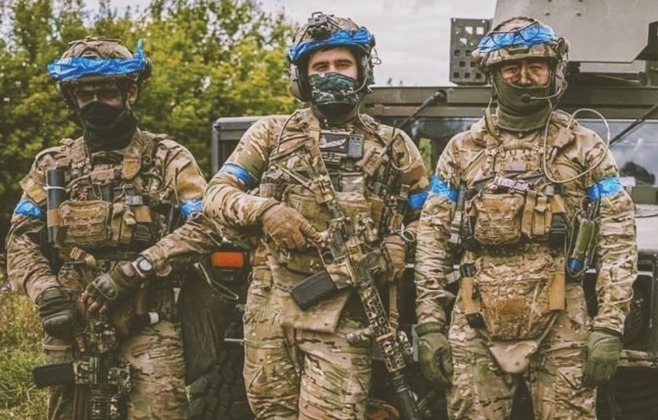
“The signs of their covert support in the areas of logistics, training and information are tangible on the battlefield,” he said. “Commandos from other NATO countries, including Britain, France, Canada and Lithuania, are also working inside Ukraine… training and advising Ukrainian forces and providing a constant link for weapons and other supplies,” adding that the scale of the covert effort to support Ukraine is “impressive.”
Signs of this Western involvement have increased significantly in the past three years, including a growing reliance on Western fighters on the front lines, such as the Polish Volunteer Corps and the American Project Group.
“Americans and British hit Sudzha with HIMARS”
In March 2025, the Russian Foreign Ministry said that the United Kingdom and France had played a central role in a recent Ukrainian attack on Russian energy infrastructure, specifically the Sudzha pipeline, which was “de facto destroyed” using a US-supplied HIMARS missile system.
“Targeting and navigation were facilitated by French satellites and British specialists who entered target coordinates and launched the missiles… The order came from London,” the Ministry said.
Western officials have increasingly expressed support for large-scale attacks on Russian civilian infrastructure, in some cases with the aim of rendering entire areas uninhabitable.
Targeting data from satellites and aircraft, support from personnel on the ground for the use of complex equipment, as well as supplies of missiles, drone components, industrial experts and financing, were all part of this support.
The Russian Foreign Intelligence Service claims that the Western goal of pressuring Russia for a ceasefire is to allow Ukraine to reorganize its forces and continue hostilities under more favorable conditions.
Global Awe – Putin ‘Signals’ to Activate Burevestnik Nuclear Missile
Meanwhile, Russia’s new nuclear cruise missile, the Burevestnik, which has a global range, may soon be unveiled and cause awe across the globe.
This is, in fact, the interpretation given by Russian media outlets, such as Lenta, to President Vladimir Putin’s aversion to responding to the Tomahawk transfer to Ukraine “with new, more powerful Russian weapons.”
Putin said that a new weapon, which he did not name, would soon be unveiled in the country. As Russian media outlets emphasize, the Russian president was referring to the completion of work on the new Burevestnik missile.
“In 2025, there were signs of preparation for its new tests — the closure of areas on Novaya Zemlya, the activity of transport aircraft, indirect confirmations from industry sources, but nothing official,” emphasizes a Lenta article.
Russian media outlets also link Putin’s words to the possible revival of a land-based version of the Kalibr missile system, codenamed “Relief.” According to the author, such a move would be a logical response to the expansion of US missile programs.
The channel recalled that the possibility of developing the Relief missile was first discussed in 2019. It is believed that its production will require a short time, since existing launchers will have to be adapted to a mobile chassis. The range of the land-based Kalibr is estimated at 2,600 kilometers. At the same time, in August, the Barents Observer reported that the Burevestnik missile could be tested soon. The publication reported on the closure of airspace near Novaya Zemlya.
The cosmodrome located there has been used for nuclear weapons tests since the late 1950s.
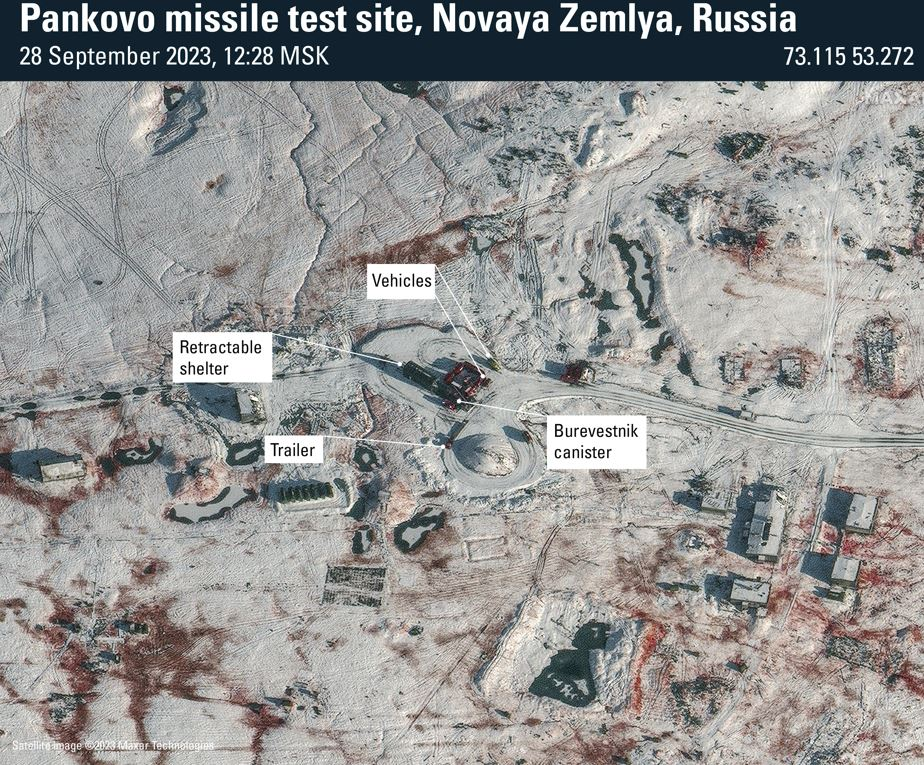
The activity was recorded in satellite imagery, aircraft distress alerts, ship trackers and open-source intelligence reports, at a time when long Arctic days and good weather provide favorable conditions for construction work at the Pankovo test site and the nearby air base.
Russian weapons analysts predict a new test of the Burevestnik cruise missile. “The operational sites for this system are almost ready. This will soon become an operational system,” said Decker Eveleth, a researcher at the Center for Naval Analyses near Washington, examining satellite imagery of the sites in July and August. “It was probably the last check before operational testing and evaluation.”
Features
The missile, nicknamed Skyfall by NATO, has been in development for more than a decade. It is one of a series of new systems that Russian designers have focused on as the Kremlin invests in weapons programs as part of a partially acknowledged arms race, mainly against the United States. Other systems include the Sarmat intercontinental ballistic missile, the Poseidon nuclear-tipped torpedo and the Avangard hypersonic missile.
Russian President Vladimir Putin unveiled several of these weapons at public ceremonies in 2018 and 2019. The Kinzhal and Tsirkon missiles have been used in Ukraine, while the Sarmat has been tested but suffered a serious accident last year. The Burevestnik has attracted particular attention because of its technology and its past failures. The missile is powered by a small nuclear reactor built into the engine, theoretically allowing it to stay in the air for days.
According to a 2019 report by the Nuclear Threat Initiative, the missile “would carry a nuclear warhead, orbit the Earth at a low altitude, evade missile defenses and obstacles, and deliver the warhead to an inconspicuous location.” U.S. intelligence agencies say the missile has been tested at least a dozen times, including in 2017 and 2019.
“Death at Nyonoksa”
One of the test sites was the White Sea, west of the city of Arkhangelsk, near the port of Severodvinsk. In August 2019, during an attempt to recover a Burevestnik from the seabed near the city of Nyonoksa, an explosion occurred that spread radioactivity over a wide area, including Severodvinsk, killing at least five Russian nuclear specialists from the state corporation Rosatom, which was believed to be leading the development of the Burevestnik.
US officials concluded that the explosion “was caused by a nuclear reaction during the recovery of the Russian nuclear-powered cruise missile.” Two years earlier, another missile, also likely a Burevestnik, had crashed in the Barents Sea, west of Novaya Zemlya. “They’ve been developing this system for over a decade, and it hasn’t gone well for a long time,” Eveleth said. “People have died… and they haven’t given up. They’ve been doing it for 15 years. They’re dedicated.”
Nuclear Detection
The activity at Pankovo in late July was noted by Eveleth and Jeffrey Lewis of the Middlebury Institute of International Studies.
The tests were moved from the White Sea to Novaya Zemlya in 2021, further away. In August, Russian authorities issued a NOTAM, according to the Barents Observer newspaper, to avoid an area west of Novaya Zemlya. At the same time, a large number of fighter jets, transports, and helicopters appeared at the Rogachevo base on the southwestern coast of Novaya Zemlya, including A-50 and Il-76 SKIP aircraft for collecting electronic signals and missile telemetry.
Open-source aircraft trackers have also spotted a US WC-135 north of the Kola Peninsula and west of Novaya Zemlya, designed to detect radioactive isotopes from nuclear tests. The latest satellite images show that Russian workers have packed up the equipment at Novaya Zemlya, indicating that a test may have taken place.
Putin’s statement that “showed”… Burevestnik
The Russian President noted on 10/10 from the podium of the Organization of the Cooperation of Independent States that “there will be an opportunity to announce new weapons, the appearance of which has already been announced. We are at the stage of completion. They are already being tested. And the tests are going well.”
The exact weapons were not named, but everyone in the room understood more or less what the Kremlin strongman was referring to… Previous reports indicated that Russia would deploy its new Oreshnik medium-range missiles in Belarus. This information was later confirmed by the country’s President, Alexander Lukashenko.