



Perhaps for the first time in their history, the two long-standing geopolitical rivals, China and India, are moving so close to each other’s positions, with the ultimate goal of creating a common front against Donald Trump and the US.
In particular, China’s approach to India shows cautious optimism about a possible new path of cooperation, but border differences and support for Pakistan remain points of friction that seek… de-escalation. The coming months will show whether this approach turns into real cooperation or remains just diplomacy at… points.
In recent weeks, China has launched a campaign of outreach to India. China’s state-controlled media, such as the Global Times and others, have published a series of India-centric articles, targeting the Indian leadership, strategic think tanks in New Delhi, and the general public.
BRICS and Global South’s game-changing partnership is taking shape
For example, a recent Global Times article titled “China-India Cooperation Could Bring Tangible Benefits to the Greater Global South” highlighted that cooperation between the two sides could enhance regional connectivity and reduce trade costs.
The tone from Beijing has been unusually positive, with statements from Chinese leaders, such as Foreign Minister Wang Yi, who visited New Delhi for the 24th round of border talks and met with India’s National Security Advisor, focusing on cooperation, trust-building, and regional stability.
Indeed, as a confidence-building measure, China has lifted restrictions on rare-earth magnets and other critical materials for India, while simultaneously addressing concerns about fertilizers and tunnel boring machines.
The two sides have also agreed to resume direct flights, reopen cross-border trade through the Himalayas, restore visas for journalists, and expand people-to-people exchanges—practical steps that reflect the restoration of relations.
The language suggests cautious optimism from New Delhi, but India remains fully aware of the underlying contradictions in Beijing’s approach.
“Focus on what unites you, not what divides you”
Chinese media have strongly encouraged both India and China to “view their relationship piecemeal,” suggesting that they focus on areas of convergence while putting aside differences.
Chinese geopolitical analysts suggest that the two countries can build mutual trust and strategic confidence, enhance Southern solidarity, and align connectivity initiatives such as the Belt and Road Initiative (BRI) and India’s “Act East” policy.
They argue that if aligned, these efforts could unlock supply chains, reduce trade costs, and integrate South Asia more deeply into pan-Asian networks.
Beijing’s narratives also highlight that, despite border clashes in 2020, more than twenty rounds of talks at the diplomatic level have established safe zones and de-escalation frameworks.
At the same time, bilateral trade has soared to historic highs, underscoring the depth of economic interdependence.
BRICS and Shanghai Cooperation Organization (SCO) Key
The two countries share convergent strategies in global fora such as BRICS and the Shanghai Cooperation Organization (SCO), thus challenging the long-standing hostility between the two geopolitical titans.
India supports China in successfully hosting the SCO Summit and is ready to create stable conditions for the final resolution of the border issue. Strategic communication on the border is crucial for stabilizing relations.
This reflects Beijing’s message that, through forums such as BRICS and the SCO, China and India could jointly promote multipolarity and resist hegemonic dominance.
At the same time, China is keen on Prime Minister Modi’s participation in the SCO Summit and wants it to be successful. Just as it used the 2008 Olympics as a platform to project power, Beijing now sees the SCO as an opportunity to present itself as a significant and stable player on the international stage.
This approach, therefore, also reflects China’s desire to present itself as a capable and successful organizer at a time when global alliances are rapidly shifting and the international system is characterized by increased instability, fragmentation, and uncertainty.
Russia, China, India agree to build oil pipeline – Terrible consequences for US
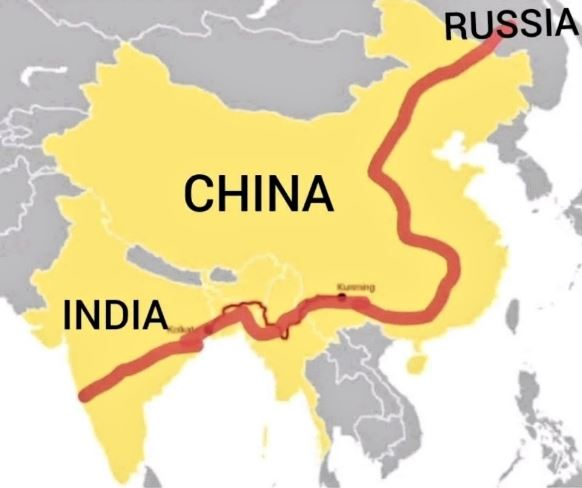
At the same time, developments in the energy sector are causing cosmogenic changes that start in Eurasia and their impact is expected to cause a tsunami of consequences beyond the Pacific: Russia, China, India and Bangladesh have agreed to build a strategic oil pipeline that aims to reduce transportation costs and avoid US tariffs or possible sanctions.
The project brings new geopolitical upheavals and strengthens economic and energy cooperation between the countries.
In its favored trend of maintaining and strengthening peace through strategic cooperation, China and India, with a total population of over 3 billion people, as well as Bangladesh, with 173.6 million inhabitants, and Russia with 143.5 million, are strengthening their strategic positions and their energy future, with Moscow in particular seeking to create a single market, in which it will have absolute control and will be largely served by itself, making these countries independent from Western control and sanctions.
Strategic geopolitical move by Moscow
With China and India ranked second and fifth in the world economy, this move is a strategic geopolitical move for Moscow, aiming to ensure its economic independence from Western attacks and sanctions.
This cooperation is expected to have significant benefits for both major Asian powers, which will no longer be dependent on the US and the West for their energy needs. The new pipeline will also pass through Myanmar, which has friendly relations with China, and is expected to be extended to Iran in the future, thus strengthening China’s energy supply and strategic security.
Myanmar, in addition to its oil production, offers strategic advantages for China’s energy security, as it allows for the diversification of suppliers and a reduction in dependence on LNG and supplies from the Middle East.
The deep-sea port in Myanmar, which is being developed, allows China to bypass the Strait of Malacca, reducing shipping times and strengthening its strategic position in the region.
The energy infrastructure connecting Myanmar with China is relatively new, with expansion plans already in place, and the relationship between the two countries is closely monitored. By choosing to participate in the construction of the new pipeline, China and India aim to strengthen their energy security, without running the risk of blackmail from Western countries, while strengthening their independence and cooperation in the energy sector.
For China in particular, the decision to support Russian oil is crucial, as it strengthens its strategic relations with Moscow.
In recent days, Chinese refiners have placed new orders for Russian crude, which will be shipped from ports that usually supply India, due to reduced demand in India after US President Donald Trump’s sanctions.
At least 15 cargoes of Russian oil have been secured by Chinese refiners for delivery in the fall of 2025.
China and India emerged as the top buyers of Russian oil after Russia’s invasion of Ukraine in 2022, as Western countries shunned exports.
China, despite pressure from the US, continues to buy Russian oil, taking advantage of the price difference, as Russian oil remains at least $3 per barrel cheaper than alternative supplies from the Middle East.


