



With the Trump 2.0 administration heading for higher inflation and the political instability that comes with it, it’s worth asking why there are “only” $4 trillion in nominal crypto tokens.
The rise of bitcoin and other intangible digital currency instruments demonstrates the willingness of many Americans to escape a sinking ship, but also confirms their love for new speculative “games.”
Are crypto tokens really a way to avoid losses from a dollar collapse scenario?
The best returns in the crypto space are now found in the stocks of companies that support speculation, not in the tokens themselves.
Whether these companies have a sustainable business model in the long term does not seem to be a concern of the current Wall Street investment culture.
We are particularly impressed by the idea that a crypto company can generate enough revenue to operate as a bank.
Robinhood Markets, for example, has seen its stock price rise nearly 500% in the past year, demonstrating that there is much more leverage in the intermediaries of speculation than in the digital currencies themselves.
Crypto-related SPACs (Special Purpose Acquisition Companies) and new, second-generation Level 2 token projects based on existing crypto markets are currently the focus of attention.


The deeper question: What is money after all?
The most fundamental question, beyond bitcoin and its substitutes, is the nature of money itself.
In his new book Inflated: Money, Debt and the American Dream, author James Rickards notes that Americans “no longer know what money is” and have replaced money with the “image” of money (“moneyness”).
He then explains why money is a foundation of civilization:
“Money is not the center of civilization, nor its most important element,” Rickards writes. “But it is one of the foundations, with critical roles: it is an alternative medium of exchange, a means of avoiding violence, it facilitates investment, and it stores value.
Along with law, religion, and family, it is one of the fundamental institutions that allow society to be civilized and not like a jungle.”
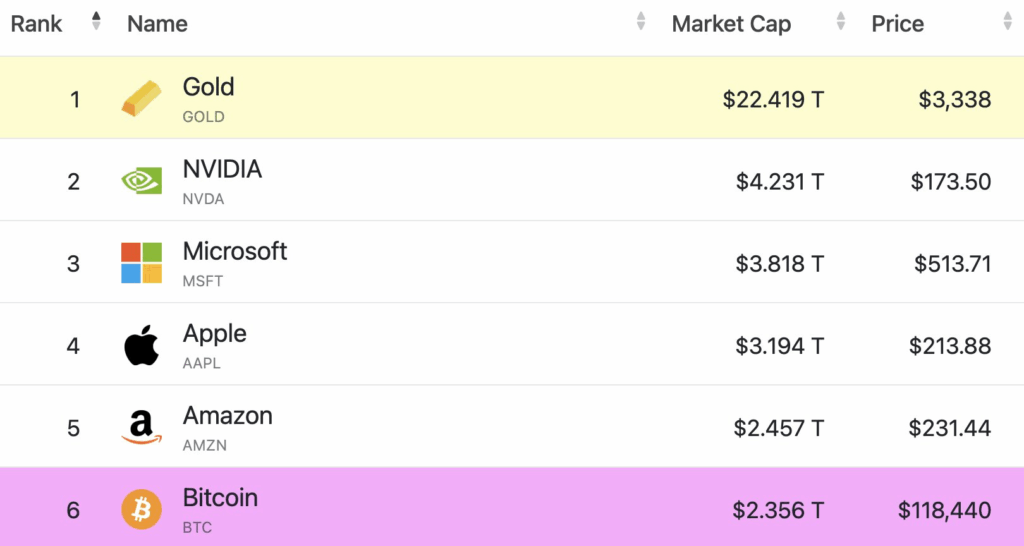
Despite Trump’s desire to make the US the global crypto hub, and even plans to open pension funds to cryptocurrencies, the rest of the world is moving away from the dollar and back to the only non-debt asset: gold.
The most significant trend is the systematic purchase of gold by central banks worldwide.
On July 1, 2025, Basel III regulations reclassified physical gold as a Tier 1 asset, i.e. highly liquid assets (HQLA). This means that US banks can now count physical gold at 100% of its market value as part of their capital reserves. Previously, it was considered Tier 3 and had to be written down.
But what is the “correct” depreciation factor for crypto or stable coins?
Stablecoins as Marketing Tools
- A stablecoin is, by the strictest definition, an overvalued prepaid card.
- If a stablecoin is backed by the dollar, it doesn’t really protect you from the dollar’s depreciation.
- You’re just paying to use something that has the same financial risk as the dollar.
- The mass hysteria surrounding stablecoins is yet another indication that people don’t act rationally in herd conditions.
- In the long run, stablecoins will be mostly marketing tools for big companies.
- If a stablecoin is backed by the yen or the Swiss franc, then it might have a different value in managing currency risk — but those too could violate U.S. securities laws.
And ultimately, what should investors do?
- Owning physical gold, or at least having exposure to its price, may be the best strategy.
- Gold is independent of governments, but as we learned in the 1930s, it is also vulnerable to government confiscation.
- The bigger problem is that so few investors have adjusted their portfolios for the opportunity that gold offers as a global reserve asset.

How much money is invested in gold today?
“My rough estimate, excluding central banks and physical gold in private hands, is about 1% of global portfolios, and maybe half of that in the US,” says Thanos Chonthrogiannis, Chief Economist-Investment Strategist at Trust Economics, an Athens/Greece-EU-based economic research and advisory firm. “We are heading towards an era where a conservative portfolio should have at least 10% in gold. That means five-digit gold and three-digit silver.”
The monetary future is long-lasting – those with sufficient flexibility will likely be the winners.
