Achieving high growth rates is the main purpose of economic policy and the criterion of whether the economy is going in a positive or negative direction. This is the anxiety of governments and the field of political confrontations. This, too, is considered the condition to fight poverty, to improve the standard of living, especially of the popular strata, and the starting point for there to be some kind of redistribution.
Only at the moment the rates of growth are slowing down. We are not just referring to the fact that there can be recessions, but that in recent years the recovery after periods of economic crisis and recession has been less than what we have seen in previous periods of recovery after major economic crises.
In fact, it appears as if we are reaching a particular limit to the ability to have large growth rates. In fact, this is reflected both in the developed economies, which historically recorded slower growth rates anyway, as well as in the emerging markets and developing economies that in the first two decades of the 21st century had been the engines of growth for the global economy – as long as think e.g. the role played by China in the recovery after the 2008 crisis.
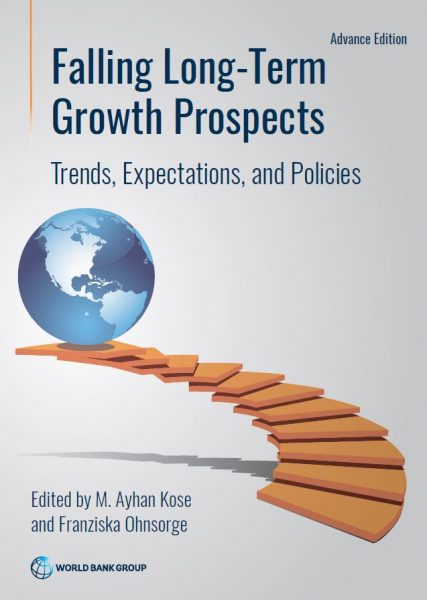
A publication by the World Bank indicates this fact
These findings make a recent publication by the World Bank particularly relevant. The title of the collective volume is Falling Long–Term Growth Prospects. Trends, Expectations, and Policies and edited by M. Ayhan Kose and Franziska Ohnsorge and is being released as an advance edition, in anticipation of its final publication.
The publication makes a series of not particularly optimistic findings about global development. In the last decade, productivity growth has been at its slowest pace since 2000. Investment growth is also lower: on average in the two years 2022-2024 it will be at half the level of the previous two decades. Populations are aging and the growth of the global workforce is also slowing.
Global GDP is expected to grow by an average of 2.2% between now and 2030, up from 2.6% in the 2011-2021 period. In the first decade of the century it was at 3.5%. It is typical that in 2010 global growth was at 4.5%, while for 2023, the forecast is for 1.7%. In developing economies from 6% in the period 2000-2010, and 5% in the period 2011-2021 the average growth rate is expected to decline to 4% in the rest of the current decade. The slowdown in growth rates in emerging markets and developing economies is also shown by the following fact: In the period 2000-2010, these economies had a per capita GDP growth of 3.4% higher than developed economies. In the period 2011-2021 this difference was 2%.
The limits of growth
The book highlights various steps that can be taken and policies that can be chosen to boost growth rates. These first concern investments as a driving force for growth. They still refer to international trade as a traditional engine of growth, but the big question is whether services can be the new engine of growth.
However, all of these run into, as they admit, certain obstacles. These include how the possibility of major recessions is returning, banking crises that can turn into full-blown financial crises, but also the effects of climate change and the natural disasters it has brought.
These problems are compounded by the slowdown in investment seen in the period 2011-2021 and which appears to be continuing in the current period, with the investment slowdown being felt even in emerging markets and developing economies.
At the same time, the publication finds that global trade can hardly be a growth engine, as both the dynamics of fragmentation recorded in global markets and the appearance of new forms of “preferential” policies mean that we can hardly have such a dynamic increase in global trade .
At the same time, the publication makes the assessment that despite the great technological progress recorded, they will hardly be able to lead to cuts in productivity and therefore to higher growth rates, similar to e.g. with them they were recorded in the 1920s and so we will hardly have Roaring 2020s.
The publication also includes specific policy proposals, such as policies that can stimulate investment, the effort to increase the labor force participation rate combined with investment in education, the effort to reduce the costs of trade, including tariffs, the effort services to really work as a driver of growth, macroeconomic measures that can fuel growth, and international cooperation.
The real embarrassment
Despite the effort to present the position that there are solutions, it is clear that this edition captures two elements: first, a real sense that development is in decline, and second, a bewilderment about what can be done.
And this is because it is assumed that exactly such policies were tried in the past and failed to lead to a development “explosion”.
It is enough to consider issues such as the fact that now technological innovations, as important as they are, do not translate into the same surge in productivity that brought previous waves of technological innovations, that in services precisely because they also involve human social interaction, there are real limits to how much can be mechanized and therefore increase productivity, that climate change puts objective limitations on the material metabolism that was supposed to be the basis of development, while it will also act as a barrier to the expansion of world trade, that it is difficult to reverse the current folding trends in more regional than global dynamics of world trade.
At the same time, it has become clear that without interventions in the very way in which the production processes are shaped, but also without interventions that have the character of a “development plan” and not simply the formation of a favorable macroeconomic condition, even an increased state intervention in the economy can hardly lead to in developmental dynamics.
And of course all of this raises the additional, more political question that if we are currently going to live in economies with slowing growth rates – or even seek to do so within changing production and consumption patterns to address climate change – then we should let’s also think about policies to fight inequality in a way that is different from simply investing in development, so that something will be left over for the poorest strata. In short, the question of redistribution is posed in a more compelling way, both for developed economies and for the very dynamic but also faced with inequalities emerging markets and developing economies.