The US Federal Reserve is in a race to prevent an imminent collapse in the US government bond market.
High US debt yields are artificially kept at these levels as the Fed maintains demand by increasing the money supply in the economy – that is, by printing dollars and trying to control the bond yield curve that way.
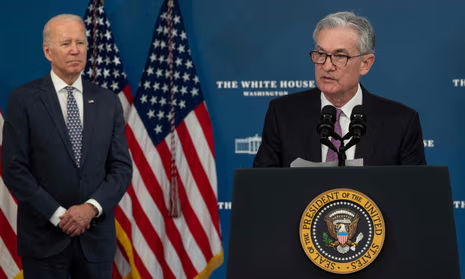
On the one hand Jerome Powell doesn’t want to let prices go unchecked but at the same time the cost of US borrowing (with the debt close to $34.7 trillion) is becoming hoarse with its servicing costs turning into fiscal hoarse
The US economy has continued to run a very large monetary surplus for the past several years, and this is partly why, after seventeen months of negative growth in the Central Bank money supply, we have only seen a slowdown in employment over the past several months.
For example, full-time employment growth has turned negative, while the total number of employed workers has been flat since late 2023. In addition, CPI inflation remains well above the 2% target rate and forecasts for significant de-escalation of inflation proved wrong.
Why the Fed and the government need lower interest rates
The Federal Reserve (as with most central banks) is motivated by two conflicting policy challenges described by their mandates. The first is price control.
Governments fear high levels of price inflation because high inflation is known to lead to political instability. One way central banks fight price inflation is by letting interest rates rise.
The second “mandate” lies in the fact that the central bank helps the government to issue debt and engage in deficit spending.
Central banks’ main tool for providing this assistance involves keeping interest rates on government debt low.
How do central banks do this?
By buying up government debt, thereby artificially boosting demand for government debt and pushing interest rates down. The problem is that buying back government debt usually involves the creation of new money, thus putting upward pressure on price inflation.
Thus, in times of rising price inflation, central banks face two contradictory tasks:
to keep price inflation low while at the same time keeping interest rates low.
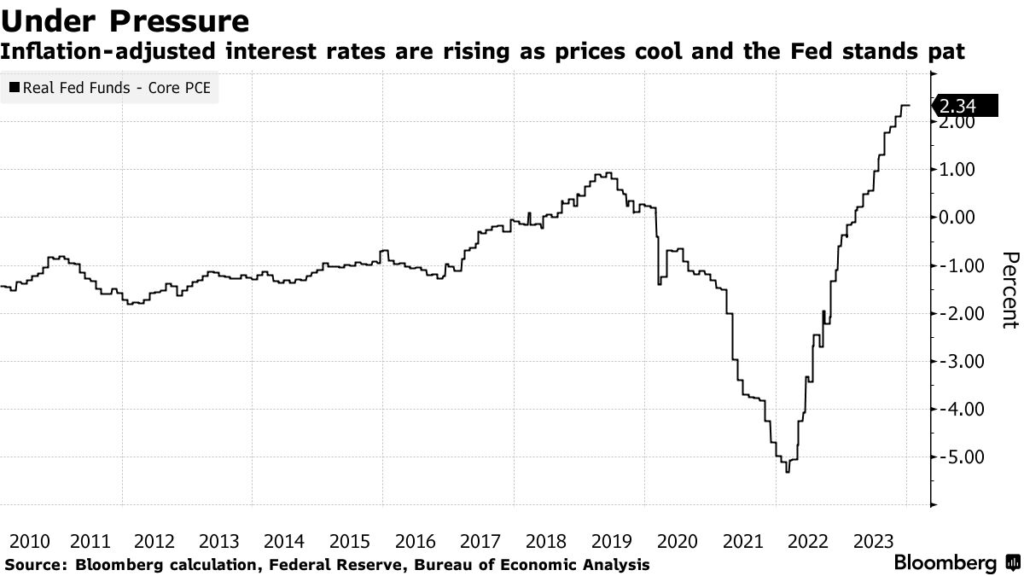
That’s where the Federal Reserve is right now. Although the projected “deflation” has remained a myth – and its inflation is not returning to 2% – the Fed has made clear in recent weeks that it does not plan to raise its key interest rate. Politically speaking, the Fed cannot let interest rates rise because it is expected to prevent any significant increases in the interest paid—that is, the yield—on government debt.
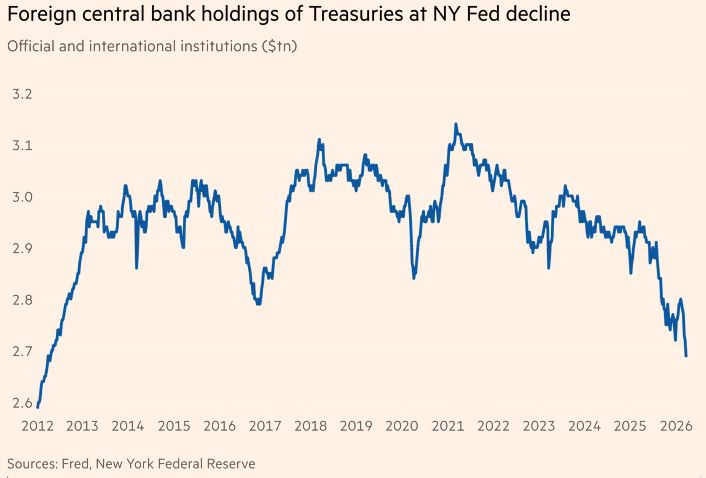
The Fed’s decision not to further tighten the money supply comes as global demand for bonds is in doubt. Foreign government bonds have risen to an all-time high, but the numbers are misleading.
Demand has weakened relative to the supply of new bonds – the expected increased supply of US debt is hard to match. In fact, an expected increase in new issuance by the Treasury creates a headache for the Federal Reserve because in any collapse in demand the sell-off in US Treasuries will be unprecedented. Already US debt – like the dollar – for a growing number of countries has become toxic – and so monetary policy has become strangely entangled with geopolitical developments.
Interest rate debt is a fiscal vise
Borrowing will be significantly more expensive when public debt interest payments reach $1 trillion and investor demand remains strong but not strong enough to keep up with an out-of-control deficit (let alone a collapse).
China’s holdings of U.S. Treasuries fell for two straight months to $775 billion, according to the U.S. Treasury Department, and Japan’s weak yen may need the Bank of Japan to intervene to sell U.S. stocks, which means disposal of government bonds.
The restructuring of the foreign exchange reserves of many countries is taking place at a steady pace. Given all this, it is rather surprising that the increase in the money supply did not happen sooner than it did.

The money supply – What the numbers say
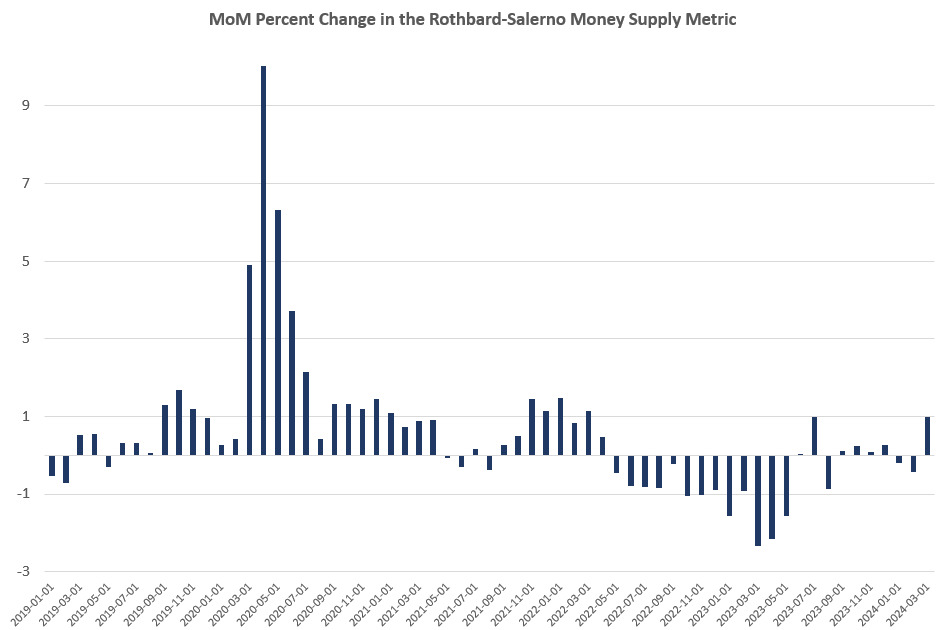
The growth rate of the money supply has now been negative – year-over-year – for seventeen consecutive months. With the negative money supply lasting more than a year and below -5% for most of the past year and a half, the contraction in the money supply is the largest we have seen since the Great Depression.
Before 2023, at no other time in at least sixty years had the money supply fallen by more than % (annualized) in any month. These dramatic reductions in the money supply appear to be over for now.
Indeed, when we look at month-over-month changes in the money supply, we find that the money supply increased by 0.9% from February to March. This is the largest growth rate since March 2022. On a month-over-month basis, money supply growth has been positive in seven of the last ten months, further suggesting that the new money supply trend is either holding steady or returning to steady upward growth.
The money supply measure used here — the “true” or Rothbard-Salerno measure of money supply (TMS) and is designed to provide a better measure of money supply fluctuations than M2. In recent months, M2 growth rates have followed a similar path to TMS growth rates, although TMS has fallen faster than M2 on an annual basis.
In March, the growth rate of M2 was -0.28%. This is higher than February’s growth rate of -1.82%. March 2024’s growth rate was also higher than March 2023’s -3.74%. In addition, M2 also shows higher overall growth than TMS, with M2 increasing by 1.10% from February to March of this year.
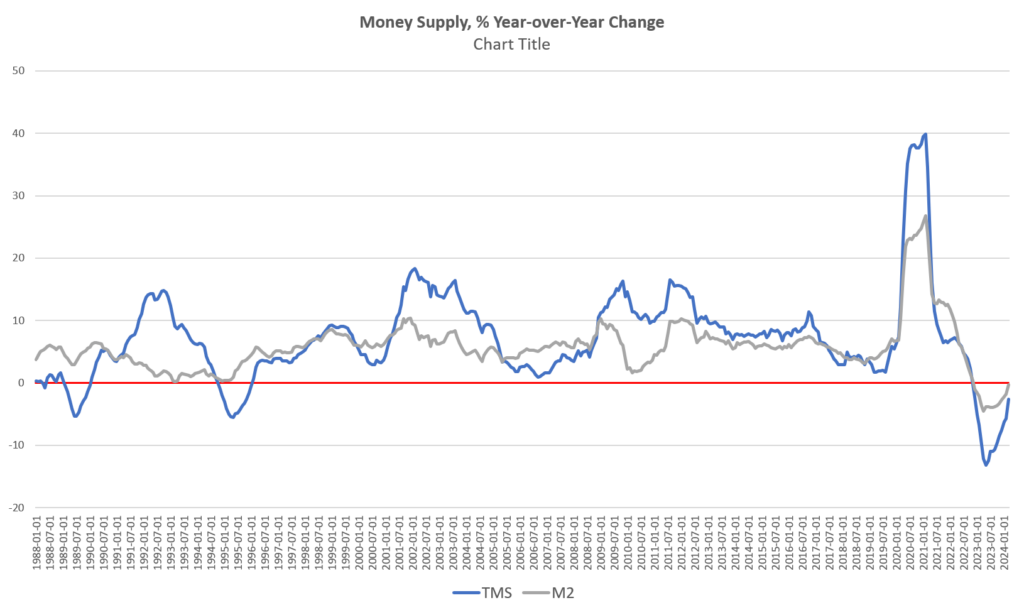
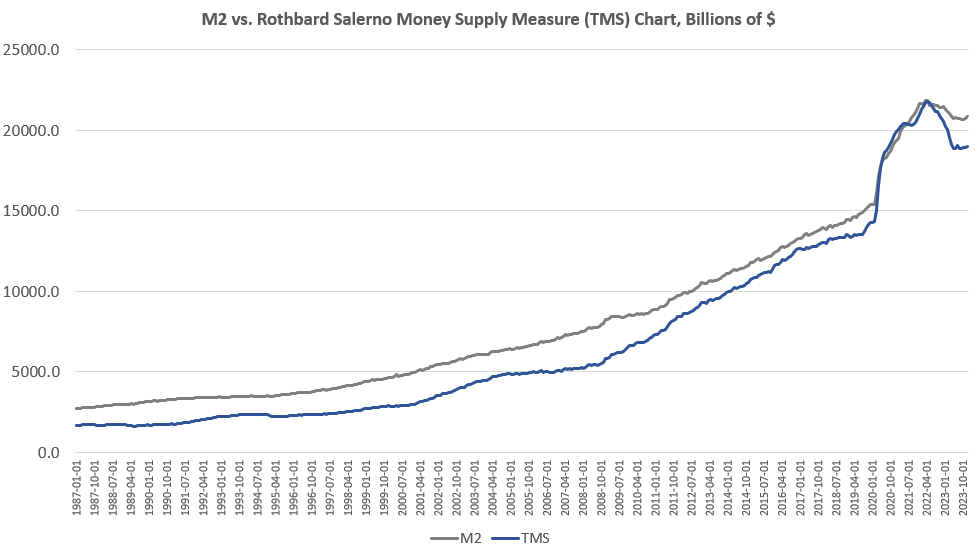
But the dip into negative territory we’ve seen in recent months helps illustrate just how far and how quickly money supply growth has fallen. This is generally a wake-up call for economic growth and employment.
This means, recessions tend not to become apparent until after the money supply begins to accelerate again after a period of slowdown. This happened in the early 1990s recession, the 2001 Dot-com Bust, and the Great Recession.
Despite last year’s significant declines in the total money supply, the money supply trend remains well above what it was in the twenty-year period from 1989 to 2009. To return to this trend, the money supply would have to decline another $3 trillion or so — or 15 percent — for a total of just under $15 trillion.
Additionally, as of March, the total money supply was still up more than 30% (or about $4.5 trillion) since January 2020. Since 2009, the TMS money supply has now grown more than 185% . (the M2 index has increased by 145% in that period.)
Of the current $19 trillion money supply, $4.6 trillion—or 24 percent—of it has been created since January 2020. Since 2009, more than $12 trillion of the current money supply has been created. In other words, almost two-thirds of the total existing money supply has been created in just the last thirteen years. With these kinds of totals, a 10% reduction in the money supply is only a small blip in the edifice of newly created money.
Waiting and hoping
What the Fed is doing now is best described as a “wait and hope” strategy. The Fed refuses to allow interest rates to rise, but it is not lowering the target rate either. Rather, it appears to be keeping the target rate steady just hoping something will happen to lower bond yields without the Fed having to print more money to buy more bonds and risk another, politically damaging spike in inflation.
However, “hope” is a strategy, and the likely outcome is that the Fed will err on the side of keeping interest rates low so the government can borrow more money because of the political cycle. This will mean a double whammy for the Federal Reserve: higher inflation and simultaneous fiscal strangulation.