



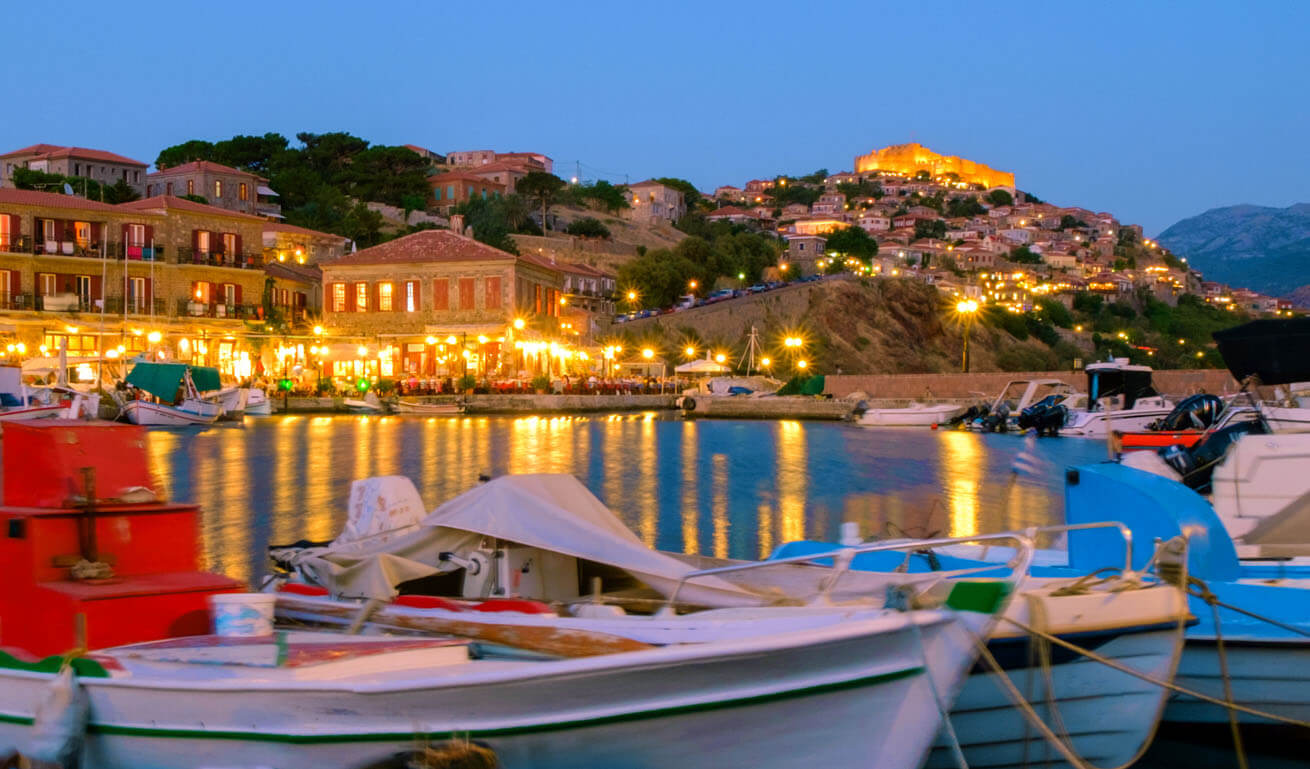
Lesvos is the third largest island in Greece, after Crete and Evia, that is, a world in itself, self-sufficient and autonomous, with its own gastronomic culture, excellent ouzo, famous sardines from Kalloni (spatula), oil from local varieties and coffee houses-institutions. With geological history and findings of the petrified forest that travel us back 20 million years. Lesvos of the great creators – Elytis, Theophilos, the Nobel Prize winner Camus who loved it deeply – is a destination for life-long journeys.
The capital of Lesvos is Mytilene on the eastern side of the island, with the famous neoclassical houses that remain reminiscent of the periods of prosperity and development of the 18th and 19th centuries and a rising bourgeoisie of merchants and shipping people. The peculiarities of the houses come from the mix of neoclassical, neo-Gothic, baroque and Renaissance elements. Pass by the Castle of Mytilene, the Archaeological Museum (tel. 22510-40223) with its impressive mosaics, the amazing Agios Therapontas and Agios Athanasios. Take a walk to the Mytilene marina and complete your tour on the commercial Ermou Street, for shopping, ouzo and meze.
Molyvos or Mithymna is the second best-known town of Lesvos, in the northern part, with the famous castle of Gatelouzo and a mosaic of cobblestone streets and stone houses with tiled roofs stretching out in front of it. It is perhaps the most beautiful settlement of Lesvos, with fanatical visitors from all over the world and is ideal for strolling through the narrow streets and eating fish in the taverns. In the summer it hosts the International Molyvos Music Festival (12-19 August 2025), the now established Classical Music Festival that fills the Aegean with the sounds of violins, cellos and piano, an event important for regional development.

The Petrified Forest of Lesvos is one of the largest in the world. The petrified trunks are located in an area of 150 sq.km., between Sigri, Eressos and Antissa, reminding us of the violent and catalytic forces of nature. At the Natural History Museum of the Petrified Forest of Lesvos, in Sigri, you will get valuable information about the value of the unique monument, with rare fossilized plants and animals, trunks, branches, fruits, leaves and bones of animals that lived 20 million years ago. Continue your walk to Sigri. The fishing village that also seems to have been frozen in time fell in love with the Nobel Prize-winning writer Albert Camus.
The island resembles an immense olive grove, literally covered with millions of olive trees. In Lesvos you will find quality oil from the varieties Adramytini (from Adramytio in Asia Minor) and Kolovi (or Valanolia or Mytilini). At the Lesvos Industrial Olive Oil Museum, in Agia Paraskevi, you will learn about the revolution that mechanical means brought to the production of olive oil. Complete your knowledge at the Vrana Olive Oil Mill Museum, in Pappados in southern Lesvos. Don’t leave without trying the PDO Mytilene olive cheese that matures in olive oil.
An important religious landmark of Lesvos is the monastery of Agios Raphael, in Thermi, just outside Mytilene, an area famous for its thermalism and the power of its thermal springs.
As everyone knows, ouzo in Lesvos is a deep-rooted habit. It is produced either by blending or by distillation, single and double. There are many distilleries and several brands on the island, not only those that are known nationwide. The mecca of ouzo is Plomari, a town in southern Lesvos. Stop by the Plomari – Isidoros Arvanitou Distillery (tel. 22520-32228), the Varvagiannis Ouzo Museum (tel. 22520-32741), try Giannatsis ouzo and enjoy a corner of the island that is fully identified with ouzo drinking.
What should you see anyway?
September is the month of festivals in Lesvos. The 7th Wellness Festival will take place from September 11 to 14 and will be a celebration of alternative sports and yoga in particular. Teachers from all over the world, locals and visitors will participate in classes and seminars (euphoria-lesvos.com). Also, on September 7-20, the International Women’s Festival of Eressos will take place with concerts, workshops, dance seminars, etc. Eressos was the birthplace of the poet Sappho and therefore a lesbian community has developed here with women from all over the world.
The folk painter Theophilos, who tenderly depicted ancient Greece, Byzantium and the Revolution of 1821 in his paintings, was from Varia, a suburb of Mytilene. The Theophilos Museum operates there, displaying 86 of the painter’s paintings, which were donated in 1965 by Teriand (Stratis Eleftheriadis), an art critic, collector and publisher of artistic publications, to the Municipality of Mytilene, along with the museum building (tel. +030 22510-41644).

For swimming
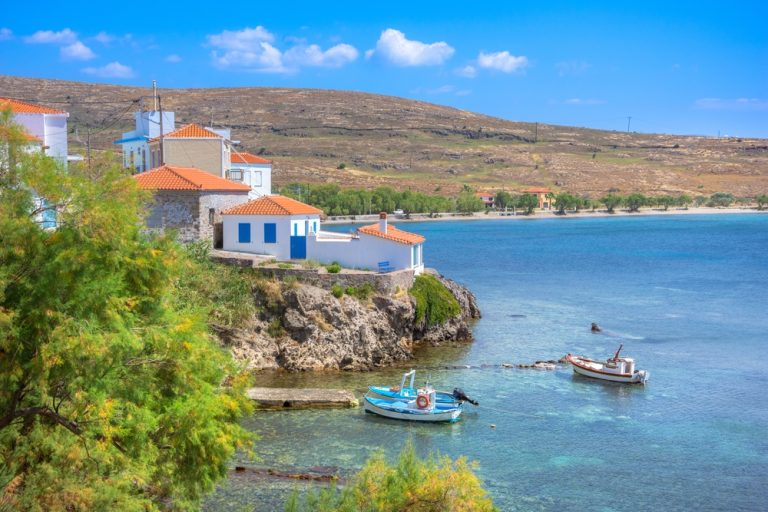
Take a first dip at Vigla beach, just outside the city of Mytilene, while if you want to see what swimming is like in such a closed bay as Gera, stop by Evreiaki beach. On the southern coastline of Lesvos, the beaches of Tarti and Patos are well-known, as is the vast beach of Vatera, 7 kilometers long, where you can go diving. Further west, Chrousos and of course Skala Eresou hold the scepters. In northern Lesvos, take a dip at Petra, but be prepared for very cold waters. On an island with thermal tourism, such as Lesvos, it is worth alternating dips in hot springs and in the sea.

