



Russia appears to be preparing for a new era in tank warfare, unveiling an innovative system that is disrupting the current state of modern armored conflict: the “Shturm,” a tank with unmanned capabilities.
Its latest test took place on July 27, with footage showing the tank and its control vehicle returning to the Uralvagonzavod factory in Nizhny Tagil.
The Shturm is not just a new tank, it is a statement about how the Russian military understands the evolution of the modern battlefield, and urban conflicts in particular. And, at the same time, it is an indication of Russia’s efforts to maintain a technological advantage over the West in an era of geopolitical turmoil.
Technological hybrid: Old chassis – New doctrine
The Shturm is based on the chassis of the T-72 or T-90 main battle tanks – two iconic types that dominate the Russian armored fleet. However, the form and function of the new tank are radically different.
First of all, it is an “optionally-unmanned” system, meaning it can operate either manned or fully remote-controlled, depending on operational needs. This feature is part of a global trend towards automation of warfare, aimed at reducing human casualties and increasing survivability in extreme environments – such as densely built-up urban areas, where conventional warfare is becoming increasingly dangerous for crews.
Designed for urban warfare
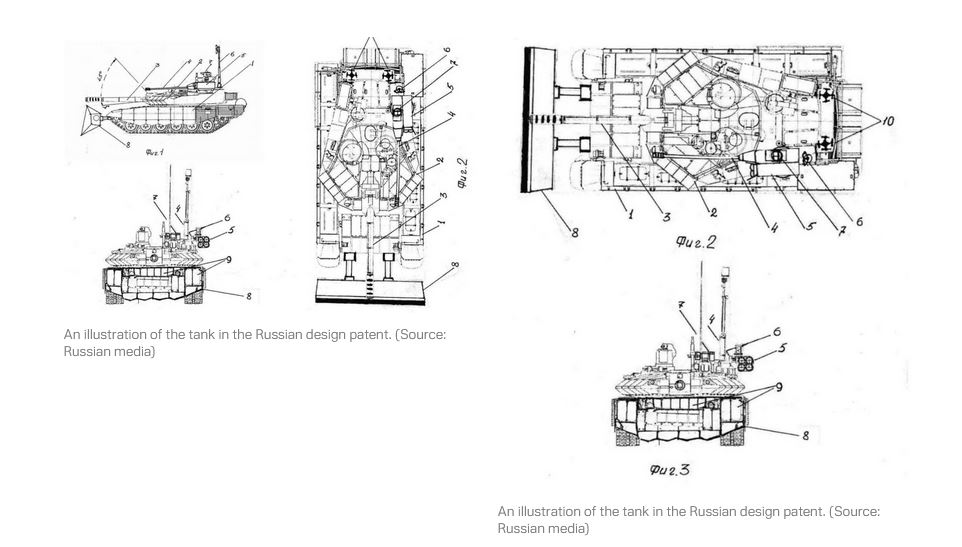
One of the Shturm’s most notable features is its shorter 125mm gun. Unlike traditional long-barreled tanks designed for open terrain, the Shturm is built for “room-to-room” – or more realistically, “square-to-square” – combat in large cities.
The shorter barrel makes it easier to maneuver through narrow streets and to aim faster at close range. In addition, the tank is equipped with thermobaric weapon launchers, most likely the RPO-A Shmel type, which are particularly effective in confined spaces due to the way they disperse the blast and overheating.
The presence of a bulldozer-like clearing blade at the front – for removing obstacles, mines and explosive devices – further reinforces the image of a vehicle designed exclusively for “dirty” and complex urban warfare.

Enhanced Armor and Protection
The Shturm and its accompanying command vehicle feature full armor with explosive reactive armor (ERA) blocks on all sides. This protection is intended to provide resistance to anti-tank missiles, rockets, and improvised explosive devices – threats that have intensified in the asymmetric warfare of recent decades.
The command vehicle, where the tank’s operators are located when operating as an unmanned vehicle, is also equipped with similar armor and a remotely controlled turret with a 12.7 or 7.62 mm machine gun for self-defense.

Technological breakthrough
Although the Shturm is not yet ready for mass production – and may not enter the Russian military’s arsenal for years – it is an indication of Russia’s plans for future battlefields.
Uralvagonzavod CEO Alexander Potapov said as early as 2018 that the Russian Defense Ministry had requested the development of a tank with optional unmanned capabilities.
The testing of this system alone suggests that Russia sees future warfare not only through the prism of numerical superiority, but also technological advancement – with an emphasis now on crew safety, urban suppression and tactical flexibility.
The context of the war in Ukraine
The development of the Shturm cannot be separated from the war in Ukraine. The battles in cities like Mariupol, Bakhmut, and most recently Kharkiv have starkly demonstrated the vulnerability of conventional tanks in urban environments, where Ukrainian forces are using anti-tank weapons and guerrilla tactics with impressive effectiveness.
The Shturm could theoretically give Russia an advantage in such environments if it were perfected and integrated into the battle lines. However, the process of developing and integrating such a system is complex and expensive – and Russia is already bearing the brunt of a long war.
Machine Warfare – The Future of Armed Conflict
Shturm is part of a broader trend in military innovation seen in the US, Israel, China and other military superpowers: unmanned, remotely controlled or AI-powered weapons systems.
The adoption of such technologies promises fewer casualties, faster response and greater survivability. But at the same time, it raises serious ethical, operational and legal questions – especially in environments where civilians cannot be easily separated from combatants.
Shturm is a turning point
The Shturm is much more than a new Russian tank. It is a technological experiment, a tactical tool and – most importantly – a window into the future of warfare. Although it is far from joining the battlefield, it reveals Russia’s intentions and strategy for the 21st century: war in highly complex environments, with machines fighting where humans might not survive.
The question now is not just whether the Shturm will technically succeed, but what its success means for the future of the military balance – and how close we are to an era when battlefields will be dominated by machines rather than humans.

