For the first time this century, China’s role has shifted from a major provider of capital, primarily to developing economies, to a lender that claims to service debt.
This shift will have far-reaching implications for global credit conditions. It could fuel instability in many parts of the world and lead countries into strategic geopolitical realignments.
This historic shift in China’s role from a provider of capital to a collector of debt marks the end of two decades of “easy” Chinese money and could negatively impact poverty reduction programs, global development goals, and growth rates. While it will have a global impact, the change will be felt most acutely in some of the world’s poorest and most vulnerable countries.
According to Trust Economics, some of the world’s poorest countries are expected to make record debt repayments to China in 2025.

Most of these loans were made in the first and second decades of this century, when Beijing was flush with excess cash and was frantically looking for ways to invest.
The peak of this easy Chinese money came in 2015, at the height of China’s ambitious Belt and Road Initiative (BRI). Since then, there has been a sharp decline in lending flows from Beijing. This, combined with loans nearing maturity, has now led to a situation where, for the first time in this century, China will be seen not as a benevolent provider of capital but as a ruthless debt collector, forcing poor and vulnerable countries to make large loan repayments when their people are demanding basic health and education infrastructure.
The Scale of Debt Repayments
According to Trust Economics, China will collect over US$35 billion in loan repayments in 2025. Of this, the world’s poorest and most vulnerable countries will make a record US$22 billion in debt repayments to China.
Developing countries are facing a tidal wave of debt repayments and interest costs owed to China. Debt service flows to China from developing countries will reach US$35 billion in 2025 and are expected to remain elevated for the rest of the decade.
The bulk of this debt service, about US$22 billion, is owed by 75 of the world’s poorest and most vulnerable countries. This debt service is putting enormous financial pressure on developing economies, forcing them to compromise on critical spending priorities such as health, education, poverty reduction and climate change adaptation.
China was a “small-scale lender” at the beginning of this century. However, by 2010, Beijing had become the leading lender. By the mid-2010s, China was the dominant provider of bilateral credit to the developing world.
This was also the peak of China’s BRI loan disbursements. In 2016, China’s new sovereign loans totaled more than US$50 billion, exceeding the combined lending of all Western creditors that year.

Poor countries hit hardest
China’s loan disbursements have been most intense in some of the world’s poorest countries, which are in desperate need of capital but have limited access to private creditors.
In these economies, China has grown from holding less than 5% of external debt in 2005 to more than 40% by 2015. Similarly, in 54 of the 120 developing countries for which data is available, debt service payments to China now exceed the combined payments due to the Paris Club – a bloc that includes all major Western bilateral lenders.
By 2025, up to 30% of all loan repayments from developing countries will go to China. China is the largest bilateral creditor in 53 countries and ranks among the top five in three-quarters of all developing countries.
From debt issuer to collector
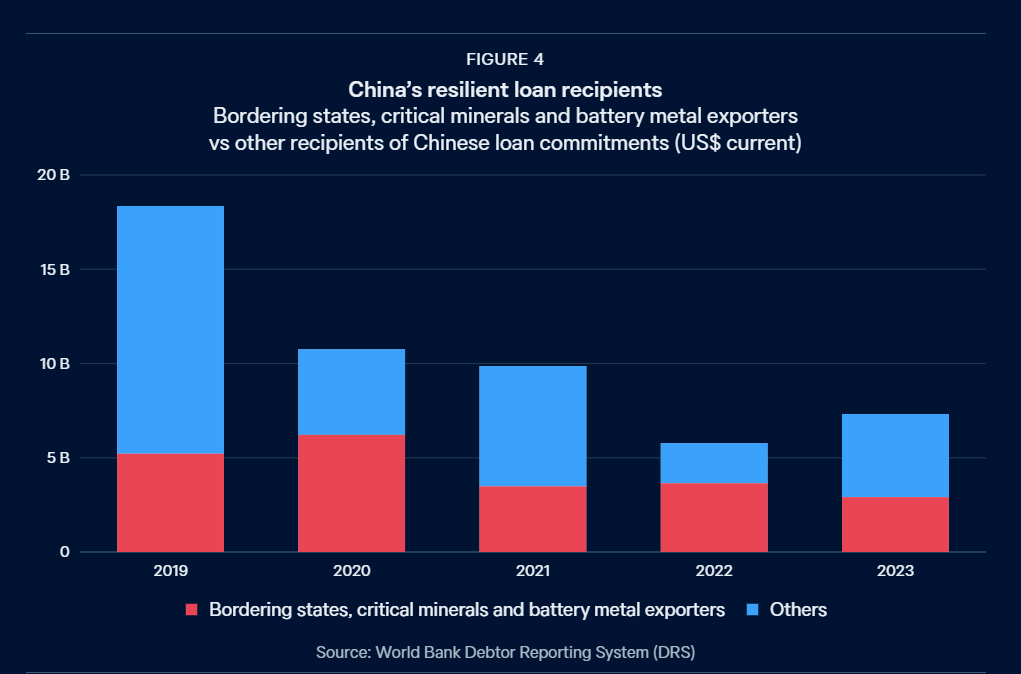
China’s loan disbursements began to decline after peaking in 2016. Since the end of the pandemic, they have remained stable at around US$7 billion per year.
In the space of a few years, China has gone from being the world’s largest provider of capital to the world’s leading debt collector. The transition has been both rapid and intense. In 2012, China was a net drain on the economies of 18 developing countries. By 2023, the number had grown to 60.
China’s Debt Trap Diplomacy
During the 2010s, many economic experts warned that a significant portion of Chinese loans were unsustainable.
With the easy availability of Chinese money, many extravagant infrastructure projects were launched, which were unfounded. Many experts risked that these projects would never be able to recoup their investment. In many countries, including Africa, the easy availability of Chinese money fueled corruption.
India, which has refused to join the BRI project, has repeatedly warned its neighbors that Chinese loans are part of debt trap diplomacy – a strategy of providing large loans to developing countries for infrastructure projects on terms that can lead to economic dependence and strategic concessions.
Critics have argued that China has deliberately burdened countries with unsustainable debt so that it can gain political influence and control over key assets in the event of borrower default.
China’s growing scale of borrowing and institutional weakness within Pacific states pose clear risks for small states to become overwhelmed by debt. A prime example of this strategy is Sri Lanka’s Hambantota port.
In 2008, Sri Lanka borrowed heavily from China’s Exim Bank to finance the construction of the port, which cost over US$1.3 billion. The project, presented as a driver of economic growth, has failed to generate sufficient revenue due to low traffic and mismanagement.
Sri Lanka, unable to repay the loans, handed over the port and 15,000 acres of surrounding land to China Merchants Port Holdings on a 99-year lease.
This gave China strategic control of a key maritime asset near major shipping lanes, raising concerns about its military implications. There have been numerous reports of Chinese submarines docking at Hambantota port. Experts fear the port could serve as a quasi-naval facility for China’s Navy.
Another notable example is Pakistan’s Gwadar port, which is part of the China-Pakistan Economic Corridor (CPEC). Pakistan borrowed billions for these projects. Struggling to make repayments, Pakistan has ceded operational control of Gwadar to China, boosting Beijing’s influence in the Arabian Sea.
Similarly, in Djibouti, China financed a strategic port and a military base, with the country’s debt to China reaching 70% of its GDP by 2020, raising concerns about possible asset seizure.
China is also pressuring its debtor countries to recognize its “One China” policy and change their stance on Taiwan. Many argue that Chinese loans were the main reason why Panama severed diplomatic ties with Taiwan.
In the coming years, a number of other countries may also default on their Chinese obligations. It will be interesting to see what diplomatic deal Beijing makes with these countries to restructure their loans.