
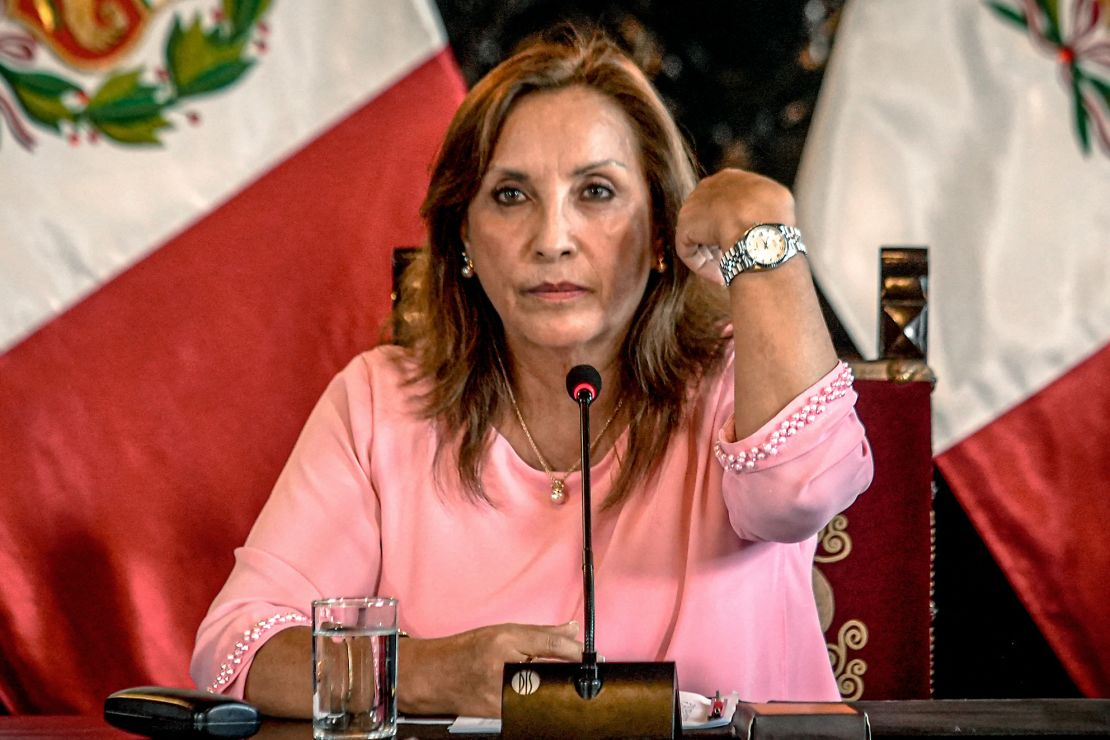
Peru’s President Dina Boluarte is embroiled in a whirlwind of scandals, the latest involving a secret nose job.
The Latin American leader, whose popularity has plummeted, is facing a series of investigations by Peru’s Attorney General.
The investigations against Boluarte
The most serious of these involve the deaths of more than 60 people during the crackdown on protests that followed the December 2022 removal of her predecessor Pedro Castillo by government security forces; the most egregious include allegations that she accepted Rolex watches and other jewelry as bribes and transported a fugitive politician in a presidential vehicle.
But it is her nose job in the summer of 2023 that is currently grabbing headlines across the country.
Boluarte, who denies all charges against her, is accused of leaving office to have the surgery, by failing to notify Congress or delegate her powers during her nearly two-week absence for a procedure she insisted was “necessary” for her health, as she was constitutionally required to do.
Last week, plastic surgeon Mario Campani disputed that account, telling a local television show that of the five procedures he performed on Boluarte – including a rhinoplasty, a septoplasty, a lower eyelid operation and a fat graft to the nasolabial folds (smile lines) – all but one were cosmetic procedures.
Kampani, who said he had judicial authority to disclose the procedures, also claimed that Boluarte was sedated and at times unconscious during the procedure – a claim that contradicts her own account, which likened the procedure to a tooth extraction, and her lawyers, who have maintained that she never lost consciousness or abandoned her position.
In addition, in March 2024, police raided her home (and later the presidential palace) as part of the “Rolexgate” scandal, in which she is accused of illicit enrichment and failing to declare her possession of several luxury watches. Boluarte insisted that the watches were in fact a “loan” she accepted by mistake.
It’s a state of affairs that may seem shocking to those unfamiliar with Peruvian politics and the well-documented problems of its leaders over the past few decades.
The Dishonored Leaders
Peru’s notorious political instability – Boluarte became the sixth president in just seven years when she took office without an election in 2022 – is often traced back to the presidency of Alberto Fujimori, who was ousted in 2000 after a scandal involving his intelligence chief and convicted on charges of corruption, embezzlement and human rights abuses that included authorizing a death squad.
But in this country, presidential scandals—proven or alleged—are so common that one of its prisons has housed four disgraced former leaders.
- Alejandro Toledo (2001-2006), the first person elected president since Fujimori, was sentenced last year to more than 20 years in prison for taking millions in bribes from Brazilian construction company Odebrecht, in a scandal that has tarnished political elites across Latin America.
- Alan Garcia (2006-2011) died of self-inflicted wounds in 2019, the day prosecutors and police were due to arrest him in an investigation also linked to Odebrecht.
- Oyanda Humala (2011-2016) was sentenced this month by a lower court to 15 years in prison for receiving illegal campaign contributions from Odebrecht and the Venezuelan government.
- Pedro Pablo Kuczynski (2016-2018) resigned after two years in office, after he was also caught up in the Odebrecht scandal, when allegations of money laundering surfaced. He is currently under house arrest, while his trial continues.
- Martín Vizcarra (2018-2020) dissolved Congress a year after taking office. He also did not complete his term, but was removed from the legislature on the grounds of “moral incompetence” after being accused of bribery during his term as governor. He is currently on trial.
- Pedro Castillo (2021-2022) was a relative unknown when he won the election after a brief period of rule by two interim presidents, one of whom resigned in less than a week. He was imprisoned for the alleged crime of rebellion and dismissed by Congress after trying to dissolve it and form an emergency government.
- Boluarte, his vice president, took office in 2022.
All of the defendants and convicts have denied the charges against them.
Why is that, though?
Many experts say that Fujimori’s 1990 inauguration marked a return to authoritarian rule in a country that had spent the entire 1970s as a military dictatorship.
The son of Japanese immigrants and the host of an environmental television show, Fujimori started out democratically, winning the election on a campaign for change during an economic crisis and defeating a right-wing coalition led by future Nobel Prize-winning author Mario Vargas Llosa.
He also won early praise for his “Fujishock” austerity policies that curbed hyperinflation, as well as for his fight against guerrilla groups responsible for tens of thousands of deaths.
However, an authoritarian streak soon emerged, and while accusations of abuse of power and corruption began to surface, he turned to his security forces to suppress his opponents.
Within two years of his triumph at the polls, Fujimori carried out a “self-coup” in which he closed Congress and the judiciary, revised the constitution, and installed a dictatorship “that demolished political parties,” according to constitutional lawyer Luciano Lopez.
For the country’s next elections, scheduled for April 2026, there are 43 candidates registered to run for president, dozens of whom are not supported by traditional party structures.
There is perhaps no greater symbol of the “presidential curse” than the Barbadillo prison in Lima, known in Peru as the “prison of presidents,” which once housed Fujimori and also held three of the leaders who followed him – Toledo, Castillo and Humala.