



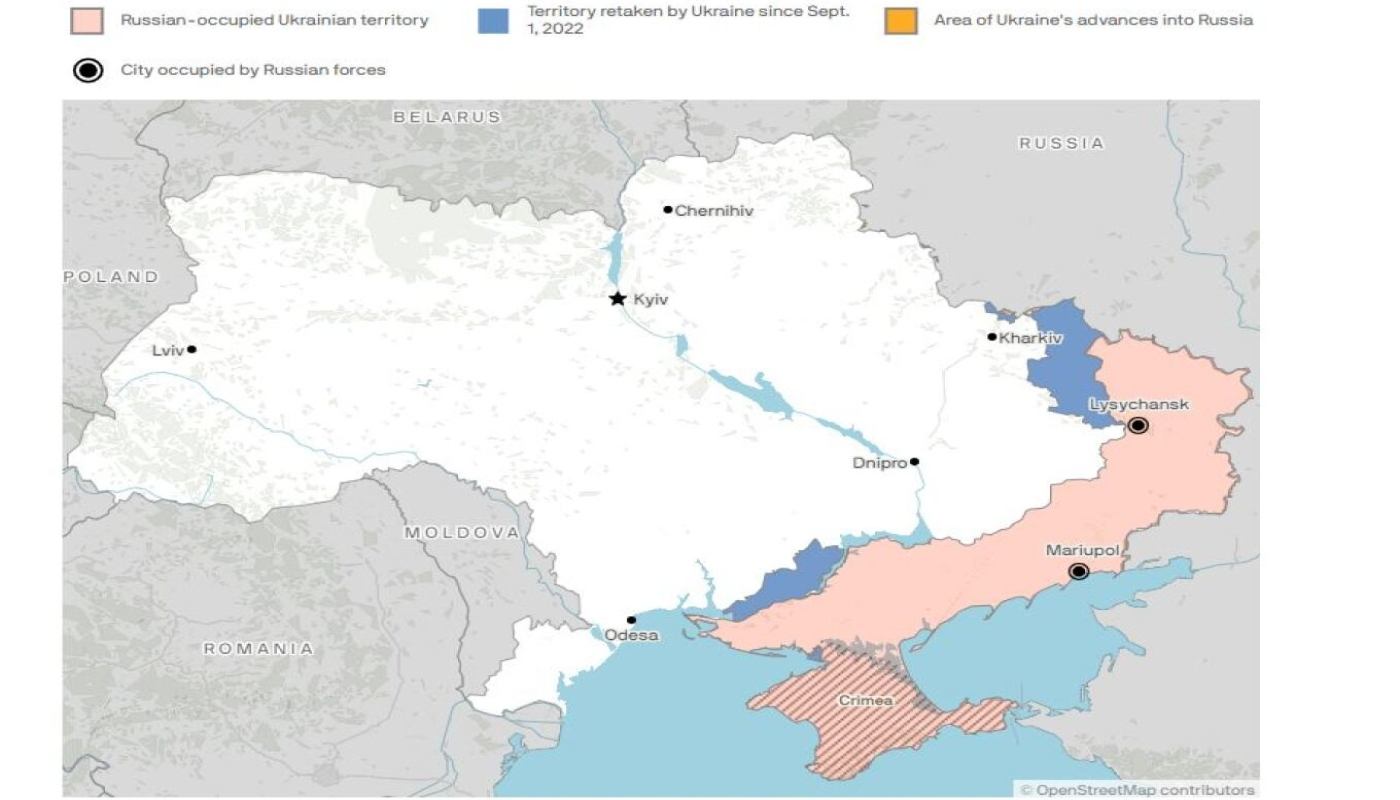
Washington is expecting Ukraine’s response today on a peace framework that includes U.S. recognition of Crimea as Russian and informal acceptance of Russian sovereignty over the occupied territories by 2022, according to information revealed by Axios. The one-page document, presented to Ukrainian officials in Paris last week, is described as President Trump’s “final proposal.” The White House says it is ready to walk away from the talks if an agreement is not reached soon. The proposal requires serious concessions from Ukrainian President Volodymyr Zelensky, who has previously rejected any recognition of Russia’s occupation of Crimea and other areas in eastern Ukraine. Although Vladimir Putin has been reported as willing to “freeze” the current front lines, he has rejected other aspects of the US framework, such as the presence of a European peacekeeping force in Ukraine.
A source close to the Ukrainian government described the proposal as particularly favorable to Russia: “It precisely describes the benefits for Moscow, while for Ukraine it speaks in generalities.”
Russia would gain:
(1) Formal US recognition of its sovereignty over Crimea
(2) Informal recognition of Russian occupation of almost all of Luhansk Oblast, as well as occupied areas in Donetsk, Kherson, and Zaporizhia
(3) A promise not to allow Ukraine to join NATO. EU membership would remain a possibility
(4) Lifting of sanctions imposed after 2014 and
(5) Enhanced economic cooperation with the US, mainly in the energy and industrial sectors.
Ukraine would receive:
(1) Security guarantees from a group of European (and possibly non-European) countries – without clarifying the role of the US (2) Return of a small area of the Kharkiv region occupied by Russia
(3) Free passage across the Dnieper River, which divides the fronts in southern Ukraine and
(4) Compensation and reconstruction assistance, without specifying the source of funding.
The plan foresees that the Zaporizhia nuclear power plant would be considered Ukrainian, but would be operated by the US, with electricity distributed to both Ukraine and Russia. There is also mention of the U.S.-Ukraine mineral deal, which Trump plans to sign on Thursday. The framework was drawn up after a four-hour meeting between Trump’s envoy, Steve Witkoff, and Putin. After presenting the proposal, Putin suggested a suspension of military operations along the current border as a sign of a willingness to make peace. European officials, however, remain wary. Witkoff is due to travel to Moscow again later this week for a fourth meeting with Putin, but neither he nor Secretary of State Marco Rubio will attend the talks in London on Wednesday as originally planned.
The U.S. delegation will be led by Keith Kellogg, who will present the plan to Ukrainian, French, German and British officials. A U.S. source said Washington and Ukraine are now discussing a 30-day ceasefire, rather than a full peace deal based on Trump’s plan. Rubio tweeted that he had a “productive” conversation with his British counterpart and that he expected to continue talks after London. White House spokeswoman Caroline Levitt said: “Negotiations are ongoing and we hope we are on the right track.”


