


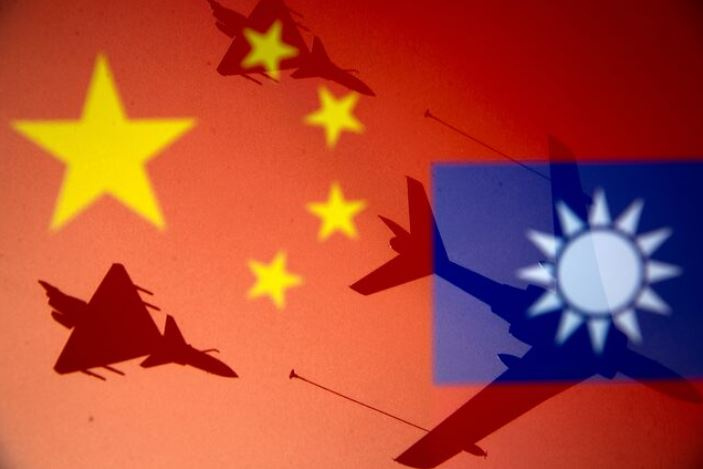
Precision strikes on key ports and energy facilities, blockade and control of the island republic of Taiwan by units of all branches of the Chinese Armed Forces, including an aircraft carrier. No, war did not break out in Asia.
That was the scenario for the large-scale military exercises – with live fire and simulated targets – that China unexpectedly carried out in the Taiwan Strait in the first two weeks of April.
The code name “Strait Thunder-2025A” suggests that Beijing is planning more such exercises in the near future as a show of force.
He described the exercises that have just concluded as “a serious warning and a powerful constraint against Taiwan independence.”
Just two weeks ago, China had sent a large number of drones and ships to the island, as part of an intensification of its military exercises.
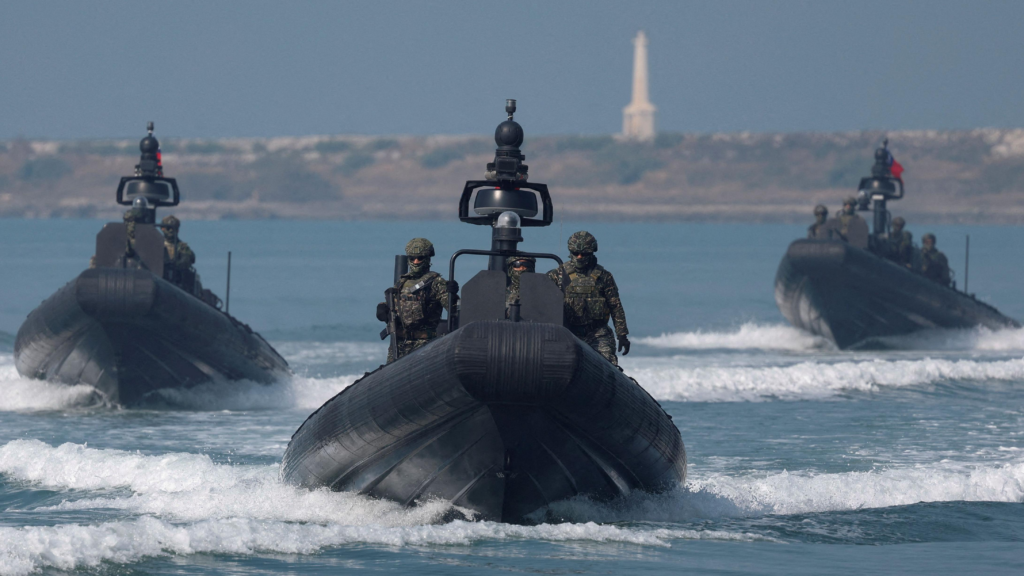
Demonstrating how extreme the situation has become, Taipei this time responded with a preemptive deployment of air and naval forces as part of a “quick reaction exercise.” The island’s ground-based missile systems were also activated.
Precision strikes on key ports and energy facilities, blockade and control of the island republic of Taiwan by units of all branches of the Chinese Armed Forces, including an aircraft carrier. No, war did not break out in Asia.
That was the scenario for the large-scale military exercises – with live fire and simulated targets – that China unexpectedly carried out in the Taiwan Strait in the first two weeks of April.
The code name “Strait Thunder-2025A” suggests that Beijing is planning more such exercises in the near future as a show of force (for more analysis about the subject of specific military exercise please read the analysis titled “China’s floating barges approaching Taiwan for military landing“).
He described the exercises that have just concluded as “a serious warning and a powerful constraint against Taiwan independence.” Just two weeks ago, China had sent a large number of drones and ships to the island, as part of an intensification of its military exercises.
Demonstrating how extreme the situation has become, Taipei responded this time with a preemptive deployment of air and naval forces as part of a “quick reaction exercise.”
The island’s ground-based missile systems were also activated. Consistently for years, but with alarmingly increasing frequency recently, the area is a potential flashpoint between China and the United States, Taiwan’s most important security partner. More and more “pieces” are being added to the “puzzle.”
“Intimidation Tactics”
With the Trump administration focusing its strategic interest on the Indo-Pacific region, aimed at containing China, the Taipei leadership is constantly raising its voice.
Just shy of his first year in office, Taiwanese President Lai Ching-te recently called China a “foreign hostile force” and announced a 17-point plan to counter Beijing’s influence and espionage operations.
US Defense Secretary Pete Hegseth, meanwhile, has just completed a tour of Asia, issuing threats to Beijing for “strong and credible deterrence” in the Taiwan Strait while pressuring Washington’s regional allies to drastically increase their defense spending.
The new Chinese exercises coincided – and apparently not coincidentally – with the visit of Chinese Foreign Minister Wang Yi to Moscow, amid a rapprochement between Russia and the United States, centered on Ukraine.
Moscow and Beijing are “continuously deepening their comprehensive strategic partnership of coordination for a new era,” Wang Yi said – according to the Chinese state news agency Xinhua – in his meeting with Russian President Vladimir Putin. “Friends forever, never enemies” was his motto, also welcoming signs of normalization of relations between Washington and Moscow.
The State Department, on the other hand, unequivocally condemned China’s “intimidation tactics and destabilizing behavior” in the Taiwan Strait. He underlined Washington’s complete opposition “to unilateral changes to the status quo, including through force or coercion.”
Endurance test
The ongoing dispute between Beijing and Taipei dates back to 1949, when the nationalist Kuomintang forces under Chiang Kai-shek fled to Taiwan after being defeated in the Chinese Civil War by Mao Zedong’s communists.
To this day, few states—mainly in the Pacific, the Caribbean, and the Vatican—recognize Taiwan as an independent country, under the name “Republic of China.” China considers the island part of its territory, threatening to bring it under its control, even by force if necessary.
Tensions between Beijing and Taipei have escalated since Lai Ching-te assumed presidential duties in Taiwan in May 2024, escalating the rhetoric in defense of the island’s sovereignty.
However, the main recipient of China’s increasing show of force is not the Taipei leadership, but the United States.
It is widely believed that Beijing is essentially measuring the limits of tolerance and commitment of the new administration of the unpredictable Donald Trump towards both Taiwan and Washington’s regional allies.
Until now, the White House has officially adhered to the “One China” policy. However, it maintains a tactic of “strategic ambiguity” as to whether it would defend Taiwan in the event of a Chinese attack. In the meantime, it is arming it.
Faced with the growing Chinese threat, Taipei has ordered new missiles, aircraft and other weapons from the US, while strengthening its own defense industry.
“Can war wait?”
China is clearly not yet ready to take the risk of an invasion, despite increasingly frequent military exercises. They are combined with a diplomatic and economic war, cyberattacks, as well as disinformation and propaganda campaigns.
The latest large-scale military exercises, for example, were dressed up in a flood of videos from the Chinese military.
Many of them were in a warlike atmosphere, with bombs raining down on Taiwan as if in a video game, with music and titles such as “Defeat Evil.”
What made the biggest impression, however, was an animation showing 65-year-old President Lai Ching-te as a worm caught on chopsticks being roasted in flames that have engulfed Taiwan. The titles read: “Parasite on the road to final destruction.”
According to a recent report by the Defense Ministry in Taiwan, the conquest of the island poses a huge challenge even for China’s rapidly rearming People’s Liberation Army. It remains unclear, however, which way Beijing’s “balance” of risks and benefits will ultimately tip.
With Donald Trump in the White House, the United States seems to be increasingly withdrawing from the international scene.
China has been detailing the transactional negotiating tactics of the new leadership in Washington towards Moscow in the Ukrainian conflict. Its revisionism towards European allies in NATO has also not gone unnoticed by the United States’ security partners in Asia.
Fears that Trump might use Taiwan as a bargaining chip against Beijing, while intensifying his trade wars against everyone, are no longer considered a priori irrational.
Allies and enemies alike
It is in this light that China, Japan and South Korea held talks last Sunday for the first time in five years, focusing on strengthening economic and trade cooperation.

