Foreign Buyers Are Unwittingly Fueling China’s Naval Rise, a new study by the Center for Strategic and International Studies (CSIS) (“In the Shadow of Warships: How foreign companies help modernize China’s navy“) shows.
The authors, Matthew Funaiole, Brian Hart, and Aidan Powers-Riggs, found that “a disproportionate share of China’s commercial shipbuilding is produced in shipyards that are closely intertwined with the country’s extensive defense industrial base.”
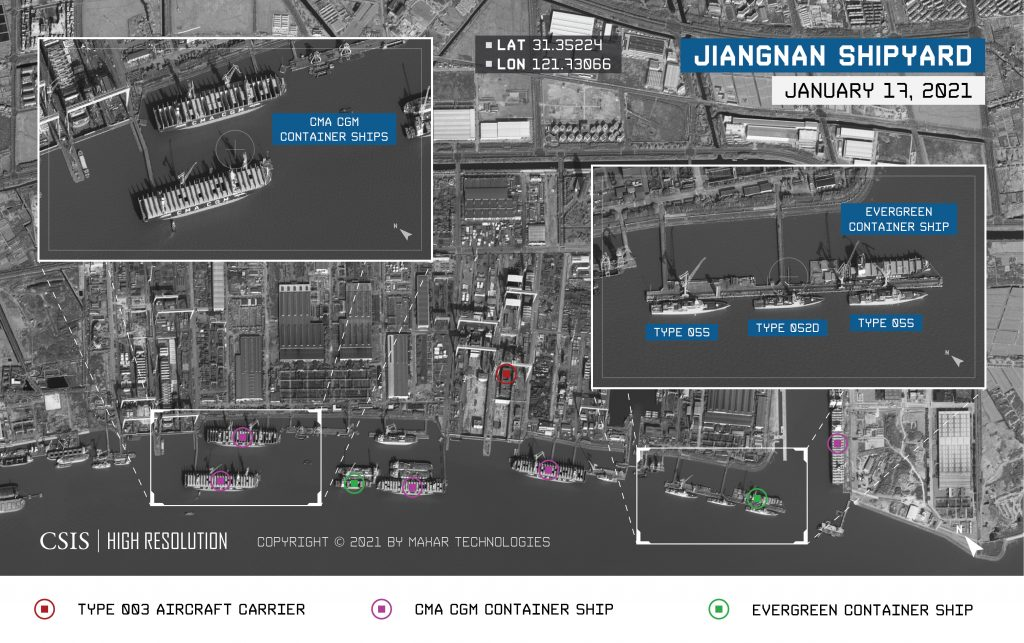
Because of the close ties between China’s commercial shipbuilding, which is largely supported by foreign buyers, and its military shipbuilding, “foreign companies have funneled billions of dollars in revenue into entities central to China’s naval modernization,” they wrote.
In the new CSIS report, China’s shipbuilding industry is divided into four tiers, with the highest having closer ties to military construction. While tier 1 and 2 shipyards account for just 15% of active shipyards in China, they produce 40% of its commercial output by tonnage. And more than 75% of the output at these shipyards goes to foreign buyers outside of China or Hong Kong.
Foreigners support China’s shipbuilding
In addition, the authors explained, “foreign companies have also provided China’s defense contractors with key dual-use shipbuilding technology through joint ventures, licensing agreements, and outright purchases” that have helped China overcome technological barriers.
Even when military and commercial production are not linked, China’s overall shipbuilding capabilities, techniques, personnel, and infrastructure give it an advantage.
The report also said that China’s industrial policies are also causing problems for the United States and its allies. Japan and South Korea are losing market share, and China’s expansion into high-value markets such as cruise ships is hurting European shipbuilders.
And this comes, the CSIS report notes, as “China’s key shipbuilders continue to benefit from access to the financial markets of the United States and its allies.”
The Capacity Gap
China’s industry has more than 230 times the capacity of the United States, according to estimates by the Office of Naval Intelligence, accounting for more than 50 percent of total global shipbuilding capacity. South Korea and Japan are second and third, respectively, after China.
Some of the largest shipbuilding capacity in China comes from shipyards operated by the China State Shipbuilding Corporation and its subsidiaries.
The CSIS researchers note that “the company built more merchant ships by tonnage in 2024 than the entire U.S. shipbuilding industry has built since the end of World War II.”
China’s vast industry, numerous shipyards, and investments have enabled it to develop a regional navy into a naval superpower. The People’s Liberation Army Navy is the largest in the world, fielding more than 370 surface and submarine units, according to a Pentagon report on China’s military released last December. That includes more than 140 major surface units. China’s could increase that number to about 425 by the end of the decade.
Shipbuilding in the United States, on the other hand, has atrophied, making reviving the industry an uphill battle.
The United States builds top-notch warships, from modern, technologically advanced aircraft carriers to stealth submarines, but they are often delivered late and over budget. Getting the industry back on its feet is a priority, but it won’t happen overnight.
There’s a lot of ground to cover for American shipbuilding
These numbers have raised alarm bells in the U.S. Navy and the Trump administration. There are concerns that the U.S. cannot generate the naval power it needs for a war and that it will not be able to repair or replace damaged ships as it could during World War II.
The CSIS findings highlight China’s continued growth in capability and the impact it is having on the U.S. and its allies.
The report offers several policy recommendations, including cutting U.S. economic and business ties to the CSSC, using diplomacy to encourage other countries to reduce their ties, and investing in U.S. shipbuilding capacity.
The U.S. Navy’s plans to continue building and maintaining its fleet will come at a high price — $40 billion each year through 2054, according to an assessment by the U.S. Congressional Budget Office.
But right now, the U.S. Government Accountability Office has determined that “none of the seven shipbuilders that build ships in the Navy’s combat force are currently prepared to meet the Navy’s ship delivery goals.”