



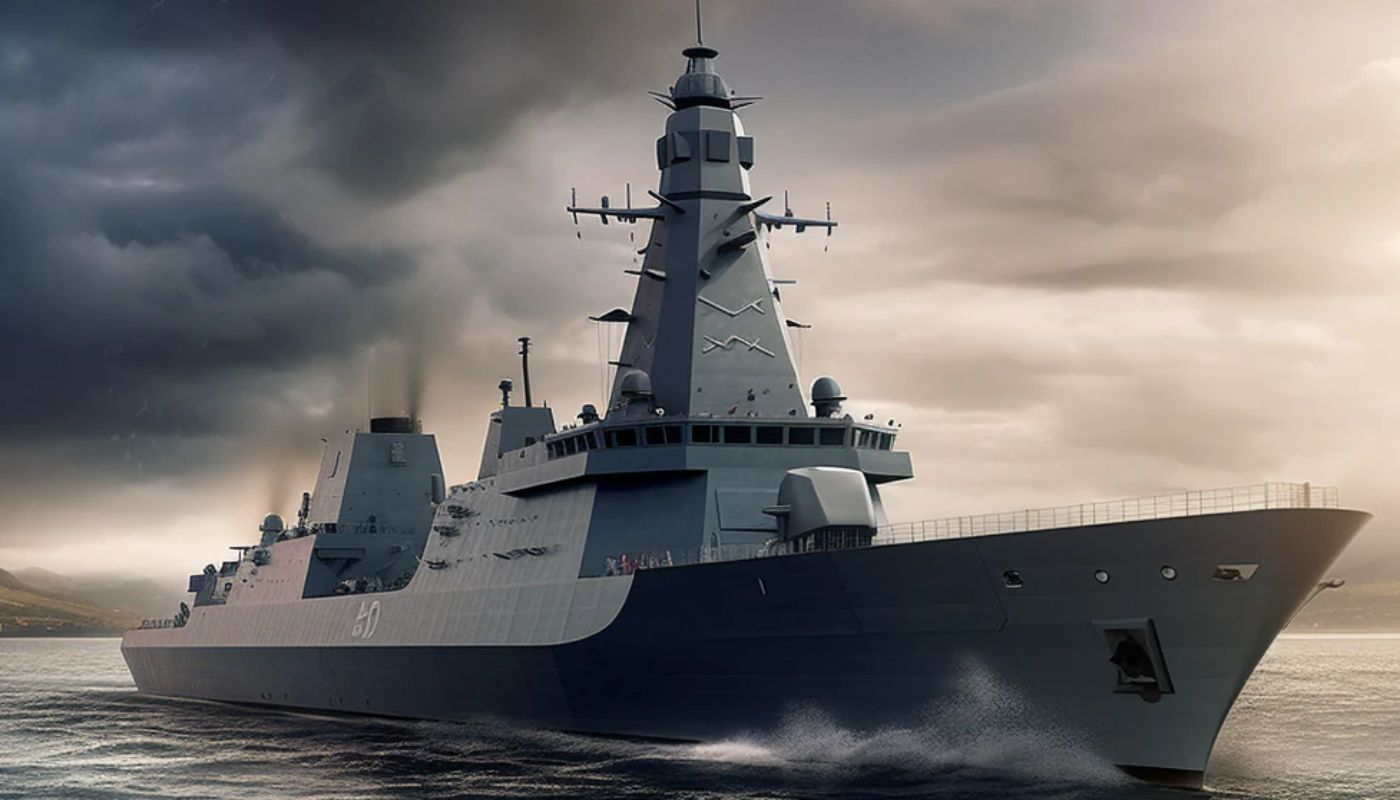
Great Britain has announced that the program of the new Type-83 destroyer has passed into the concept phase. The Type-83 will be at the center of the broader FADS (Future Air Dominance System) program which will replace the existing MADC (Maritime Air Defense Capability) system based on the Type-45 destroyers. The design of the Type-83 has not been completed, as it is at a very early stage. However, the British Navy wants the ships to have leading anti-aircraft and anti-missile capabilities, but also to incorporate new capabilities, such as hypersonic missiles and a laser weapon. The main goal of the FADS program is to create an anti-aircraft and anti-missile umbrella, through the networking of land, naval and air assets. Within this umbrella, the British Armed Forces will be able to operate safely. The Type-83 was first mentioned in March 2021, by the British Ministry of Defense, as a new destroyer design that will replace the Type-45s in the late 2030s.
According to the current Royal Navy planning, announced in January 2024, the sixth and final Type-45 will be retired from service at the end of 2038, at the age of 25 years (the Type-45 entered service in the period 2009-2013). It should be noted that the initial plan called for the construction of 12 Type-45s, to replace the Type-42s, but in the end their number was reduced by half. Based on the retirement limit of 25 years of service, the first Type-45 should be retired in 2034, as it entered service in 2009. If the first Type-83 enters service in the late 2030s, then there is a serious operational gap, from 2034 to 2038, when the Type-45s will be retired without being replaced by a new ship. In order to avoid an operational gap, either the Type-45s should remain in service beyond 25 years or the Type-83s should enter service sooner. As for the number of Type-83s, the maximum desired number of ships is six, but it is not excluded that four will be built, as a decision has not yet been made.
As for the basic sizes of the ships, the Type-83s will have a displacement of around 10,000 tons and a length of 170-180 meters. The configuration of the ships, in terms of sensors and weapons, has not yet been decided, but will follow the configuration of the Type-45s with an emphasis on increasing capabilities. Given the choice of the American vertical launchers Mk.41 VLS (Vertical Launch Systems) on the new Type-26 and Type-31 frigates, it is estimated that the Type-83 will also incorporate Mk.41, compared to the European Sylver which incorporates the Type-45. The Mk.41 can launch anti-aircraft and anti-missile missiles of the Standard Missile (SM) family, shorter-range RIM-162 ESSM (Evolved Sea Sparrow Missile), in quads in each cell, as well as BGM-109 Tomahawk land-based missiles. The Mk.41 can also launch the British CAMM (Common Anti-air Modular Missile) family of missiles and the FC/ASW (Future Cruise/Anti-Ship Weapon) missiles under development against land and naval targets, which are being developed jointly by Great Britain, France and Italy.
As for the number of cells, the most likely minimum number of cells will be 72. Today, the Type-45s incorporate 48 Sylver cells to which another 24 will be added, as part of the mid-life upgrade program of the ships. The 48 cells of the initial configuration use Aster-15/30 missiles, while the additional 24 cells will use CAMM (Sea Ceptor) missiles. It is not excluded that the British Navy may choose to install more than 72 cells for greater firepower. The projected displacement of the ships, namely 10,000 tons, allows this. As for the anti-ship missiles, the most likely option is 8-16 NSM (Naval Strike Missile), which have been selected as replacements for the RGM-84 Harpoon of the Type-23 frigates. What is certain is that the Type-83 will incorporate a laser weapon, most likely the Dragon Fire, which is currently under development and is expected to enter service in 2027. The main gun of the Type-83 is expected to be the BAE Systems Mk.45, 127/62 mm, while the installation of other guns and machine guns of various calibers, as well as close-in missile defense systems, is not ruled out.
In the design of the Type-83, special emphasis will be placed on reducing the ship’s footprint. This will be done both at the hull and superstructure design level (construction material, inclination angles, etc.), and at the propulsion level (reduction of acoustic footprint). In any case, it has been announced that the Type-83 will incorporate a conventional propulsion system and will not be nuclear-powered ships. The most likely propulsion combination for the Type-83 is expected to be a Rolls-Royce MT30 turbofan engine, German MTU diesel engines and electric motors, i.e. a CODLAG (Combined Diesel-Electric and Gas) combination, which has been selected for the Type-26 frigates. As for the main sensors, the choices are between British systems or American ones. Currently, the Type-45 and Type-26 incorporate the Type-1045/1046 (SAMPSON) and Type-997 Artisan radars respectively. The Type-1045 and Type-1046 radars are of AESA (Active Electronically Scanning Array) technology and constitute an alternative to the Type-83, probably in a newer and more capable version. The American systems that could be integrated into the Type-83 are the Aegis battle management system and the AN/SPY-6(v) radar, of AESA technology.
