




The destruction of Poland in just 15 days alarmed the Western Allies. However, they themselves had done nothing substantial to relieve their hard-pressed ally. In the period from the occupation of Poland to the attack on the West, that is, from the end of September 1939 to May 10, 1940, there was relative calm on the Western Front. Only in the air was there activity.
The first dogfights
In one of the first dogfights, on September 8, 1939, 4 Me 109s engaged French Hawk 75s. The French prevailed and even shot down the aircraft of Melders, the top ace of the Condor Legion. Melders managed to make a forced landing and was slightly injured.
On the same day, the first Me 109 shot down on the Western Front was achieved, when Lieutenant Colonel Gubrod shot down a French reconnaissance aircraft.
This was followed, also on 8 September, by four more victories for German fighters.
On 20 September, Melders was in the air again. In a dogfight with French Hawk 75s, he shot down two of them. 20 September is also memorable because on that day the first RAF aircraft of World War II were shot down. They were two Fairey Battles of 88 Squadron.
On the 25th of the same month, one of the greatest German aces, Heinz Bahr (220 victories in total) achieved his first shot down. On the last day of September, the largest air battle to date took place between two German fighter squadrons and British squadrons. The Germans shot down 13 enemy aircraft, losing 4 of their own.
In October, weather conditions limited air activity. However, on 6 November, one of the most serious air battles to date took place in the Saar region. German observers spotted 10 French aircraft flying over the area.
27 Me 109 Ds immediately took off, led by Lieutenant Colonel Gentsen, the leading German fighter in Poland.
The German pilots gained altitude without being noticed and attacked their opponents – 9 Hawk 75s and one Potez 63. Despite their height advantage and their superiority of 3 to 1, the Germans were soundly defeated. Four German fighters were shot down and four more were forced to make emergency landings due to the hits they had received. Only Gensen managed to shoot down a French fighter.
It is worth noting that the French pilots, in 1940, achieved 2/3 of their downings with the American Curtis Hawk 75 fighter. As for Gensen, he would achieve one more downing – reaching 9 – before being killed on May 26.
In those same days of the “phone war”, Lieutenant Commander Helmut Wieck, who was to become a great Luftwaffe ace, achieved his first downing. Here is how he described his experience in the German magazine of the time, “Der Adler” (“The Eagle”): “Since the French did not cross the German border often, my “second” and I decided to visit them for once.
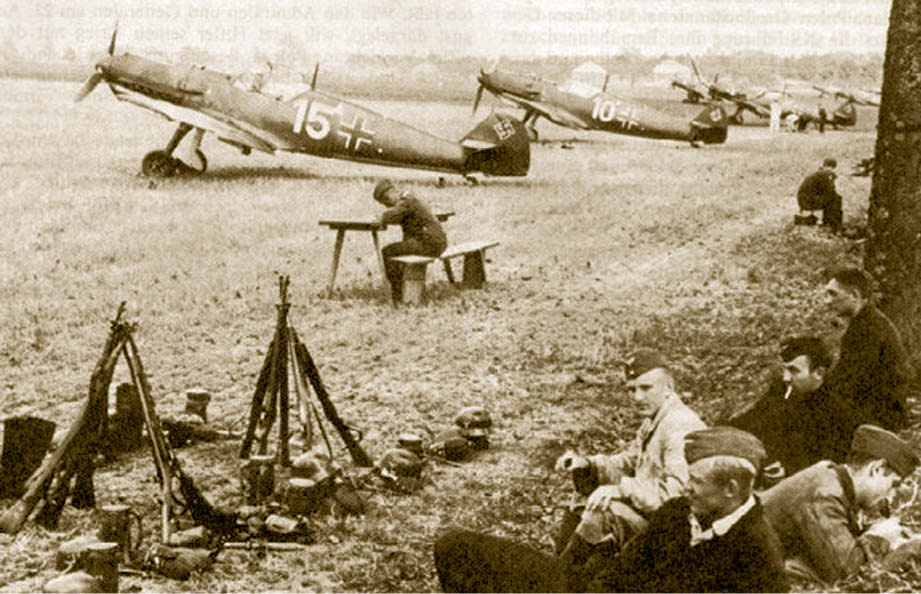
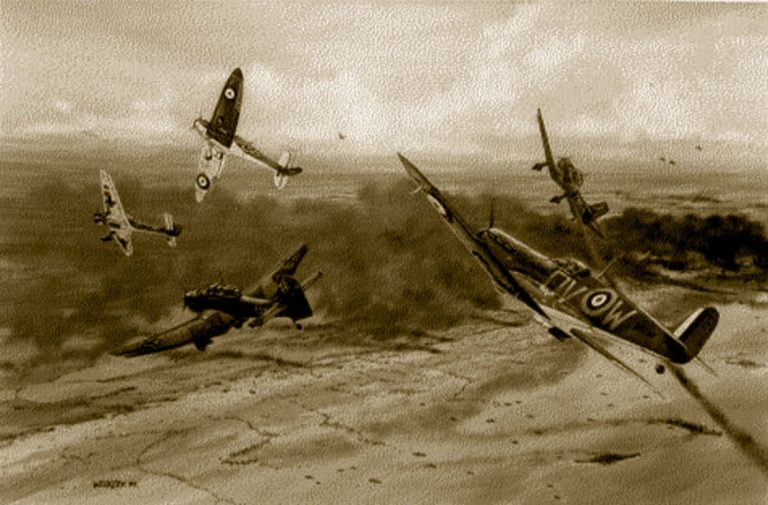
The wind was pushing us west. Near Nancy we spotted a formation at about 6,000 meters. We realized they were not German. Suddenly two of them broke away from the formation and rushed at us. They were Curtis (Hawk 75).
We dived, and the French followed us. I made an upward turn with the one Frenchman pinned to my tail. I remember that I could make out his tricolor when I looked behind me. At first I was rather surprised by the sight, as the Frenchman was throwing everything he had at me.
But when I realized that someone was following me and shooting at me, I felt bad. I pushed the stick and dived away from him, thanks to my superior speed. Then I looked for him. He was nowhere to be seen. Instead, I saw four Curtiss attacking me to my right.
Small red flashes stood out. A stupid question arose in my mind: was it permissible to shoot at me like this? But then I gathered my wits. Would I try to escape again? No! It was time to hit them. One of them dived right in front of me. I tilted the stick to the right and followed him.
The second was behind me and the others on top of me. I maneuvered skillfully until I brought him into my sights. I aimed and pressed the button on my machine guns, as I had been trained.
With the first shots, I saw pieces of metal detach from his plane. Then both wings detached.
Very close to my tail, the fourth Curtis charged at me, without hitting me. The other two were gaining height to attack me again. I moved away, as my aircraft was running out of fuel.”
On 22 December it was Melders’ turn to strike again. While patrolling with Lieutenant von Hahn, they spotted three enemy fighters. Having the advantage of height, Melders and Hahn executed a dive and passed at high speed over the enemy, their guns firing furiously. Two Hurricanes of 73 Squadron were their victims.
Weather conditions significantly limited air activity until March 1940. Even then, however, action was limited, since Hitler did not allow serious air action to be taken in the West. Thus, fighter patrols and reconnaissance flights were mainly carried out, for the purpose of covering or intercepting which some skirmishes occurred.
Since mid-October, Hitler had been demanding that his staff launch an attack on France. Fortunately for him, bad weather prevented this, giving Manstein time to work out the famous Ardennes plan.
On January 10, a small German Me 108 aircraft crashed in bad weather on Belgian soil. One of the passengers, Major Rheinberger, was carrying secret instructions regarding the impending German attack on France, Belgium and the Netherlands.
The Belgians arrested the careless Germans and confiscated the documents, some of which they had managed to destroy.
Hitler was very upset, and not unreasonably so, when he learned the news the next day. He almost went so far as to dismiss Göring from his duties. The one who was finally relieved was the commander of the 2nd Air Fleet, Wing Commander Felmi. In his place was placed an acquaintance from Poland, Albert Kässerling.
As the German leadership settled on the final plan for an attack on the West, the Luftwaffe was also preparing, assuming its now familiar role, that of direct support for the ground forces.
Air assault
The attack against the Western Allies would begin on May 10, 1940. It would be supported from the air by the 2nd and 3rd Air Fleets, under Kässerling and Speerle respectively.
Kösserling was tasked with supporting Army Group B and had the 1st and 4th Air Corps, as well as the Airborne Corps, under Student, which was to play a catalytic role in the operations.
Speerle’s forces would operate on a more extensive front, providing support to Army Group A – which would deliver the main blow to the enemy – but also supporting Army Group C. Each air fleet was also allocated an anti-aircraft corps.
The two air fleets had a total of 1,120 He 111, Do 17 and Ju 88 bombers, 324 Ju 87 dive bombers, 42 Hs 123 biplane dive bombers, 1,106 Me 109 fighters, 248 Me 110 fighters, about 600 reconnaissance aircraft and about 500 transport aircraft.
On the other hand, the Allies had 1,151 fighters and 1,045 bombers and attack aircraft – British, French, Dutch and Belgian. Another 1,200 RAF aircraft were stationed in England and played little part in the so-called Battle of France, despite the appeals of the French to their British allies.
The Western Allies were therefore both numerically and qualitatively inferior to the Luftwaffe. Of the French fighters, only the Hawk 75 and the D 520 were capable of opposing the German Me 109.
The Dutch Air Force had only about 50 combat-worthy fighters – see below – and the Belgian Air Force had a few Hurricanes – the only ones capable of fighting the Me 109 – as well as a few Gladiator and Fiat 42 biplanes. The RAF had almost completely re-equipped its fighter squadrons with Hurricanes and the first newly built Spitfires.
However, in addition to their superiority in means and materials, the Germans had taken care to create a legend around the Luftwaffe. It was not only its achievements in Poland that Goebbels exaggerated.
It was not the “dangerous Luftwaffe” of 1935-36 and the exploits of the “Condor” Legion. It was Milch’s inventive mind that had engendered a subconscious terror of the Luftwaffe in the Allied leadership.
In 1938, Milch had invited the head of the French Air Force, Wing Commander Vuillamin, to an official visit. Together with Udinet, the former World War I ace and head of the Luftwaffe aircraft production office, they decided to “drive” the Frenchman crazy.
They took him to dozens of airfields, showed him hundreds of aircraft, the same ones, which were transferred from airfield to airfield every night, and on which the code numbers changed!
They also convinced him that they had “super fighters”. These were the He 100 and He 112. Of the He 100s, only 21 were built (6 were given to the Soviets, 3 to the Japanese and 12 formed a self-defense squadron of the Heinkel factories).
Also, very few He 112s were built, and they were given to Spain and Romania – and very few were given to the Japanese Navy. It was the biggest “bluff” of the century, since the French leader believed that the Germans had incomparable superior weapons.
This of course had a negative impact on the morale of the French leadership when the battle really began. Shortly before 6:00 a.m. on May 10, the sky was filled with planes. More than 300 He 111s and Do 17s were heading, like a huge aerial armada, towards Dutch, Belgian and French airfields.
At the same time, the Panzers began to invade the “impenetrable”, according to the French leadership, Ardennes, covered by hundreds of Stukas and dozens of Hs 123s, which in turn were covered by hundreds of Me 109s and Me 110s. The main French bases in Dijon, Lyon, Metz, Nancy, were bombed fiercely.
Over the next three critical days, in the selected sectors of the German armored wedges, in Dinan and Sedan, fierce air battles were fought.
In Sedan especially, at the crossing point of the Meuse River, on a front of 1,200 meters, the Luftwaffe supported the attack of Guderian’s Panzer divisions with Richthofen’s entire 8th Air Corps.
Two artillery regiments would complete the preparation.
The sensitive sector of Sedan was held by two reserve French infantry divisions of type B, reinforced by 150 field guns.
The French divisions held positions on the south bank of the river, while their artillery was positioned a little further back.
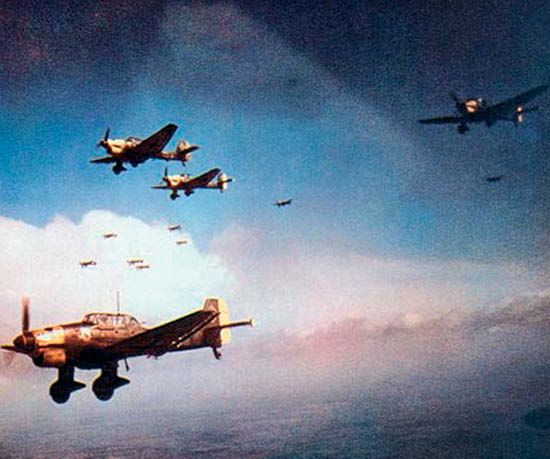
The morning of May 13 was to remain unforgettable for the French. More than 200 Stukas filled the sky. The German artillery opened fire, only to be met by a response from the French.
But the Stukas were lurking. As soon as the French gun positions were located, one after the other the German “birds” began to sink, their sirens producing a demonic noise, flock after flock.
At 500 meters from the ground, they would drop their deadly cargo and, after almost “shaving” the ground, would rise again. Each dive was followed by a terrifying explosion.
The French artillery horses went berserk and ran wildly. The gunners held their composure for a while.
But when they saw other swarms charging, and then another and another, the French reserves simply could not stand it. Their morale was shattered.
Most of their guns remained intact.
They were too well modified to be seen, but they themselves had no desire to serve them anymore. The same pandemonium prevailed on the banks of the river. Dozens of French machine guns literally disappeared. Bombs, sirens, shells, and in the distance the rubber boats in which the German armored grenadiers were coming at them, crossing the river.
The situation was too difficult for them to endure. In most cases, the French simply fled, exhausted by the constant blows. Of course, some heroes defended themselves to the last. But without the cover of their artillery, they had no hope.
Unperturbed by fire, the German tanks descended to the north bank and easily fired direct shots at the French machine guns that were still holding out.
But the nightmare was not over. Richthofen’s Stukas returned to their bases for refueling, but were replaced by Me 109 fighters and bombers of all types.
The German grenadiers took the opportunity and bridged the Meuse River, crossing their tanks to the south bank.
French and British bombers attempted to destroy the German bridges, but were decimated.
It is indicated that the British bomber force in France numbered 135 Blenheims and Battles on 12 May. On the 14th of the same month, 112 of these aircraft had 109 and 110 He 11 and Do 17 bombers. But the Stukas soon returned and continued their work.
By evening, the two French divisions no longer existed. Thirty thousand men and 150 guns had been deleted from the battle formation of the French Army.
The worst thing was that the fleeing French transmitted the panic that had seized them to other units that came to reinforce them. In total, in the Sedan sector, German aircraft flew 814 sorties on May 14, shooting down more than 90 British and French aircraft. The rest were shot down by anti-aircraft guns.
May 14 was called “fighter pilot day” by German pilots.
Not without reason, the next day, French Prime Minister Paul Reynaud called Churchill, shouting: “We have been defeated. We have lost the battle of Sedan.”
Churchill attributed the Frenchman’s behavior to the French… temperament. And yet, Reynaud was absolutely right.
Combined with the armoured divisions at Namur and Dinan, the Battle of France was lost, just three days after it began, to the sound of Stukas. From then on, all French attempts to reverse the situation were doomed, although they had fought heroically on many occasions.
It was France’s death knell. From the Ardennes, German Panzers poured into the exposed right flank of the fighting Allied armies.
On 24 May, Guderian was at Boulogne on the Atlantic coast. More than 30 Allied divisions were surrounded.
On 14 May, another event occurred that shook the British-French alliance. The head of the British pursuit, Wing Commander Dowding, after a stormy meeting, prevented Churchill from sending additional British fighter planes to France.
This decision essentially acknowledged, despite Churchill’s “dramatic” appeals, that the French had indeed already been defeated. But the same had happened to the RAF. Within the first five days of the German attack, the British air force in France had lost 247 aircraft of all types (86 Battle, 81 Blenheim, 9 Lysander, 71 Hurricane and Gladiator).
After this, the RAF effectively withdrew from the Battle of France. It carried out isolated raids from English bases, with meager and sometimes disastrous results for itself.
Meanwhile, the situation on the ground was now comically tragic for the French. German fighter planes landed at their new airfield, at Chauny le Petit.
It was an abandoned French airfield. The runway was full of debris. One of the pilots took 10 of his men with him and together they tried to move the debris and cut down some trees at the edge of the runway.
To their great surprise, they found a large group (over 200 people) of French soldiers on the edge of the small grove, whom they captured. Among the prisoners was a French lieutenant general and three major generals!
The Germans collected the machine guns of a destroyed French plane and, armed with them, led the French to the hangar, where they locked them up.
In another incident, the pilots of JG 77, as soon as they landed at their new airfield, were attacked by a detached French battalion. These “mistakes” were due to the rapid advance of the German armored forces, which left behind several pockets of resistance, which the following infantry would clear.
Meanwhile, in the air, the German pilots were operating almost unmolested, increasing their “scores”. Thus, on the afternoon of 17 May, Me 109s massacred a Blenheim Squadron. Of the 12 British bombers, only one returned! On the 20th, Melder achieved his 3rd “French” shot down, already reaching 27 in total. On 22 May, the last RAF planes left French territory. The next day, German fighters began their first engagements over the English Channel.
JG 27 Wing achieved 18 kills over the Dunkirk-Calais area on 23 May, losing three aircraft. Three kills that day were achieved by the Spanish veteran Balthazar. For this particular air battle, the first in which the Me 109s were involved “massively” with Spitfires, British sources report the shooting down of 6 German aircraft, with one loss of their own. However, it seems that the Germans were ultimately right.
The British, now defending the port of Dunkirk and the surrounding beachhead, threw the bulk of their fighter planes into the battle. Hitler’s decision to stop his tanks before they threw the British into the English Channel was disastrous. Göring’s boasting also played a role in his decision, who declared that the Luftwaffe was enough to annihilate the enemy beachhead.
On May 25, however, Balthasar shot down two more Spitfires. The next day, five more Spitfires were shot down over Dunkirk. But Melders was not slow either. Between 21 and 26 May he shot down seven more enemy aircraft – two French Hawk 75s at the same time – reaching 20 victories in France. He was awarded the Knight’s Cross, as he was the first to reach this number of victories.
Major air battles took place daily over Dunkirk. Between 28 and 29 May, 63 British and two French fighter planes were shot down over Dunkirk. Despite the sacrifices, however, the evacuation of 340,000 Allied troops was achieved.
The battles of Dunkirk cost the Luftwaffe 240 aircraft of all types. Accordingly, the RAF lost 180 and the French Air Force around 200.
The final phase of the battle
The German Army, immediately after the evacuation of Dunkirk, had already begun to take up positions on the north bank of the Somme River, from the sea to the plain of Campania. The remnants of the French Army had also taken up positions on the opposite bank, awaiting the attack and hoping for a miracle.
The French Army had lost, in the first phase of the operations, almost 1/3 of its original strength and almost all of its large armored units. The Air Force, especially the Bomber Air Force, had also suffered a terrible hemorrhage. The Germans, on the other hand, were ready to attack with a numerical superiority of about 2 to 1. In the air, the Luftwaffe dominated.
On June 3, Operation Paula was launched, which involved bombing airfields, infrastructure, factories and installations in the greater Paris area. In the first phase, more than 500 German aircraft were used.
The damage to the French was heavy. 13 airfields, 22 railway stations and 15 factories were damaged. Sixteen aircraft were destroyed on the ground and about 900 people were killed or wounded. The French Air Force responded with honor, and the last major air battles of the Battle of France took place. Melders achieved two more victories and Galland his 12th victory.
On June 5, air battles resumed on the Somme front. Melders shot down two more French aircraft, returned to base, refueled, and went out again to “hunt.” He spotted six French fighters near Compiègne. Before he could attack, however, another German squadron rushed at the French, opening fire from a great distance, to no avail. The French responded immediately, and a fierce dogfight ensued.
“I watched the battle for a while and immediately attacked a Moran, which was being pursued unsuccessfully by three other Me 109s. I soon had it in my sights. It immediately “dipped” and I lost it. Suddenly, there it was again. It was shooting. Finally, this Moran was shooting too. I “broke” high, towards the sun. It must have missed me, since it had “broke” in the other direction and disappeared to the south. Below, two Me 109s were chasing the last Moran.
I saw the sky full of our fighters. I was flying at 800 meters. Suddenly, an explosion. Pieces of metal were flying into the cockpit. The aircraft was out of control. I was falling vertically. I had to get out, or it was all over. I pressed the ejection lever and the canopy flew away. My faithful “bird” raised its nose upwards and gave me my last chance to leave the seat. Free.”
This is how Melders, the top German ace, described his downing.
Moran’s fire was not misdirected, as he believed. The pilot who shot him down was the French Lieutenant Pomier-Lairaz. The Frenchman shot down another Me 109 before his plane fell to the ground in flames. Melders had underestimated the French pilot and, most importantly, had mistakenly underestimated his plane, which was not, as he thought, an Ms 406, but one of the new D 520s.
Balthazar also distinguished himself in the same battles, who on June 5 shot down five French fighters, out of a total of 22 shot down that day by his colleagues from JG 27. He thus reached 23 kills and was awarded the Knight’s Cross. He was the second pilot to receive this decoration.
It is worth noting that Balthazar had also destroyed 13 additional enemy aircraft on the ground, but these were not credited to him as kills. He nevertheless received the informal title of the most successful German fighter in the Battle of France.
However, the battle was not over yet. The French, after the Meuse fiasco, fought brilliantly on the Somme and in Campania, on land and in the air. However, they were unable to counter the German attacks. France’s agony lasted until June 25, when the armistice was signed.
In the 15 days that passed between the break of the French lines on the Somme and the end of hostilities, the French Air Force carried out a fairly successful aerial stealth war, with all the aircraft it had available. This included the raid by a single French Farman 223 bomber on Berlin!
The Battle of France was over. The Luftwaffe had triumphed. The numbers speak for themselves. The French Air Force had lost more than 900 aircraft since May 10. The RAF, even worse, had lost more than 1,000.
The Dutch and Belgian Air Forces – with about 400 aircraft in total – had been completely annihilated. In contrast, the Luftwaffe reported the loss of 534 aircraft, a rather small number.
In reality, German losses amounted to 1,389 aircraft. Of these, 551 were bombers, 122 Stukas, 367 fighters, 213 transports and 160 reconnaissance aircraft, military cooperation.
As for the Luftwaffe aces, the two leading figures in this great victory, Melders and Balthazar, met ignominious ends.
The former was killed in an accident when the transport that carried him to Germany on leave crashed, and the latter was killed in the Battle of Britain, not by enemy fire, but because the wing of his aircraft was detached during a very tight turn.
Both were knights of the air, imbued with the spirit of the “flying circus” of the great Manfred von Richthofen.
According to his last wish, Balthazar’s body was buried in the French city of Abbévig, next to the grave of his father, a captain in the Imperial German Army, who had been killed there in 1915. He had achieved 40 victories.


