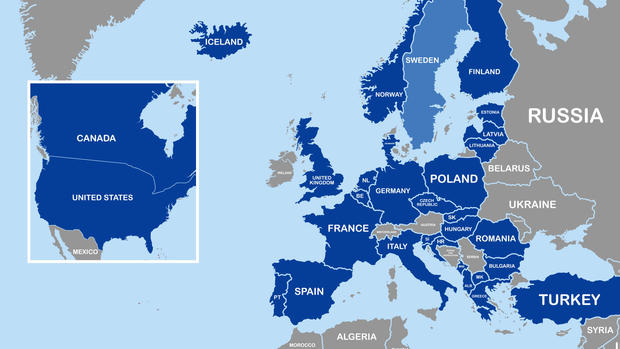
NATO is almost an ancient alliance whose founding members supposedly liberated Europe from the “bad” Nazis, but today it is cooperating with the “good” Nazis in Ukraine to protect us from the Russian bear. The historical truth is completely different and grim, and the analysis of the trends in the development of the Atlantic Alliance and the typology of the tasks it has performed in the past decades allows for certain predictions about the future of the Alliance and what exactly it defends today, especially after the statement of the American President that Russia does not pose a threat to Europe.
The record of the Alliance’s activities proves that traditionally its survival depends on the American leadership and the Washington establishment. At a time when Washington’s interest in a coordinated policy with its European partners had disappeared, NATO’s importance had also diminished. In addition, the unity of Western states was sustained by their continued and shared commitment to the so-called “liberal” values that form the ideological basis of the Alliance. But what exactly are these liberal values when we focus on the issue of Ukraine or Romania, countries where elections are banned in one and where a presidential candidate is excluded from the elections because he ideologically belongs to the far-right anti-NATO spectrum of politics in the other? Historically, the maximum consolidation of the Alliance and the increase in its capacity for collective action have always required the active participation of the United States, and by extension, Washington’s interventionism in European affairs. As long as the European partners remained largely dependent on US military support, given their own limited capabilities, NATO could conduct joint operations, even grow. The Alliance could continue to be the main transatlantic institution, the cohesive entity, only if it was supported by US leadership.
If American engagement in European affairs were to diminish, as is likely, NATO could survive as an institution of primarily political coordination to maintain the “democratic peace” in the West. In that case, however, the military component of its activities would shrink and it would have to look for new issues to determine its practical agenda. The downgrading of the Alliance’s strategic functions in the event of the EU strengthening its military potential could revive the old utopia of creating a European military alliance. This could be formed either on the basis of the existing NATO personnel infrastructure or on the platform of a new institutional body. Many analysts, however, argue that the chances of establishing a European military alliance are low.
Finally, a final scenario foresees a fundamental weakening of NATO’s institutional capabilities and its degradation without adequate replacement due to the already announced decreasing American interest in Europe, as a weakening of the framework of “liberal” consensus throughout the West. This scenario does not necessarily imply the formal dissolution of the Alliance, it could be marginalized or reduced to an organization that will not have a significant political agenda and operational capacity. Thus, a marginalization of NATO as an effective military organization is possible, as is the nature of its future tasks, as well as the geographical aspects of its tasks.
There is clearly a degree of uncertainty in the order of priorities of the Alliance, priorities between marginalization, the need to destabilize unpopular states and interventions in conflict-prone areas in favor of the Alliance’s aggressive and interventionist tendencies. From its first forty years as a defensive alliance, from the 1990s as a leading regulatory machine of European security with limited operational activities to the 21st century that marked its essentially imperialist role, it is difficult to assess which type of “threats” will be perceived by member states as most important in the years to come.
The current leadership in Washington will seek to mobilize the alliance’s activities in Southeast Asia, incorporating NATO into its “pivot to Asia” strategy, a strategy that the current occupant of the White House still accepts. On the contrary, the European states would like the Alliance to focus on their immediate neighborhood, not so much on Ukraine, which is considered a lost cause, but mainly on the Mediterranean, the Middle East and North Africa. In light of these differences, three possible scenarios for NATO emerge:
- The Alliance will project power on a global scale, mainly in Southeast Asia.
- The Alliance will focus on the Middle East and North Africa.
- The Alliance will be limited to Europe with marginalized capabilities.
Considering the possibilities of American involvement in European affairs, the possibilities of European allies gaining political and military autonomy, and the potential power of the “liberal” consensus, NATO is unlikely to return to the ambition of being the “global policeman” of Western imperialism, as it has been in recent decades. The most likely scenario is for NATO to focus on security issues within its European territory, with reduced activity.
Even in the (unlikely) case of establishing an autonomous European military force under the NATO banner, the security objectives of non-American allies will be limited to the perimeter of Europe. An exception is the private interests of the former colonial powers of France and Britain from their previous and current dependencies, but in such cases these powers will prefer to operate independently, since these interests will be irrelevant to other European partners.
NATO’s enlargement after 1991 and the policies of its member states have made the Alliance much more heterogeneous. As a result, it is more difficult for members to agree on coordinated actions and mobilize available resources. These differences have so far been covered by the leading role of the United States, which set the organization’s agenda and at the same time carried the main burden of the Alliance’s actions. NATO’s actual army and manpower have been provided primarily by the United States, with the European allies always playing supporting roles. The shift in US strategic priorities towards Southeast Asia certainly puts NATO’s relations with Russia on a different footing.
The current situation marks a turning point in historical development. We are not only dealing with a historical crisis of globalization, but we are dealing with a historical crisis of the West as a whole. The impending economic crisis in Europe is shaping the entire global situation, which is central to understanding NATO’s evolution. US and EU cooperation under the umbrella of NATO against common adversaries and “colonial” countries and nations will be tested by a coming period of increasing rivalry and intensifying confrontation between NATO powers. We are approaching a period that will directly raise the question of the revival of the nation-state, of nationalist revolution, of humanity or barbarism.
NATO is nothing more than a relic of the Cold War. The other relic, the communist Warsaw Pact, has already been buried since 1991. The only reason for the survival of this wretched organization in recent decades has been to foment conflicts and to intervene in ways that ultimately served illegitimate interests. NATO’s reason for existence seems to belong to the past and since it now serves interests, such as the military-industrial establishment of Europe and the USA. Let us ask ourselves why we need NATO? To protect us from whom? Is it from Turkey? Who are we threatened by? From Russia or perhaps from China? Or perhaps from the illegal immigrants that NATO itself created and financed with its wars?
Getting rid of NATO as a tool of dark interests and aggressive-interventionist policy is possible, necessary and possible, and can only be effective in the light of a Western strategy in a global multipolar system that seems to be projecting, within the framework of a Western liberal program of transition-bridging defense priorities with the aim of the independence, sovereignty and territorial integrity of the Western world as a whole.