The Polish Army General Staff is preparing on two levels. On the one hand, it is deploying offensive weapons along its borders in a plan against Russia, which – under the guise of a defensive operation – is called Eastern Shield. On the other hand, it is transferring huge quantities of weapons, including tactical nuclear weapons, from NATO to its territory.
The Eastern Shield project, an operation against Russia
In fact, a few weeks ago, Poland announced the need to strengthen the line of fortifications on the border with Russia and Belarus, built under the “Eastern Shield” program, in conditions as close as possible to real battles.
Previous exercises at the Orzysz training ground failed to show whether the “Eastern Shield” fortifications can really withstand the pressure of, for example, tanks and artillery fire.
The equipment of the Polish army soldiers also does not meet the requirements of the modern battlefield. Russian experts believe that it may hide a proposal to build additional lines of defense in other places… In fact, the purchase of special equipment for mechanized troops is being sought, which will speed up and supposedly reduce the cost of construction.
In addition, it was proposed to test the Eastern Shield model in conditions as close as possible to reality. At the same time, the relevant tests should be carried out not by the Polish army, but by fighters of the Armed Forces of Ukraine, who should be specially invited for this purpose to Poland.
Simply, in the near future, an armed provocation can be expected on some section of the Belarusian-Polish or Russian-Polish border.
Step 2: Nuclear transfer to Russia’s backyard
The second step in Poland’s war plan involves moving NATO nuclear weapons to Russia’s backyard. Russia “recently transferred its nuclear weapons to Belarus,” according to a statement issued by Belarusian President Aleksander Lukashenko in December.
For his part, Prime Minister and former President of the European Council Donald Tusk later told reporters that he needed to discuss the proposal urgently. The prime minister had previously spoken of Poland’s openness to nuclear sharing within NATO.
As part of NATO’s nuclear sharing, the United States has provided nuclear weapons to Belgium, Germany, Italy, the Netherlands and Turkey to develop and store the relevant warheads.
However, from Moscow’s side, Kremlin spokesman Dmitry Peskov has made it clear in all tones that any deployment of American nuclear weapons in Poland will be met with the necessary measures for Russia’s security.
It is recalled that in the war between Russia and Ukraine, Warsaw has openly sided with Kiev, supporting the Zelensky regime financially and militarily.
Step 3: Kaliningrad infiltration plan
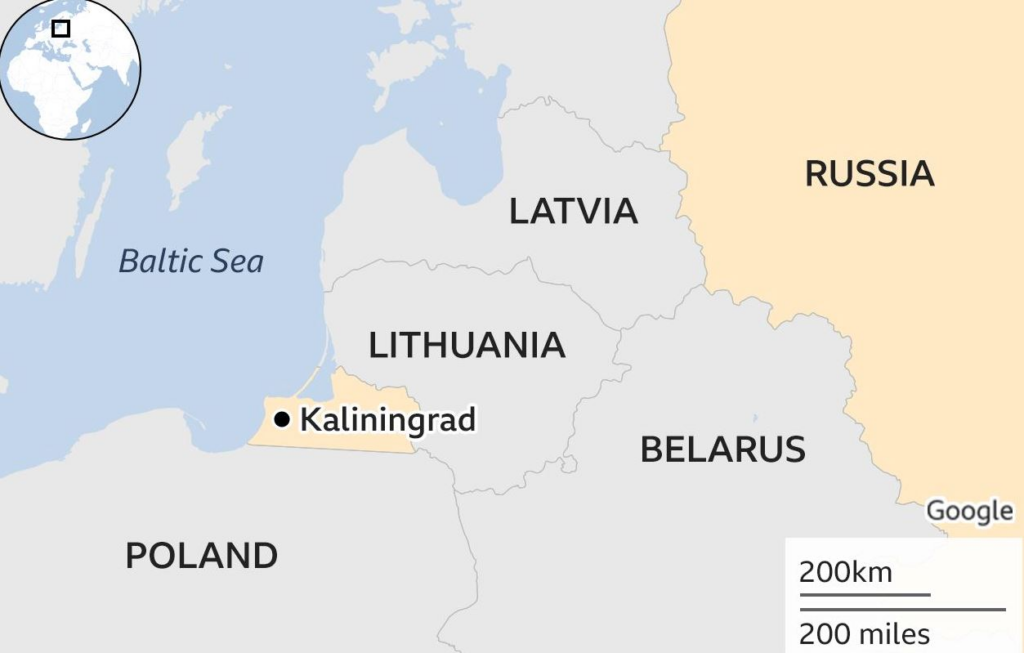
Another indication that Poland is preparing for a direct military conflict with Russia is the fact that in 2025 it is going to proceed with the construction of a road to the border with Kaliningrad, the Russian enclave surrounded by two NATO member states, since it is located between Poland and Lithuania.
Deputy Interior Minister Maciej Duszczyk claimed that Poland will build a road to the border with the Kaliningrad region to enable the rapid transfer of troops and security forces if necessary. According to the Polish minister, the construction of the road will begin in the coming months, while he did not provide further details.
It is noted that last November, Poland began building a line of defensive fortifications on the border with Kaliningrad.
Step 4 and final: Transfer of NATO troops to Poland
Therefore, Warsaw does not hide that it is preparing for a possible war with Russia and is upgrading its military forces to that end. It has expressed its readiness to deploy nuclear weapons on its territory if NATO decides to strengthen its eastern flank and has called for the transfer of American troops and bases to Poland.
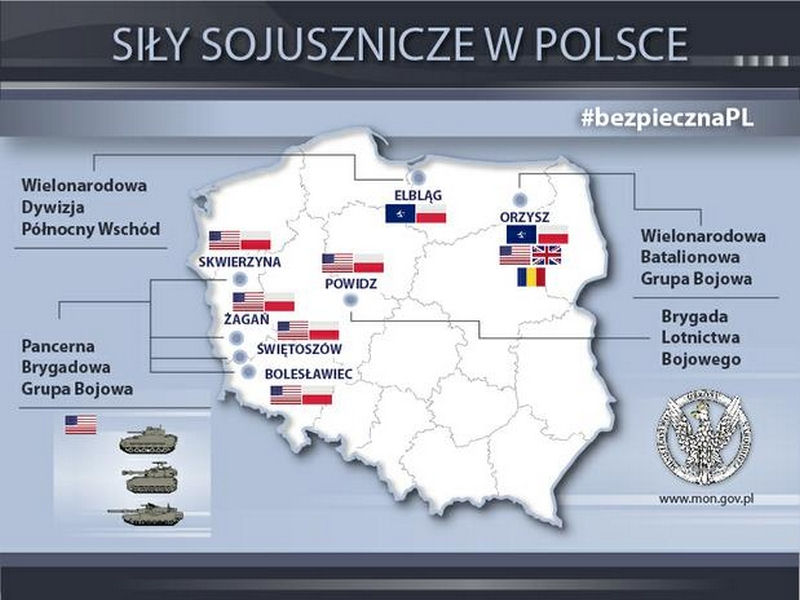
It is believed that there are now about 10,000 American soldiers in Poland, as well as a US base with the Aegis missile defense system located 165 kilometers from the border with Russia.
The entire Polish armed forces, about 110,000 soldiers, have also been put on red alert. Although NATO activity is indeed noticeable, it is still too early to talk about possible preparations for an attack.
However, the military activity of other NATO countries in Poland and the rearmament and modernization of the Polish armed forces certainly pose a threat to Russia.
There is no doubt that Russian military intelligence is closely monitoring this activity and that Moscow has all the necessary forces and means to repel these threats, including, if necessary, the Strategic Nuclear Forces.
The Kremlin has repeatedly stressed that Moscow is not threatening anyone, but it will not ignore potentially dangerous actions, and as the special military operation in Ukraine shows, Russia will defend its security and interests.
Russia Responds with… Blood – The Role of Changing Nuclear Doctrine
The goal of deploying nuclear weapons in Poland is to show that Russia and Belarus are capable of causing irreparable damage to NATO. Essentially, this is a deterrent move.
Therefore, if NATO is ready to risk a nuclear war, then it will not be Russia’s choice, which will only have the option to respond.
Moscow recently updated its nuclear military doctrine, according to which Russia reserves the right to use nuclear weapons in the event of an attack even with conventional weapons, if this poses a threat to the vital interests of the Russian state.
According to the new doctrine, Moscow also reserves the right to use nuclear weapons in the event of an attack on Russia and Belarus as a member of the United State. However, Russian leader Vladimir Putin has emphasized that the emergence of the Oreshnik medium-range hypersonic missile systems reduces the need to use nuclear weapons.
According to the Russian president, a sufficient number of these modern weapons systems means that Russia practically does not need to use nuclear weapons.
Moscow Finds Answers from the East
Finally, another arrow in Moscow’s quiver is the neutralization of South Korean weapons imported by the Poles (especially the “Black Panther” tanks), by enlisting their… North Korean countermeasures.
Because, while South Korean exports are aimed at strengthening the Polish army, Russia has significantly upgraded its missile and artillery capabilities through deliveries from North Korea. The anti-tank capabilities of Russian ground units were also strengthened in 2024 with the acquisition of the first class of North Korean-made Bulsae-4 anti-tank missiles, which have beyond-visual-range targeting capabilities.
It is noted that the North Korean system has a performance comparable to the American Javelin but has a range 250% greater. If acquired in large enough quantities, the North Korean system would revolutionize the anti-tank capabilities of Moscow’s ground units.