




One of the most repeated promises in Donald Trump’s 2024 election campaign was that he would “end the war in Ukraine within 24 hours.” But no one believed it to the letter, not even in his own Republican party, as it was understandable that it was typical Trumpian megalomania. But the message was clear: “I will try to end this particular war as quickly as possible.”
So this promise, completely respectable and commendable (the end of any war always becomes a universal demand after a certain period of time), ran into the purely geopolitical and practical question: “How will you end this war, in what context, with what goal”? Trump has not answered this question in his election campaign, but even today after a month in power as US president. It has not described a framework, it has not set a “red line”, it has not even clarified what the shape of post-war security in Eastern Europe will be.
What have we learned? Only some “negative” data. That is, in the name of realism, “there will be no demand for Ukraine to return to its original borders of 2014” (something that Ukraine itself has indirectly accepted since last year, so nothing different is being brought here). Also, through the mouth of US Vice President J.D. Vance, we learned that if peacekeeping forces are needed, they “will not be American” and that such a mission, if it occurs, “will not fall under NATO actions”.
And the above is respected, the USA is declaring what we already knew as the general perception of Trump: namely the partial return to its political disconnection from Europe, something we had first seen in 1823, with the Monroe Doctrine. That is, when the then US President James Monroe declared that “European interference in the events of North and South America” would not be accepted, implying, however, the opposite: that the newly formed USA would also have no role and say in what was happening on the “Old Continent”. Of course, at that time, it was the Europe of the great colonial powers, mainly Britain, France and Spain, that played a global role and with great interventionism, economic and military. So the young but already dynamic USA formulated this doctrine of isolationism, declaring the American continent as an “untouchable” by strong colonialism.
We return to the initial observation: The US tells us what it “won’t” do in Ukraine, but no one knows what it “will do”. The contradictions are even intensifying. A few days ago, Trump stated that the US, Russia, Ukraine “and others” will sit at the negotiating table. Yesterday we learned from Trump’s special envoy for Ukraine, Keith Kellogg, that “there will be no others” and that Europe will not have a presence, again in the “name of realism”.
At the same time, Vance told us that the security issues of Europe and Ukraine in particular concern Europe, which “must take charge of them,” but now for some mysterious reason, the security of Europe will be discussed with “Europe outside,” which will, however, be asked to pay the “costs of the ceremony.” The contradiction is obvious, even for the geopolitical lightness of the Trump administration.
What else do we know? That the US is claiming and even demanding a huge agreement to exploit Ukraine’s mineral wealth, because they have “valuable rare earths there,” worth, by an estimate, 500 billion dollars. And here is a significant contradiction, as if the US is attempting to collect such enormously valuable wealth, which they will probably secure with a colonial treaty, how is it possible that they will not impose their own security guarantees for this bloodletting, within Ukraine? Simply put, if Trumpian logic requires the friendly plunder of Ukraine in 80% of its territory (the other 20% has been undertaken to be plundered by Russia by occupying it), how will the “receipt” not be protected by the US itself? Will they entrust this huge “portfolio of values” to European states, which they clearly despise and consider weakened, as Mr. Vance told us? And for the decades that this extraction and exploitation will last? Or is Trump so naive to trust Moscow that it will not be bothered by such American expansion on its borders?
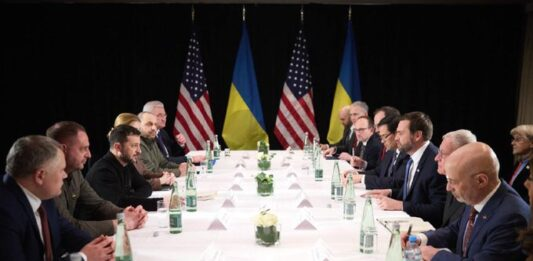
Let us recall here that a key element of the Russian argument for the invasion of Ukraine was that “we are afraid that Kiev will join NATO, so it will squeeze us even more”. So now they assume in the US that Russia will accept billions of dollars of American interests in Ukraine, massive exploitation of the country in both mineral wealth and agricultural production, plus a few thousand European soldiers as “peacekeeping forces” on its (new) borders? Won’t this be a “tightening” of Russia? Won’t it be an even greater threat, as Ukraine will now have become completely captive of NATO forces, albeit in their divided form? That is, the US in a domestic economic action and the European states in another action, that of military assurance? And with joint assurances, by the US and European states, that they will “enhance the reconstruction and improvement of the Ukrainian armed forces”?
Does anyone think these are scenarios that Putin will easily accept? That is, to keep the 20% of Ukraine that he already owns (through rivers of blood), but watch the other 80% become a “cheap shooting range, where foreign soldiers practice cursing.”
Again, the torrential speech of Mr. Vance, who arrived in Europe to reproach it for not having a “strong democracy”, coming from the USA, where it was again declared a few hours ago, through Trump’s mouth, that “anyone who saves the country does not violate any law”, (for more on the subject, please read the analysis entitled “Trump has gone “crazy” and is defying Justice itself!“), thus destroying – for the time being – the very concept of Western democracy.
So, in an interview in Munich, when asked about “how Trump will end the Ukraine war,” Mr. Vance replied that there are “many tools to pressure Russia, economically and militarily,” that “everything is on the table,” and that Trump “is a very capable negotiator, whether it’s real estate or international agreements.” At the same time, Trump, in response to a question from reporters, said that “it’s too early to say what will happen with the negotiation… Russia may make big concessions, it may not.”
A plan on kraft paper?
With all of the above, plus several similar vague, vague, partially or even completely contradictory statements, with no focus on the substance, for over a year on Trump’s part, even some basic terms and limits within which the negotiation on the Ukrainian issue will proceed, we will dare to state the (for us) obvious: There is no plan. There is no structured American proposal, or preliminary work, or a certain framework for action, based on a thorough geopolitical analysis.
On the contrary, and as usual for the Trump administration, the discussion about the future of Ukraine and European security in general will be “heated”, with a succession of vague threats and vague promises, using maximalist terms (“perfect peace, amazing future for Ukraine, there is no better deal, I am the best negotiator”), with a crude bargain and on-the-spot plans on paper, while the following 4 elements will dominate:
a) The negotiation will be completed at the Trump-Putin level, with the former coming forward with absolute confidence that whatever he is doing is “ideal”. However, he has already adopted many points of Putin’s formulations, either intentionally (e.g. to terrorize the Europeans, or to flatter his public that considers the war a “construction of the Democrats”) or because they have convinced him.
b) The discussion in which Ukraine will not participate (essentially, because at least this was partially clarified), but as it seems neither will Europe, will evolve with ignorance of local and regional security issues, so any conclusion it reaches has little chance of resolving them.
c) The negotiation will be carried out with the main objective of extracting the maximum possible benefit for the USA at the lowest possible cost, regardless of whether any agreement will have foundations for survival, whether it will essentially guarantee peace (with any compromises), whether it will establish a commonly accepted security environment. We are not talking here about any “justification” of Kiev or anything related, but at least the effort to ensure that there is a lasting end to the war.
d) The negotiation will primarily be “sold” within the USA, that is, where Trump draws his political power. So that a media “Roman triumph” of the returning Caesar-soldier who… subdued the Goths can follow.
Is the above ultimately a “framework” for peace in Ukraine? If one looks at it cynically, yes, of course it is. And in themselves they may constitute a “plan”. So, we assume that the US will impose, “spatially” pushing aside everyone, a tentative peace in Ukraine, extracting what they can for their own benefit, while leaving the “final solution” to be given either in a new round of war in a few years, where of course they have warned (Europe) from now on, that “this will be your problem”, or in a political dissolution of Ukraine, where if it collapses, it will simply be divided among every “interested party”.
Is Trump like that, a “great negotiator”? Why not, History will answer. We have clearly seen worse, from the 1919 Versailles peace treaty for World War I, which laid – in its short-sighted logic – the foundations for World War II, or the 1973 Paris peace treaty for Vietnam, which simply offered North Vietnam the “permission” to conquer the disintegrating South Vietnam. Even the Abraham Accords, which are – rightly and positively credited – to Trump, for the rapprochement of Israel and the Arab Gulf states, showed their great deficit, as they attempted to “solve the Middle East without solving the Palestinian issue”. And we have seen the tragic results, which are not entirely due to Trump’s perception, but somehow stem from his pompous geopolitical amateurism.
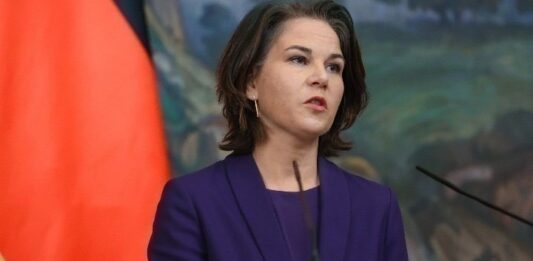
There are no plans, but the “building” is being built
To accurately weigh the situation. If Trump does not have a comprehensive and long-term plan, do the Europeans have one? The answer is obvious here too. Neither. So to some extent we will recognize the “right to gloat” in every follower of either Putin’s bulimia or the ultra-conservative analysis, which sees the problem of “woke-ism” as the most serious today, while failing to distinguish the general impoverishment, the establishment of inequality, the undermining of the rule of law, the annulment of social contracts, where both the “internationalist left” and the “nationalist right” cunningly converge.
So Europe initially approached the Ukrainian issue with intensity and position – and it did well, not because there was some magical “right side of history”, but because it simply could not tolerate, for the first time in the post-war period on the continent, a massive invasion and border change by an imperialist superpower. But after 3 years of war, neither France, nor Italy, nor Germany, nor Britain, nor the consensus of “Brussels”, have any answer to give “the day after tomorrow”.
Support Ukraine “as long as it can”? This requires a lot of money, defense investment, political risk and above all, consensus on a common foreign policy. Abandon Ukraine? They know that they will pay for this, sooner or later. Find a basis for understanding with Russia, offering it some security framework, before Moscow “gets it together” with Washington, surpassing them? But this also requires a consensus that does not exist, not only in foreign policy, but also in energy policy, natural resources, trade, defense and many other fields. Should they try to “come to an agreement with Trump”? And here some sacrifice in his arrogance is required and mainly acceptance of the new American mercantilism, something very difficult.
Thus, Europe (which we describe with one word, but in practice is divided in many ways), has not expressed any other opinion about Ukraine than the expectation that with American help it would manage to exhaust Russia, so that they could bring it to a negotiating table. How likely this was to happen we will probably never know, although there were several signs that indicated the “imminent” collapse of either Kiev or Moscow.
So now Europe, having seen the internal limits of its consensus, has neither the consensual weight to impose any strong policy, nor the leverage of a commonly accepted, or even promising, peace plan. So what is left for it? To be surprised by Trump’s brutality and his anti-institutional/populist behavior, as well as his open hostility. Something that the US will also pay for (because breaking off relations with your closest allies is not a survival policy for anyone), but this will probably happen when Trump has left politics.
Conclusion?
If the Ukrainian “was built” for many years and for 3 years now the “construction” of a new security environment continues, which we will see when the bullets stop, this construction is being done without a plan. Without foundations, without a method, without control, without a regulatory framework, without a forecast for the next “earthquake”. What will happen, that’s for sure.
