



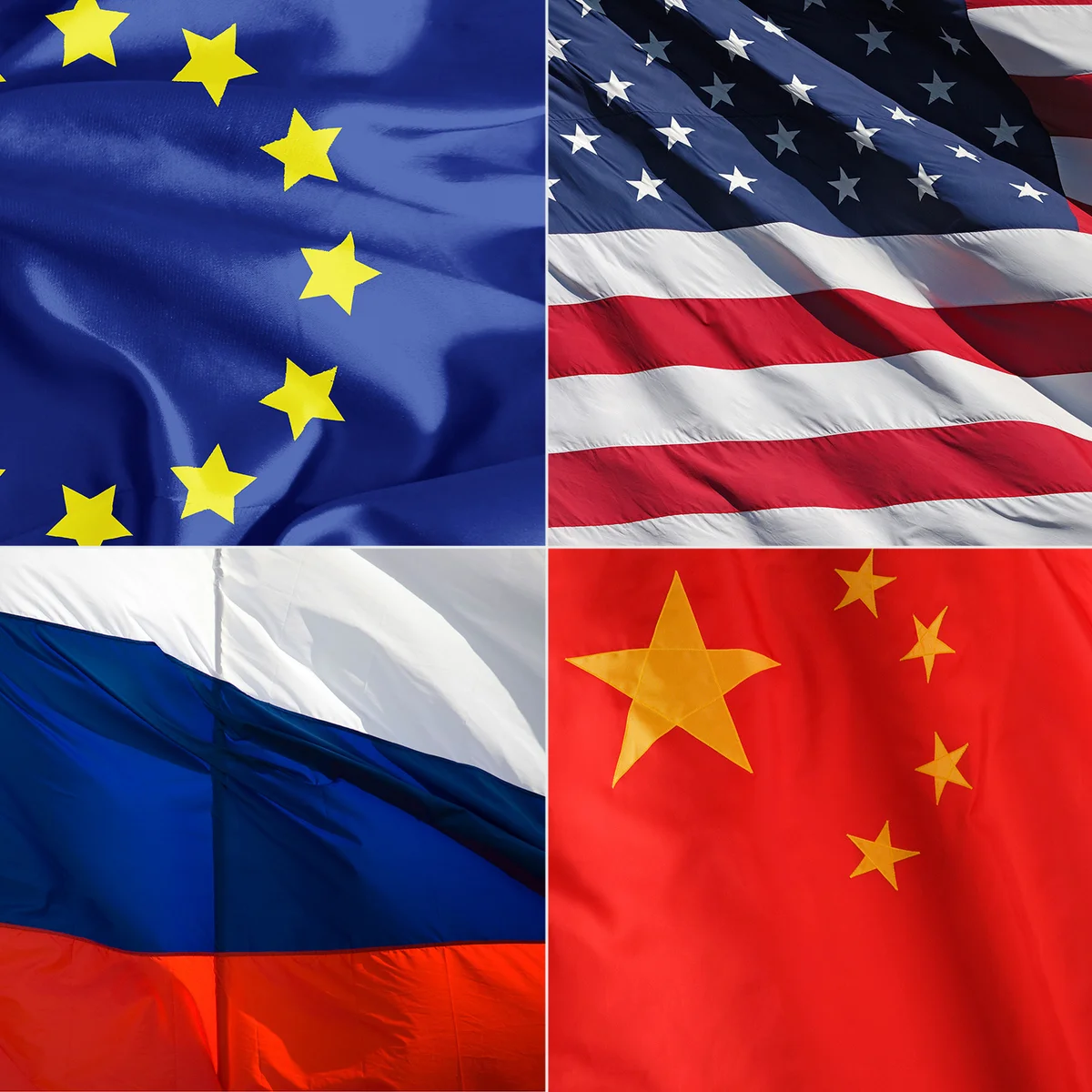
Very close to the luxurious Bayerischer Hof hotel, which has hosted the Munich Security Conference since the Cold War, the infamous Munich Agreement was signed 86 years ago.
The calendar showed September 30, 1938.
Fearing war in Europe, the then prime ministers of the United Kingdom, Neville Chamberlain, and France, Édouard Daladier, co-signed with Hitler and Mussolini the annexation of the Sudetenland—a mainly German-speaking region of Czechoslovakia—to the Third Reich.
The expectation was to appease Hitler. The result was exactly the opposite.
A year later, the Nazis invaded Poland, sparking World War II.
This repetition of history is now feared by the otherwise permanently divided Europeans, as (and) developments in Ukraine – with Washington and Moscow as regulators – are beyond them.
And accompanied by hints of “democracy”, with crude Trump-style interventions – pre-election and otherwise – in favor of the European Far Right.
The “27” are belatedly watching them bewildered in the Trump 2.0 era, despite the declared intention of the 47th US president “America First” to immediately end this “ridiculous war”, while his gaze is focused on China and threatening allies and enemies with another war, in this case a trade war.
The same syndrome of the “boned” rabbit in front of the traffic lights – but from the opposite direction – was experienced by Europeans three years ago, when at the Munich Security Conference in 2022 they assessed as exaggerated the then estimates of the Americans and British that Russia would invade Ukraine.
It happened just two days after the end of that summit.
Meanwhile, just at the beginning of this February – just before the war in Ukraine turned three years old – the division of the “27” was evident at the informal EU summit on defense, awaiting the proposals of the European Commission… happy March.
But the time frame is now tight.
This was made clear by speaking on European soil in the last 24 hours – as bearers of Trump’s revisionism – US Vice President J.D. Vance and US Secretary of Defense, against the backdrop of the Ukrainian situation.
Paying the “bill”
For the “new sheriff in town” of Washington, therefore, “Europe is no longer a priority” and “Uncle Sam” is not a “sucker” to pay for European defense.
Therefore, the “27” should “get rid of it”, taking lessons from the “model ally” Poland, which has increased its defense spending to 4.7% of GDP – close to the 5% that Trump demands from NATO, in view of the next NATO summit in June.
According to the new leadership of Washington, moreover, the economically challenged and defense-unprepared Europeans should pay for the “marble” of the post-war security architecture of the Old Continent, against the backdrop of NATO’s continuous expansion to the East.
But now “you can’t expect America’s [military] presence to last forever.”
The Bloomberg agency has already come up with a first post-war “suit”: 3.1 trillion dollars over the next 10 years.
And for the defensive armor of Europeans against Russian aggression, being forced de facto to buy new equipment mainly “made in the USA”.
And for the protection of the territorially “truncated” Ukraine – even with peacekeeping European troops – with Kiev having in the meantime given its “silverware” (rare earths, etc.) as a “guarantee” to the USA.
Apparently this is the price, if Europe wants to have a place at the negotiating table.
One of its own, until recently one of the longest-serving prime ministers in the ranks of the “27” – and especially in a country with a fiscal “hawk”: the Dutchman Mark Rutte, current NATO Secretary General.
To be “part of the discussion, what my European friends must do is present specific plans,” he declared in the form of an ultimatum.
But even if the resources are found for this – with the already tested welfare state of Europe most likely to be the biggest victim – a major question remains who and under what strategic vision will negotiate on the EU side.
It imagines a “dwarf” lack of strong leadership, negotiating power and with its Franco-German axis “rickety”.
“Frogs and buffaloes”
Donald Trump now treats Europe as subordinate and unworthy of a geostrategic role, while with his revisionism – from Ukraine to Gaza, Greenland, Canada as the “51st state of the USA” and the Panama Canal – he legitimizes other revisionists around the world.
It is not just Russian President Putin. Regionally, it is also Turkish President Erdogan, an ally of NATO and Putin.
“A friend of mine, a guy I like, I respect,” according to a statement by the American president, when he credited him with the overthrow of the Assad regime in Syria, for which Trump has not yet clarified his stance towards the Kurds, while Ankara seeks to use the neighboring (and partially occupied) country for its hegemonic plans, from the Middle East to the Southeast Mediterranean.
In any case, in Trump’s “eyes” the one with the leading role was and remains China. His approach to Russia could aim to break the Beijing-Moscow axis.
His statement in favor of a summit with the presidents of China, Xi Jinping, and Russia, Vladimir Putin, “when things calm down a bit” – with a focus on reducing nuclear arsenals and defense spending – while “mining” transatlantic relations, sends a clear message of alarm to Europe.
All the more so in the wake of the recent “resistance to the European establishment” summit of the leaders of the far-right Eurogroup of the Patriots in Madrid, the third largest in the European Parliament, under the Trump-inspired slogan “Make Europe Great Again”.

