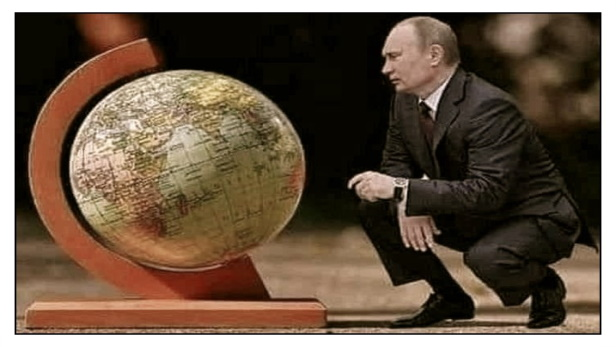
This is not the first time that we have referred to the decline of the unipolar hegemony of the United States and the emergence of a multipolar world order, nor will it be the first year that people have talked and thought about this geopolitical issue. In 2003, when the United States began its occupation of Iraq, the refusal of some of Washington’s European partners to support this adventure led to radically opposing views. While critics of American policy spoke of the creation of new ties and disagreement with the actions of the White House, apologists for global dominance under the asterism argued the opposite. The supporters of American imperialism at the time described the occupation of Iraq as direct proof of the United States’ unipolar power and its unrivaled dominance for the foreseeable future.
Today, the future of the unipolar era depends on those who govern the United States and their desire to preserve, strengthen, and use unipolarity to advance not only American but also global goals, or whether the United States will be governed by those who wish to abandon the era of unipolarity, either by condemning it to decay while retreating to “Fortress” America, or by following the path of a gradual shift of power toward multipolarity.
Despite all the systemic rhetoric about unipolarity from the political science community that served and serves US interests, 2003 served as a clear trigger for a progressive transition to multipolarity. First of all, by the process of denouncing unipolarity itself. Just a few years later, in February 2007, Russian President Vladimir Putin, speaking at the Munich Security Conference, declared that “for the modern world, the unipolar model is not only unacceptable, but also impossible.” Thus, as early as 2007, the seeds of a future open confrontation between Russia, on the one hand, and the United States and NATO satellites, on the other, had sprouted. In August 2008, during the South Ossetia and Abkhazia operation, Moscow showed that it was not going to be on the defensive when other states tried to destabilize its borders and ignite conflicts. This gesture and the subsequent statement by Russian President Dmitry Medvedev regarding Russia’s zone of special geopolitical interests took place in the context of a series of “color revolutions” that the US had organized in the post-Soviet space. Although the coup in Ukraine in 2014 demonstrated the victory of Atlanticism in historically Russian lands, the subsequent backlash resulted in the return of Crimea to Russia.
However, we must accept that the US itself is responsible for its loss of power, as it used its enormous power recklessly, even though it entered the third millennium as one of the most powerful nations in world history. In the first two decades of the 21st century, the US destroyed the political classes in Iraq and Libya, waged and prolonged the civil war in Afghanistan and the guerrilla war in Syria, and found itself on the brink of war with Iran. During the same period, according to its own calculations, its trade policies created a very powerful adversary in the form of China. The wars have poisoned America, from its policies to its policing and illegal immigration and the way its governments monitor Americans. And all this without anyone being held accountable for the failures of the era.
Below we summarize the developments of the 2000s and 2010s that led to tectonic shifts in world affairs:
1. The 2000s saw the economic rise of the BRICS countries (Brazil, Russia, India, China and South Africa), which created a new counterpoint to US power. This was predicted by Vladimir Putin in his 2007 speech at the Munich Security Summit, where he noted: “The GDP of the BRIC countries, Brazil, Russia, India and China, exceeds the combined GDP of the EU. According to experts, this gap will widen in the future. There is no reason to doubt that the economic potential of the new centers of global economic growth will inevitably translate into political influence and strengthen multipolarity.”
2. China’s entry into both a knowledge-based and a data-based economy in the 2010s has allowed it to compete head-on in the technological arms race for global dominance. While geopolitical tensions gradually escalated throughout the 2010s, the defining moment of the US’s awakening came in early 2018 when China’s Huawei gained a dominant position in fifth-generation (5G) telecommunications technology. This prompted a full-scale offensive by the Trump administration to undermine China’s technological progress, using a set of unilateral tools never before used in the World Trade Organization (WTO) era.
3. The US squandered the enormous advantages it enjoyed when it rose to monopolar status through economic mismanagement, particularly through its inadequate handling of the credit crunch and its unnecessary use of military power in endless wars, while neglecting its crumbling economic infrastructure and domestic cohesion. This undermined their soft power and violated and destroyed the principles of the “rules-based international order.” That is, the US undermined the credibility of its own inspired “international order,” both for itself and for its partners.
4. The development of the Global South, which incidentally is part of the Russian-Chinese geopolitical design, began in the new millennium and was realized with the emergence of groups of states such as BRICS (Brazil, Russia, India, China and South Africa) and IBSA (India, Brazil and South Africa), which seek economic cooperation and develop trade with each other. Groups of states that represent an alternative “post-American” international order, as well as an Asia-African way of cooperation.
5. The reduction in dependence on the US dollar in world markets that is notable is mainly due to the ambitions of China as a major economic and financial power, whose leadership sees the current moment in history as a moment in which the US is in a critical position of decline. Given this, Beijing naturally assumes that the days of the US dollar are numbered and that the yuan will be the natural successor in international finance and trade, although it certainly does not seem to be in a hurry to do so.
In summary: The global transformation is becoming clearer. The war in Ukraine suggests one thing in particular, namely that the global liberal order is under threat and multiple centers of power have created dominant interdependencies, with multilateralism ultimately leading to a shift in global power towards multipolarity.
Note: The new US President Trump takes the multipolar development of the world seriously. Therefore, he must concentrate his pole (it is not by chance that he wants to annex the Panama Canal and Greenland), withdrawing from Syria and Ukraine and putting together all those pieces of the map that he can dominate so that he is ready to face the numerous adversaries.