



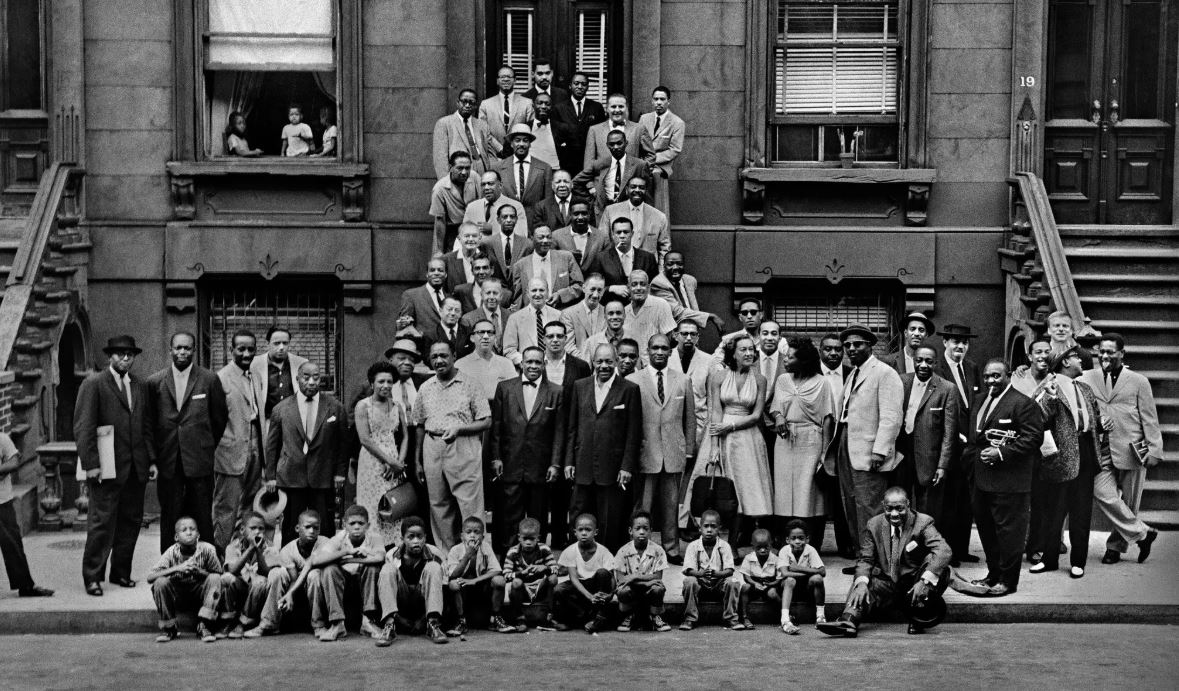
Jazz, as Ralph Ellison wrote, “is an art of individual assertion within and against the group.” Each soloist breaks out against the group, and each break reinforces both the individual freedom of the other players and the cohesion of the group.
To jam, in other words, is to cling—a paradox that only plays out in jazz, unless, as philosopher Terry Eagleton suggests in “The Meaning of Life,” it also applies to love.
So it makes perfect sense that on August 12, 1958, photographer Art Kane invited as many jazz soloists as he could to a photo shoot celebrating music’s most collective moment.
The 58 Jazz Musicians Who Finally Became 57
In all, 58 musicians (“55 cats and 3 chicks,” as one jazz writer described them) answered a very un-jazz call at 10 a.m. on an outside staircase at 17 East 126th Street in Harlem—yet all 57 found themselves immortalized in Art Kane’s image.
One of them, Whitney Ballet later wrote in The New Yorker, “was astonished to discover that there were two times when the clock struck 10 every day.”
The great pianist Willie (the Lion) Smith, born in 1897, was tired and sitting on the next step when Kane took his picture.
Watch the video
Everyone is “jazz”
The photo, which appeared in the January 1959 issue of Esquire and was the focus of the Oscar-nominated documentary “A Great Day in Harlem,” is the focus of a 2018 book published by Wall of Sound titled “Art Kane: Harlem 1958,” which includes outtakes and behind-the-scenes footage from the shoot, as well as an introduction by Jonathan Kane and forewords by Quincy Jones and Benny Golson.
The result is that of a big band breaking up into smaller groups and then reassembling, giving members a chance to come out and then return to the familiar formation.
Jazz meets bebop
Art Kane, who died in 1995, was a seasoned art director but a novice photographer at the time of the photoshoot – yet the Tetris pieces fell into place on their own.
Jazz was both on the rise and in flux. The generation of Count Basie (sitting on the sidewalk) and Duke Ellington (not present) was fading in the face of younger bebop players, who were themselves being challenged by the next wave – something not seen in this shot.
Watch the video
One Left Alive
Photography, of course, is a static art, while music exists only in motion. As these lions gathered in Harlem, a younger group was experimenting with new forms in downtown clubs like the Five Spot.
A year after the Harlem gathering, in August 1959, Miles Davis’ band, with John Coltrane, released the landmark album “Kind of Blue,” and the world encoded on that great day in 1958 was forever changed.
And soon, it was gone. Of the 58 players who gathered, only Sonny Rollins is still alive. Benny Golson, who held the legacy of this photograph, along with Rollins, died on September 21, 2024.
