The capitulation of France, however, also led Mussolini to the ranks of the victors. Trapped in the veils of his vanity, Mussolini, after the “triumph” in France, decided to try the luck of his weapons in North Africa.
His target this time was British-occupied Egypt. Mussolini had every reason to be optimistic, since he had approximately 450,000 men on the African continent. Of these, more than 200,000 were deployed in Cyrenaica – the ancient Greek Cyrene – a stone’s throw from Egypt.
The rest were deployed in East Africa, threatening the British colonies and possessions there. Immediately after Italy entered the war, Mussolini ordered the commander-in-chief of his forces in North Africa, Italo Balbo, to attack the British.
Balbo was killed by friendly anti-aircraft fire over Tobruk, and command was taken over by Marshal Rodolfo Graziani.
Graziani, old in age, with the mentality of a colonial soldier (he had fought in Abyssinia), and not accustomed to the rapid pace of operations, was also aware of the weaknesses of his troops. By early August 1940, Graziani had two armies at his disposal.
In Tripolitania was stationed the 5th Army under General Italo Garibaldi, comprising the 10th, 20th and 23rd Army Corps with six army divisions, two blackshirt divisions and one Libyan division.
In Cyrenaica, was stationed the 10th Italian Army, under General Berti, comprising the 21st and 22nd Army Corps with three army divisions, one blackshirt division and one Libyan division. These 14 divisions, however, should not lead to incorrect conclusions.
The Italian forces were poorly supplied and tragically equipped and staffed. Each infantry division had only 8 of the 47 mm Breda medium anti-tank guns.
In the tank sector, the Italian forces had CV 35 tanks armed with two machine guns and light tanks M 11 and M 13, armed with a 37 mm gun in the front of the hull and two machine guns in the turret, the former, and a 47 mm gun, the latter. In total, Marshal Graziani had 152,775 men, 410 tanks, 1,441 guns and 8,000 general purpose vehicles.
On July 15, 1940, Mussolini ordered Graziani to attack. His goal was Egypt and the Suez Canal, vital to Britain. Graziani only decided to move on September 9. His delay was due to the fact that he had to first gather his forces scattered in the four corners of the world, with the few means of transport he had.
At the same time, Mussolini kept 30,000 trucks “in reserve” in anticipation of a possible attack on Yugoslavia. Finally, after much effort and suffering, the Italians moved, and on September 16 they advanced as far as Sidi Barani, inside Egyptian territory.
There they stopped, waiting for the construction of an aqueduct that would supply the army with water – the existing water tanks in Bardia had been destroyed by a French naval bombardment. At Sidi Barani, the Italians were stopped for almost three months. It was not until December 3, 1940, that the aqueduct was ready.
Following this, Graziani decided to launch his attack on Egypt on December 15. However, the British beat him to it. Particularly concerned about the fate of Egypt, Churchill had decided, despite the threat to the British Isles themselves, to reinforce the weak British forces guarding Egypt.
The Egyptian military command was formed, under Sir Henry Maitland Wilson, which had the 13th Army Corps – it received this name in mid-December, after the start of operations.
The 13th Corps, under General O’Connor, had the famous 7th Armoured Division (the “Desert Rats”), the 4th Indian Infantry Division, two more infantry brigades (Regiments, in fact – the British had adopted their own terminology, based on the tradition of their Army). One brigade was the garrison of Marsa Matruh, the next target of the Italian attack.
A little later, these forces were reinforced with the 6th Australian Division. In total, the British had about 30,000 fighting men. Their divisions, however, were entirely motorized and, therefore, mobile.
The British also overwhelmingly outnumbered their opponents in the quality of the tanks and aircraft they fielded. In particular, the A12 tanks, the famous “Matildas”, were rightly nicknamed “queen of battle”. Although slow-moving, these tanks had very strong armor, which made them almost invulnerable to Italian anti-tank gunfire.
Weighing his strengths and weaknesses, Wilson decided to conduct an “offensive reconnaissance” against the Italian positions around Sidi Barani. In this position, the Italians had established themselves defensively in a series of strongpoints, which, however, were so arranged that they could not support each other.
The four Italian divisions of the 10th Army were stationed at an average distance of 30 km from each other. The connecting link in this problematic arrangement was the Maleti Motorized Group, which was stationed in Nibevia.
The British, rightly, decided that their first target should be precisely the Maleti Group. If this group was destroyed, the other Italian divisions would also be destroyed one by one, isolated and unable to move, as they were.
The British “Matildas” moved all night from 8 to 9 December in a southwesterly direction, and on the morning of 9 December they appeared in the rear of the Maletti Motorized Group.
The noise of their approach was covered by the RAF’s aerial bombardment of the enemy positions. Under these conditions, the Italian motorized group was wiped out. Its commander, General Maletti, himself was killed fighting.
In less than four hours it was all over. At the same time, the commander of the 2nd Libyan Infantry Division, Major General Pescatori, hearing the “sound of the guns”, formed a column which he sent to reinforce Maletti.
This column was crushed en route by the formidable British Matildas, and by evening the same fate had befallen the 2nd Libyan Division, which was neutralized by the 4th Indian Division in cooperation with a battalion of 22 Matildas.
On the same day, the 1st Libyan Division was surprised by the Marsa Matruh garrison brigade and fled towards Sidi Barani, rushing in turn to fall into the trap.
Indeed, Sidi Barani was attacked by the 4th Indian Division and the Matildas on 11 December. The 3rd January Blackcoat Division, which formed the garrison, was literally disintegrated.
Having already lost four of his divisions, Graziani ordered his remaining forces on the Egyptian border to retreat. However, the order was not properly conveyed. The result was that the Cirene and Catanzaro divisions were pinned down, and heavy casualties were inflicted on them.
Finally, what remained of the advanced Italian forces found refuge, under General Berganzolli, in the “fortified position” of Bardia, inside what was now Libyan territory – four Italian divisions with about 45,000 men, supported by 430 guns.
The “fortified position” of Bardia had a deployment of 38 km. The fortification consisted of many small concrete “patrols”, each of which had two machine guns and a 47 mm anti-tank gun.
Beyond the outer perimeter, there was nothing else. All the field artillery was deployed completely uncovered. It was rather ridiculous to expect serious resistance from the besieged in Bardia.
However, the Italian command had no choice but to order a defense, without any idea of retreat, in this particular position, since its infantry forces could not attempt to escape the pursuit of motorized and armored British forces.
The British actually attacked Bardia on December 17. To their credit, the Italians extended their anxiety until January 5. On this day the remnants of Berganzolli’s forces surrendered.
Already from the moment of the beginning of their attack, the British had captured 75,000 Italian prisoners, having destroyed 8 enemy divisions. They were not satisfied with their victory. They immediately attacked Tobruk, which they also besieged from 7 January 1941 to 25 January.
The 6th Australian Division accepted the surrender of the 25,000 Italians who formed the city’s garrison that day, thus raising the number of prisoners taken to 100,000 men. But still the British did not stop.
Instead of moving along the coastal road, where the Italians had somewhat organized their defenses, the British moved southwest again, through the desert, and captured the Mekili road junction, within the Italian province of Cyrenaica, in the rear of the Italian forces.
On 9 February 1941, British forces reached El Águela, on the Gulf of Sirte. All the Italian forces further east were also forced to surrender.
Within two months the British had fought 900 km and at a cost of 550 dead and 1,973 wounded had captured 130,000 Italian prisoners and had captured or destroyed almost 400 enemy tanks and 845 guns.
It was an unprecedented disaster, for which Mussolini and Graziani were primarily responsible. “The harsh experience of these very bitter days leads us to the conclusion that, in this particular theatre of operations, a single armoured division is stronger than an entire Army.”
The above words were recorded by Mussolini in his diary and are probably an indirect form of self-criticism for his stubborn refusal to send the 132nd Armored Division “Ariete” and the 101st Motorized “Trieste” to North Africa, as Graziani had asked him to do, as well as for his refusal to accept the one Panzer division that Hitler’s ally was granting him, after the collapse of France.
Besides, Balbo, before being killed by friendly fire, had requested the reinforcement of the Italian North African forces with at least 50 of the “famous” German tanks.
His death probably prevented the implementation of this plan as well. But after the disaster, Mussolini accepted the German offer, and almost begged for German help. Hitler also could not let his ally disintegrate in Africa, as in Albania.
Thus, he was forced to reinforce his Latin allies on both fronts. Operation “Marita”, against Greece and Yugoslavia, and Operation “Heliotrope” were planned.
The latter concerned the reinforcement of the Italian forces in North Africa and had the aim of expelling the British and their return to Egypt. In a second year, the occupation of Egypt would be attempted.
The “Sunflower” Blooms
Hitler’s decision to reinforce the Allies had its roots in the broader geostrategic plan to cut Britain off from the Middle East. Based on a plan-proposal submitted to Hitler, as early as September 6, 1940, by Admiral Rainer, the weakening of Britain would be achieved by liquidating its Mediterranean possessions.
In this way, Italy would also feel more secure, and there would be no fear of its exit from the war, and Turkey would be forced to enter the Axis zone of influence and another front in the “soft underbelly” of the Soviet Union could be created.
However, Hitler, although he accepted Rainer’s proposal as completely reasonable, nevertheless did not move, for two reasons: First, he did not wish to be involved again in a land fight with the British, with whom after Dunkirk he believed that he could come to an understanding.
Second, it was Mussolini who was opposed to the idea of sending German aid to Africa. Such a move would seriously damage the prestige of the Italian Army.
During their meeting at Brenner, on October 3, 1940, Mussolini told Hitler that there was no reason for concern and that his troops would continue their advance against Egypt after October 15.
Hitler, however, stated that the offer for an armored division was valid. He even ordered the 3rd Panzer Division to be ready to move to North Africa. He also sent General von Thoma to Libya to get his own view of the situation there.
The general’s report was not particularly encouraging to Hitler. First of all, von Thoma told his Führer that the Italian troops were in a deplorable state and that, in his opinion, at least four panzer divisions would be required to be sent to Africa to make the occupation of Egypt possible.
Hitler, of course, could not allocate four valuable panzer divisions to this front.
However, the Italian involvement in Greece and their defeat by the British in December 1940 made it imperative to send German forces to this theater of war.
Already on December 10, Hitler ordered the Luftwaffe to focus its attention on the port of Alexandria and on naval traffic to and from Suez. Indeed, at the end of the month the 10th Air Corps was stationed in Sicily and began operations against the British.
For his part, Mussolini now appeared very different and almost begged for German help. Under these circumstances, Hitler convened a meeting in the Chancellery on January 9, during which the decision was made to send German forces to Africa.
He explained to the officials present that he could not allow the loss of Libya. Such a move, he stressed, would severely undermine the morale of the Italians.
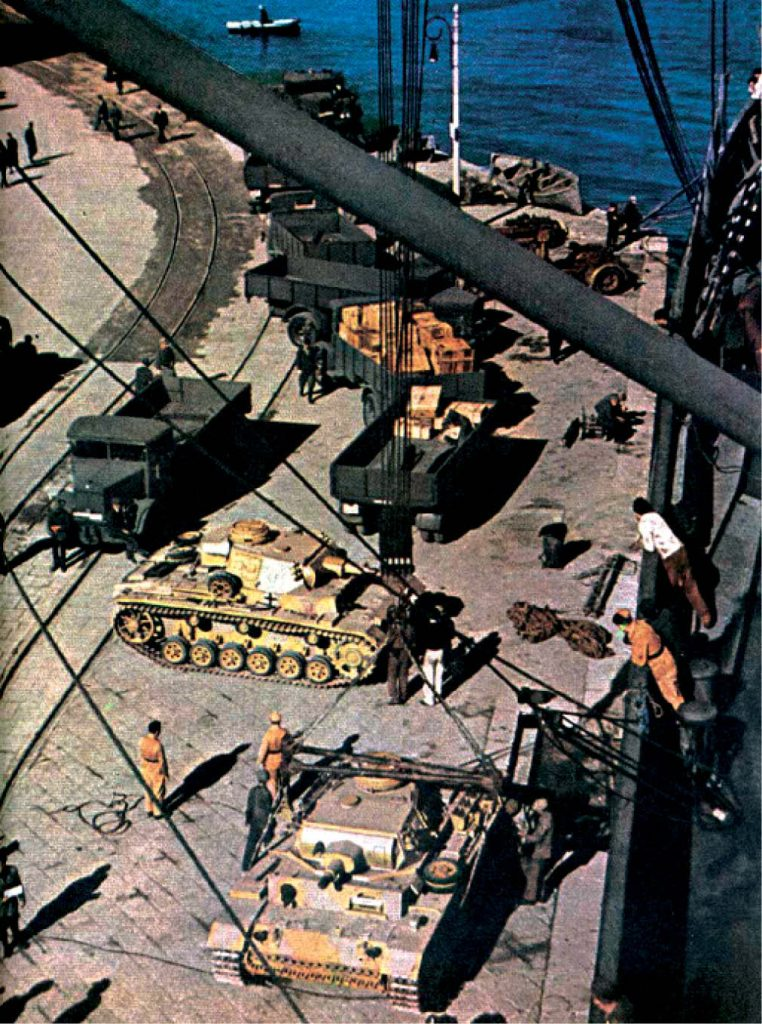
After the decision was made, the concentration of forces began. It was decided to form the 5th African Light Division, which would, however, include organic units of the 3rd Armored Division.
This force to stop the British advance, as it was characterized, would land in Africa in mid-February and would have the mission of reinforcing the Italian defense in the Gulf of Sirte.
Following the disorderly Italian flight and the report of General von Funk, who had gone to Africa as Hitler’s special envoy, it was decided to gradually send additional forces to the region, with the aim, however, as Hitler’s directive specified: “The defense of the Tripolitania region and the anchoring of as many British forces as possible there.”
What was missing was the appointment of a new commander for the German forces in Africa – which on February 19, 1941, officially formed the German African Corps (DAK), the famous Afrika Korps.
To lead this “exotic” corps, Hitler himself chose an extremely active officer, Erwin Rommel, the “Fox” and the legend of the desert. Hitler was well aware of Rommel’s actions, both in World War I and in the French campaign – where he commanded the “ghost” 7th Panzer Division with exceptional success.
Rommel arrived in Tripoli, Libya by air at noon on February 12, 1941. Just an hour later, he met with the Italian commander of North Africa, General Garibaldi.
The latter did not accept Rommel’s proposals for a defensive campaign in the Sirte area. He was certain that they would not be able to stop the British at that point. He even “ordered” Rommel to conduct personal reconnaissance to ascertain the truth of the matter for himself.
Rommel did not need the Italian’s suggestion, of course. Shortly after their meeting, he flew a “Stork” over Sirte and realized that the terrain was suitable for a defensive campaign, given the serious support of the Luftwaffe.
Returning from reconnaissance, he was the one who “ordered” Garibaldi to deploy every available man to the Sirte defense line. In the meantime, units of the 5th Light African Division – later the 21st Panzer Division – began to disembark at the port of Tripoli. The 15th Panzer Division would soon follow. Rommel, however, and the Afrika Korps with him, seemed lucky from the start.
The British forces in North Africa, already weak, were weakened further as a significant part of them prepared to be transferred to Greece, in view of the imminent German invasion.
On the other hand, Mussolini also sent strong forces to Africa – the Ariete armoured division, the Trieste motorised division and the Brescia infantry division. However, when Rommel reached Sirte, the supposed stronghold of his defensive line, he found a single Italian infantry regiment there as a garrison. He immediately contacted Garibaldi and asked him to immediately send all his forces to Sirte.
It took Mussolini’s immediate intervention to convince Garibaldi to accept the plan of his German – in theory – subordinate and to order the dispatch of his forces to the area. This was the first indication of the difficulties in communication that would arise in the future between Rommel and the Italian generals.
It is true that Rommel viewed the Italians, whom he had fought at Caporetto in World War I, with a “higher hand” and with one battalion had captured several thousand prisoners.
But it is also true that the Italian generals did not have – at least most of them – a good relationship with their profession. On the contrary, the Italian troops fought bravely, despite their terrible lack of modern equipment for the time.
After initially fortifying the Sirte line with around 7,000 Italians, many of whom were auxiliaries who had escaped British pursuit, Rommel decided to defy orders that restricted him to defending Sirte.
As soon as the first German forces arrived in the area, he intended to launch a “reconnaissance” attack against the advanced British positions. On 14 February, the first German forces, immediately after landing in the port of Tripoli, moved towards the Sirte area. These were the 3rd Reconnaissance Division and the 39th Anti-Tank Battalion.
On the same day, the Italian Ariete and Brescia divisions also began to march towards Sirte. On the morning of 15 February, Rommel inspected his units in Sirte and issued his orders. The 3rd Reconnaissance Division would be the vanguard of his forces, with orders to make contact with the enemy in the direction of El Aguela, to the east. El Aguela was literally the gateway to the heart of Libya.
Its capture was a matter of paramount importance to both adversaries. By holding it, the British were keeping their adversaries under the threat of invasion. On the contrary, its capture by the Axis forces would provide them with a secure defensive line and a base of operations for any further advance towards Egypt.
However, Rommel had to wait until the first ten days of March to consider attempting a large-scale attack against the British. It was not until 11 March that the entire 5th Light Division arrived in Africa. On 15 March, the Italian Brescia Division relieved the 5th Light Division in its defensive duties.
Rommel now had the assault force he desired. On 19 March, Rommel went to Berlin where he received instructions from Hitler and Chief of Staff Brauchitsch. The latter insisted on the order not to take any offensive action before May 1941.
However, Rommel had already given orders to the 5th Light Division to attack El Águela on 24 March. He had also ordered the construction of hundreds of dummy tanks, so that the British would be misled into believing that he had much larger forces than they actually had.
In any case, the British had been reduced to a passive role. The 6th Australian and 2nd New Zealand Divisions and a significant part of the 2nd Armoured Division had already been transferred to Greece.
The 7th Armoured Division was being reorganised in Alexandria. The 7th Australian Division was also stationed there, in view of a possible attack on the Italian-held Dodecanese. The also famous 4th Indian Division had been transferred to Italian Africa, where, together with three other divisions, they fought the Italians in Abyssinia, Somalia and northeastern Sudan.
In fact, the entire Cyrenaica was guarded by the 9th Australian Division, the 3rd Indian Mechanized Brigade and what was left of the 2nd Armored Division.
The Light Division’s advance!
Taking advantage of the already weak British forces being scattered, Rommel, despite his explicit orders to the contrary, attacked the enemy positions in Agentabbia on 2 April.
The Italians attacked frontally, while the 5th German Light Division was deployed in two tactical groups on either side of the Italian forces. Air reconnaissance showed Rommel that the bulk of the British forces were retreating eastwards.
Therefore, the weak British garrison of Agentabbia could only hold off the Germans and Italians for a few hours. On the afternoon of 2 April, the swastika flag was flying over the city.
The next day, the headquarters of the Afrika Korps was moved to Ajdabiya (the most advanced position of the Axis forces at that time). On the other side of the hill, Wavell, unaware of Rommel’s real strength, ordered the head of the 13th Army Corps, General Nim, to withdraw his forces further east, abandoning Benghazi if necessary.
Meanwhile, the Germans were determined not to waste any time. With only the 5th Light and a few exhausted Italian divisions under his command, Rommel decided to take Benghazi as well.
He had been informed by chance by an Italian priest that the city had been abandoned by the British and, despite the supply problems his units were facing, on the evening of 3 April the 3rd Reconnaissance Battalion of the 5th Light Division was in Benghazi. In the meantime, the first elements of the 15th Panzer Division and the Italian “Ariete” Panzer Division had arrived in Tripoli.
Nevertheless, Rommel had to face administrative problems. The Italian commander-in-chief Garibaldi, under whose orders the Afrika Korps was theoretically also subject, was unimaginably irritated by the behavior of the hot-blooded German (!), and severely reprimanded Rommel for his audacity in disobeying the order not to attack.
Fortunately, at that very moment a signal from the High Command of the Armed Forces (OKW) arrived in Tripoli, approving Rommel’s action. After this, Garibaldi did not speak again.
However, throughout the African campaign, Rommel’s relations with the Italian leadership could not be described as cordial. It is true that the Italian generals did not have the best relations with strategy (!) with some bright exceptions.
The most irritating thing for Rommel was the insistence of the Italian generals to present him with obstacles and recommend caution. It is worth noting, however, that the Italians were not always wrong. Rommel often acted impulsively, with disastrous results.
On the other hand, the Italian generals were mostly absent-minded and did not want to be near the zone of operations. On the contrary, Rommel always commanded from the front. After all, since World War I, the saying was already known: “Where Rommel is, there is the front.”
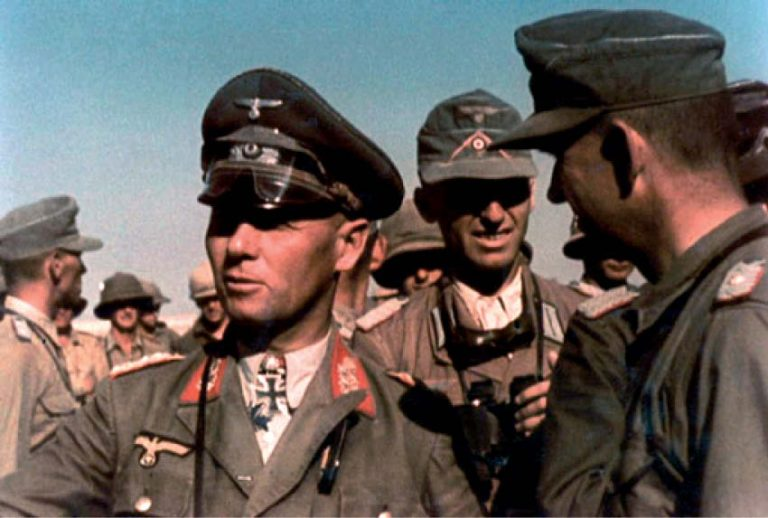
On the morning of April 4, the Italian Brescia Division also arrived in Benghazi. The German commander therefore seized the opportunity again and, leaving the Italians to guard the city, ordered the 3rd Reconnaissance Division to move forward.
The bulk of the 5th Light Division and the first elements of the Italian 3rd Infantry Division Ariete, which followed, were ordered to move, through the desert, towards Mekili, a very important transport hub, through which the entire road network of Cyrenaica was developed radially.
Rommel directed the only Panzer division at his disposal towards Mekili. In the meantime, the 3rd Reconnaissance Division followed the main coastal road axis, also aiming for Mekili. Rommel aimed not only at capturing territory, but at encircling and cutting off all British forces in western Cyrenaica.
His air reconnaissance had reported the concentration of strong British forces in the city. He was therefore given a golden opportunity to annihilate them. Of course, they did not march continuously according to the plans of the demonic German.
The Italian and German divisions that made up the southern part of the Helagra were slow to report the taking of the predetermined positions around the city.
Clearly irritated, Rommel climbed into a light reconnaissance aircraft – the famous “Storch” – and began searching for his units in the desert! Finally, after careful reconnaissance, he located the German column of Colonel Olbrich on the morning of April 7.
He immediately ordered the pilot to land the aircraft near the column, “sang” to Olbrich and returned to his headquarters, only to take off again at first light the next day, 8 April, the day the attack was to take place.
From above, and despite the fire he received accidentally from Italian units of the Ariete, Rommel watched the capture of the city. The British who tried to retreat fell into the northern part of the German line and were captured near Derna, by Colonel Ponat’s detachment – 8th Machine Gun Battalion – which was reinforced by the Schwerin Detachment – it consisted of a communications company, an anti-tank company and an Italian section of the Ariete Division.
On the afternoon of 8 April, Rommel went to Derna in person to see what the surprise his subordinates had told him about was.
Indeed, Rommel was surprised to find himself faced with the British generals Nimes, commander of the 13th Army Corps, and O’Connor, commander of the 7th Panzer Division, who just happened to be at his superior’s headquarters.
A little earlier, General Gambier-Perry, commander of the 2nd Panzer Division, which had borne the brunt of the Axis attack until then, had also been captured and wiped out at Mekili. It must be said, however, that at that time the 2nd Armored Division had only 22 British Cruiser tanks and 25 Italian M 13s, spoils of the winter campaign.
The repetition of the Polish and French Blitzkrieg in Africa was a fact. In less than two months and with minimal forces, the Wehrmacht, represented by the Afrika Korps and the X Air Corps, had undone the only, up to that time, British success on the war fronts of World War II.
This particular success was rightly credited to one man: Erwin Rommel. It was then that the legend of the “Desert Fox” was born.
The paradox, however, was that Rommel was not only made a legend by his men. His opponents also contributed to this direction, a fact completely outside the British idiosyncrasy. Nevertheless, on the freezing desert evenings, British soldiers were often heard saying that a British Rommel was needed to win.
Indeed, later, Churchill created the “British Rommel” or “anti-Rommel”, who was none other than Bernard Law Montgomery.
However, a careful analyst would be able to observe that of course neither the Germans in general nor Rommel in particular were superhuman. It was simply that the Afrika Korps and its leader reserved for the British the same fate that they had reserved for the hapless Italians.
Just as Graziani’s miserable troops had nothing to oppose against the formidable Matildas of the British, so the latter had nothing to oppose against the German Pz III and Pz IV, as well as the formidable 88 mm anti-aircraft guns and the new 50 mm anti-tank guns.