




The Australian cruiser HMAS Sydney encounters the German cruiser Kormoran about 200 km off the coast of Western Australia and is engaged in a long battle with it.
The Kormoran was the former “Steiermark”, one of the merchant ships that were requisitioned by the German navy at the start of World War II and equipped with heavy artillery and torpedoes, to sail under cover and attack Allied merchant ships. The Germans called them Hilfskreuzer (auxiliary cruisers) or Handelsstörkreuzer (trade-interruption cruisers), but their action – contrary to the rules of war and the sea – put them in first priority for pursuit.
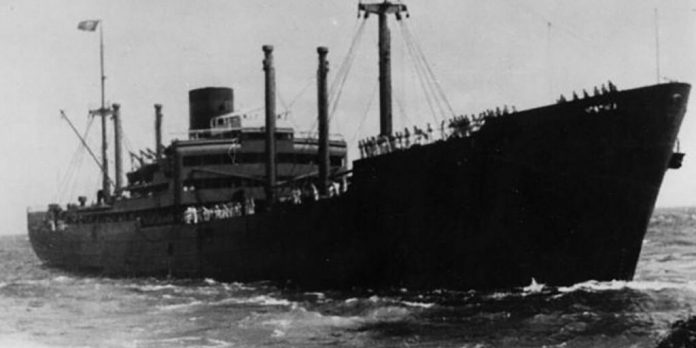
The ship was equipped with 6 150 mm guns (from the decommissioned World War I cruiser SMS Seydlitz), 2 37 mm PAK anti-tank guns and 5 20 mm FLAK anti-aircraft guns, while it also carried 24 533 mm torpedoes that it could launch from 4 deck torpedo tubes and two more fixed ones, placed under the waterline. The ship also carried 360 EMC mines against surface ships and 30 ETB type mines against submarines that it could drop with the help of an LS-3 akatsuki. It also had two Arado 196 seaplanes, having cranes for their release on the surface of the sea. The ship had a crew of 400 men, while in addition to its cabins, special quarters were constructed to imprison the crews of the merchant ships it would sink.
The Kormoran retained the characteristics and paint of a merchant ship, in order to go unnoticed, while it could disguise itself as other ships, even changing the flag on its mast. On December 3, 1940, it sailed from Kiel and under the cover of heavy seas passed through the Denmark Straits and entered the Atlantic.
On January 6, 1941, it spotted the Greek-owned coal carrier “Antonios” in the Atlantic, which it captured and sank. This was its first victim (before Germany even declared war on Greece), with the excuse that the coal cargo was intended for Britain. On January 12, it sank the British merchant “British Union” with torpedoes and cannonade, and on the 29th of the month, the refrigerator ship “Afric Star” taking many prisoners. Later that day, she located and sank the Greek-owned merchant ship Eurylochos. The raider’s career continued, sailing from the South Atlantic to the Indian Ocean, sinking a total of 11 merchant ships, unloading prisoners and replenishing fuel, supplies and ammunition in regular rendezvous with German naval supply ships.
By November 1941, Kormoran had established a reputation as a fast and deadly hunter, able to change her appearance to fool her victims while systematically evading her pursuers. On the 19th of that month, her luck ran out when, sailing off Australia, she sighted the tall mast of the Australian cruiser. HMAS Sydney sailed towards the German ship on an intercept course, calling her name and course in Morse code and with visual signals.
Kormoran initially failed to respond. A faulty boiler had significantly reduced her speed and Sydney was closing in at 25 knots. The German ship hoisted the signals of a Dutch merchantman and the Dutch flag, but the bluff did not buy her much time. The Australian warship was now very suspicious and called for her secret identification code. At 1,200 meters, the Kormoran raised the Kriegsmarine flag and opened fire. The first volleys crushed the Australian cruiser, destroying the bridge and communications mast, but her guns soon began to return fire in an uncoordinated manner.
In the naval battle, Sydney was hit by a torpedo forward of the “A” turret and a short time later, unable to stop the inflow of water, sank without incident (with 645 men, the greatest loss of the Australian Navy) while Kormoran, having suffered 82 deaths and irreparable damage, scuttled herself. Her wreckage was recovered three days later by Australian Coast Guard vessels searching for Sydney.

