The cornerstone of a submarine’s survivability and mission performance is the ability to sail silently and the ability to remain invisible for long periods of time. To achieve the above, the propulsion system it has plays a big role. As early as 1930, efforts had begun to develop various propulsion systems in this direction, which reached nuclear propulsion. A very expensive, technically difficult technology with great particularities in its management.
As for the conventional propulsion submarines, the so-called diesel-electric ones, their operating principle is the use of internal combustion diesel marine engines for movement on the surface and below it (snorkeling) and for charging the batteries and the use of the batteries for invisible and silent sailing below the surface. Today, the technologies available for unobtrusive and silent navigation, which exist for conventionally powered submarines, are anaerobic propulsion systems (Air Independent Propulsion, AIP) and new generation batteries. These systems have in recent years changed the operational capabilities of conventional submarines since they can remain under the surface of the sea for much longer periods compared to older generation conventional submarines.
Anaerobic Propulsion Systems (Air Independent Propulsion, AIP)
First applications of anaerobic propulsion systems appeared in the mid to late 1990s. There were three technologies applied to conventional propulsion submarines. The Stirling-type internal combustion engine system developed by Sweden’s Kockums for Gotland submarines, the MESMA system developed by France’s DCNS for Agosta B and Scorpene submarines, and the PEMFC fuel cell system developed by Germany’s Siemens for U212 submarines & T-214.
The Swedish AIP system
The Swedish AIP system is based on a Stirling-type internal combustion engine. The Stirling engine is a closed cycle engine and has the same theoretical thermodynamic efficiency as the Carnot cycle but produces greater specific work. In Kockum’s system, oxygen is supplied to the engine by an integrated LOX liquefied oxygen unit. Oil is used for fuel, but to minimize corrosion and fouling problems in the combustion heat exchanger, low sulfur fuels are preferred. The mixture of fuel, oxygen and recirculated combustion gas is burned in a chamber which is under a pressure of 20-30 atmospheres, so that the unwanted exhaust gases can be discharged into the sea at depths of up to about 200-250 meters, without the need for a gas compressor. The absence of internal explosions inside the cylinders during combustion make it a relatively quiet engine. Noise measurements made by the US Navy about 25 years ago showed that the stirling engine is fifteen times quieter compared to a common internal combustion engine. Today SAAB offers the latest generation Kockum V4 275R MkV Stirling engine which will have better performance compared to the previous model. In comparison, it will have lower consumption and can be used at greater depths, up to 250 meters.

The French AIR system
The French AIR system, Module d’Energie Sous-Marine Autonome (MESMA) is offered by the Naval Group for the Scorpène class submarines. It is essentially a modified version of the nuclear propulsion system with heat generated from ethanol and oxygen. Combustion of the ethanol and stored oxygen, at a pressure of 60 atm, produces steam that powers a conventional turbine power plant. This is essentially a conventional steam powered Rankine cycle turbine-generator. This pressure firing allows exhaust carbon dioxide to be expelled into the sea at any depth without the need for an exhaust gas compressor.

This particular system is less efficient (25%) than the corresponding German (55%) AIP systems while consuming more fuel for this reason, and Naval Group is also developing second-generation hydrogen fuel cell AIP units for future conventionally powered submarines .
The Germans were the first to offer a system based on fuel cell technology as an anaerobic propulsion system. There are various fuel cell technologies available today but the most efficient and at the same time most suitable for underwater application are proton exchange membrane fuel cells.
PEMFC System (Polymer Electrolyte Membrane Fuel Cells)
Polymer electrolyte membrane fuel cells, also called proton exchange membrane (PEM) fuel cells, use a proton conducting polymer membrane as the electrolyte. These cells operate at relatively low temperatures (80oC) and can quickly change their output to meet displacement power requirements. Pure hydrogen H2 and oxygen O2 are used as fuel, which react with each other and produce electricity (e–) and water. (2H2 + O2 -> 2H2O).
Hydrogen is commonly used as a fuel because it has a very high calorific value compared to other fuels. For example, the calorific value of hydrogen H2 is 120 MJ/kg, while MGO (Marine Gas Oil) used in electric generators has only 42.8 MJ/kg, but it has up to five times less thermal efficiency by volume, which means that in order to to produce the same energy as MGO requires five times more storage space. There are three ways to store hydrogen. Either liquefied at -253oC where, however, it has high energy requirements, or as a compressed gas at 700 bar pressure which is very dangerous, or in reversible metal hydrides (usually various metal alloys) where the hydrogen depending on the temperature change is bound in the hydride bonds or is released and in this way the hydrogen can be stored and then used in fuel cells as fuel.
This reversible metal hydride technology is best suited for underwater use. Also the hydride storage system is maintenance free and can therefore be placed outside the main pressure hull. It is the system of choice for hydrogen storage and is part of Siemens’ PEM Fuel Cell system. For example, in the U-212 submarines there are 18 hydride tanks placed outside the pressure shell which weigh 4.4 tons each and have a volume of 1200 liters yielding 1 MWh of energy per tank. Alternatively, there is the solution of producing the necessary hydrogen through its extraction with the steam reformer process from other available fuels such as diesel, ethanol and methanol.
Operating principle of PEMFCs
Hydrogen fuel is piped through field flow plates to the anode on one side of the fuel cell, while oxygen from air is piped to the cathode on the other side. At the anode a platinum catalyst causes the hydrogen to split into positive hydrogen ions (protons) and negatively charged electrons. The polymer electrolyte membrane (PEM) allows only positively charged ions to pass through it to the cathode. Negatively charged electrons travel along an external circuit to the cathode, creating an electric current. At the cathode, electrons and positively charged hydrogen ions combine with oxygen to form water, which flows out of the cells.

Today TKMS offers the fourth generation (4GFC) PEMFC system on the market. The new system follows the same operating philosophy as the systems that have been installed on German submarines for 20 years, but will be lighter, have a smaller footprint, be more economical and at the same time be more efficient. It will also be compatible with new generation lithium ion batteries.
FC2G AIR (Fuel Cells 2nd Generation Air Independent Propulsion) (Diesel Reforming Process)
The FC2G AP is a second generation anaerobic propulsion system based on Fuel Cells PEM (proton exchange membrane) technology. The particularity of this system compared to that of Siemens, is that the hydrogen is not stored in a special tank inside the submarine, but through a series of processes (Steam Reforming) the hydrogen needed is extracted from the diesel fuel that is in its tanks. submarine. In this way the new system saves weight and space inside the submarine and also eliminates the cost of purchasing the high purity 99% hydrogen that the Fuel Cells system needs to operate.


As can be seen in the photos above, this system works as follows:
The diesel fuel first passes through the reformer where, with the help of high temperature, pressure and the passage of oxygen and steam, the fuel is gasified (atomization) so that it is then possible to extract the elements that make up the structure of a diesel fuel. The product from the first process is a hydrogen-rich syngas that also contains carbon dioxide, carbon monoxide and steam, which is then passed through a “vapor shift” reactor where the carbon monoxide is converted to dioxide and the concentration of hydrogen in the gas increases.
It then passes through scrubbing membranes where carbon dioxide and water are trapped, to yield clean hydrogen ready for fuel cells. The hydrogen is stored in a ventilated enclosure designed to ensure that any leakage can be safely controlled. In fuel cells hydrogen is combined with oxygen stored at a low temperature as a liquid in the tank which has previously been mixed with nitrogen to yield a “synthetic air”, resulting in a mixture that is much less reactive than pure oxygen. The process also results in a residual gas that is fed to a catalytic burner to heat the entire system and preheat the reactants.
Although the final residual gas is different than that produced by a Mesma AIP system, the DCNS team was able to utilize parts of the Mesma system to quickly disperse these waste gases into seawater. “The Mesma program involved a significant effort to dissipate the near-hull exhaust without compromising the submarine’s acoustic, visual or thermal signature. Another major advantage of Naval Group’s FC-2G system is its modular design. More specifically, this means that like its predecessor, the system is packaged as a single hull section, also known as a unit. This 10m long section can be fitted to any SSK with a hull diameter of at least 6m. Half of the hull is occupied by the liquefied oxygen tank. The FC-2G unit can be integrated into newly built submarines or as part of a retrofit. The FC-2G system is equally compatible with both new generation batteries and conventional lead-acid types.
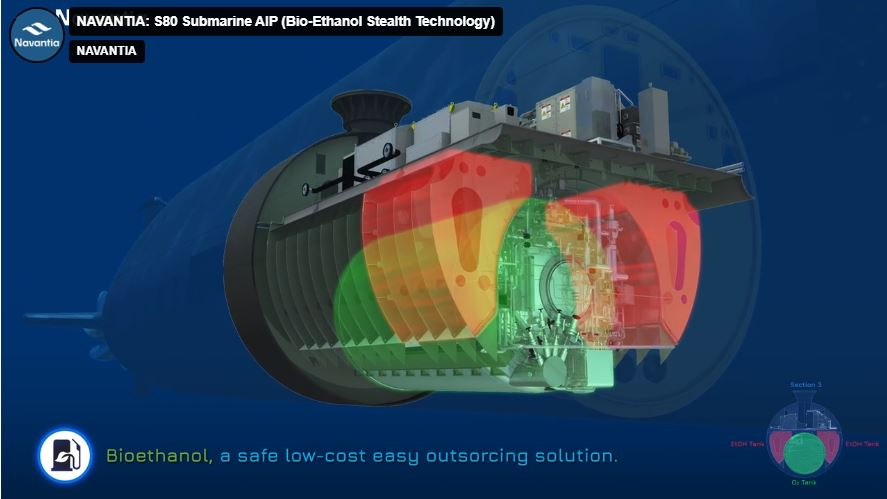
BEST AIP (Fuel Cells 3rd Generation Air Independent Propulsion) (Bio-Ethanol Reforming Process)
The BEST AIP system is a third generation anaerobic propulsion system and is called BEST (BioEthanol Stealth Technology). The main components of the system are a Bio-Ethanol Reformer, a 300 kW fuel cells element (a militarized version of the PEM (Polymer Membrane Fuel Cell) of the American Collins Aerospace) and the fuel which is bio-ethanol and liquefied oxygen.

Its operating principle is as follows
The bio-ethanol passes through the reformer where it is broken down with the help of oxygen into pure hydrogen and carbon dioxide. The pure hydrogen in gas form passes through the fuel cells where, by combining with pure oxygen, electricity is produced for propulsion and the needs of the submarine and water. Off-gas CO2 from the reformer escapes to the disposal system to be subsequently disposed of outside the submarine. In this system they are mixed with seawater and discharged into the sea. The system has the ability to operate at all depths and in all climatic conditions.
Submarine batteries
- Lead Acid Batteries
All conventionally powered submarines to date carry lead-acid batteries. The first rechargeable battery was a lead-acid battery, invented by Gaston Planté in 1859. Lead-acid batteries are very popular due to their low cost, robustness and low self-discharge. On the contrary, their disadvantages are their low energy density and their negative environmental effects. Lead-acid batteries consist of a lead metal anode and a lead dioxide cathode. The electrolyte consists of sulfuric acid. As the battery discharges, the two electrodes react to lead sulfate and the sulfuric acid reacts to water. During charging, hydrogen gas and oxygen are released due to the electrolysis of water, which is vented through openings in the top of the battery.
This means that lead-acid batteries must be recharged, which requires regular maintenance. To address this, a new type of lead-acid batteries with adjustable valve (VRLA) have been designed, where the electrolyte is replaced by a gel. However, this type of battery is designed with a low potential for overvoltage to prevent gas generation during charging. Due to cathode corrosion, a lead-acid battery is capable of 200-300 cycles.
- Lithium Ion Batteries
Today the new trend is the use of new generation lithium ion batteries. Lithium is the lightest of all metals and has one of the highest electrical potentials. In lithium-ion batteries, positively charged lithium ions (Li+) move from the anode to the cathode during discharge. These features provide the highest energy density in terms of volume and weight. Also, lithium-ion batteries are low-maintenance and do not require scheduled cycling to maintain their desired lifespan.
Self-discharge is less than 50% compared to nickel-cadmium batteries. Aging occurs in lithium-ion batteries, resulting in the deterioration of battery capacity. In general, a very big disadvantage of a lithium-ion battery is the possibility of thermal runaway. This process can occur when exothermic chemical reactions are triggered due to physical or electrical abuse, such as short-circuiting, external heating, or excessive (dis)charging. The results of a thermal runaway are high temperatures, formation of toxic gases and the risk of explosion and fire.
The main advantages of these batteries compared to lead-acid batteries are:
- Less Weight
- Greater energy density which yields greater energy storage in the same volume.
- Very short charging time
- More charging cycles (5-6 times)
- Almost zero maintenance
- Longer life by about 40%.
In terms of the mission of a submarine this translates into greater autonomy in underwater navigation using batteries. Shorter exposure time of the submarine during battery charging using the diesel engine both in terms of charging time and due to the lower number of charges.
Conclusion
The new technologies will help the new generation of conventional submarines to have an increased duration of sailing under the surface of the sea compared to the existing ones, to levels that will simulate that of nuclear-powered submarines. Already the French Naval Group promises for the Scorpene Evo submarines a duration of continuous navigation in a dive of about 80 days, only with the use of the new generation lithium ion batteries. That is why they offer these specific submarines without an AIP system. Therefore, submarines that will carry an AIR system and lithium-ion batteries should expect a very long duration of diving. As it seems the only limitation in the future will be resurfacing to replenish the oxygen the crew needs.
Bibliography
- IMarE Transactions vol 102 – Power Plant Development for Underwater Naval Vehicles up to 3000t Displacement.
- Journal of Kones. Combustion Engines Vol 8, 2001 – Submarine Hybrid Propulsion Systems.
- RINA Warship 2008 – Naval Submarines 9 – Hybrid Nuclear/Fuel-Cell Submarine.
- Paper – Submarine Power and Propulsion – Trends and Opportunities – BMT Defense Service Ltd.
- Paper – The Role of Fuel Cells in the Supply of Silent Power for Operations in Littoral Waters.
- Technology and Science for the Ships of the Future (2022) – Near Future Submarine: Development of a Combined Air Independent and Lithium Battery Propulsion System (AI-LiB Propulsion System).
- Proceedings WHEC2010 – Fuel Cell Methanol Reformer for Submarines.
- TUDeltf – Thermal behavior of lithium-ion batteries and the implications on submarine system design.