


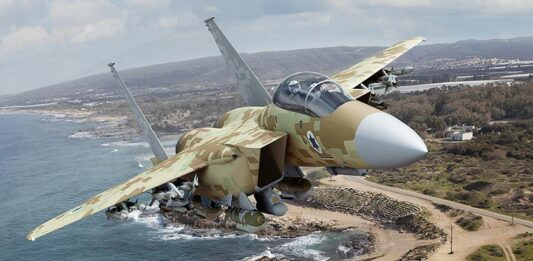
The announcement last week of the (potential) sale to Israel of 50 new F-15IA (Israel Advanced) fighters at the same time as the upgrade of 25 older F-15Is to the same model, although expected as it had been discussed many times and only time left was proposed (in relation to the availability of annual military aid), it nevertheless stirred the waters.
What are the ultimate Eagle II fighters that the Israeli Air Force is acquiring?
Whether the F-15EX, the first of which left the assembly line in St. Louis, Missouri in March 2021 and was later delivered to the USAF at Eglin Air Force Base in Florida, is a “fifth” generation Eagle (after the F-15A /B, F-15C/D, F-15E/I/S/K/SG and F-15SA/QA), it’s a matter of perspective. For many, this also depends on the further sales of Boeing’s fighter, which despite predictions in the late 2010s that it was in the west of its commercial course, continues to attract interest despite its high price, which far exceeds that of the stealth F -35.
On the other hand, the differences between the USAF F-15EX and the “Advanced” versions in service with the Saudi Arabian and Qatari air forces are not many, although some are substantial, as we will see below. It is noted that the Eagle II development and testing process benefited significantly from the fact that most of the aircraft’s subsystems were derived from the F-15SA/F-15QA and were funded by the respective users. [Despite what is believed, and quite a bit of it is traded in analyses, there are also differences between the F-15SA and F-15QA, which are enough to classify them as different generations, so the F-15EX will automatically become a sixth-generation Eagle.]
Current aircraft deliveries are to eight units, with the initial six aircraft (c/n EX1 to EX6) making up the OFPCTF (Operational Flight Program Combined Test Force), which is sponsored by two Squadrons, the 40th FLTS (Flight Test Squadron) under the 96th OG (Operations Group) and the 85th TES (Test and Evaluation Squadron) under the 53rd Wing, based at Eglin AFB. There they support various tests and evaluations in the first phase of IT&E (Integrated Test & Evaluation Phase 1), including sensors, weapons, tactical data links as well as cooperation with other air platforms, among them fifth generation fighters and unmanned aerial vehicles.
Recall that the six test aircraft as well as the first two initial production (EX7 and EX8) were related to a $1.2 billion contract, which was finalized only in July 2021, i.e. after the delivery of the two initial EX1 and EX2. The Eagle II EX3 through EX8 differ from their predecessors in the built-in equipment.
The F-15EX, like the F-15SA/QA from which it evolved, was and remains a multi-role fighter operated by a two-man crew, in a practice that began with the F-15E Strike Eagle. However, the American Air Force, based on the selective possibility that exists, intends to utilize it, at least initially (and for some permanently and exclusively), as a single-seat air superiority aircraft. For this purpose, all the infrastructure of the rear position of the cockpit occupied by the HOS (Weapon Systems Operator) is also present in the forward position. This selective “single-pilot” configuration (which does not eliminate the possibility of conducting operations with a two-man crew) is – as far as is known – the main difference with the SA/QA versions. [Actually, as Boeing implies, the F-15SA/QA also has a “single-pilot” capability, but on the Eagle EX it is specifically configured (and enhanced) to US Air Force requirements.]
As we have written in our previous article, the USAF initially considered the case of a single-seat fighter with the capabilities of the F-15EX (ie the SA/QA), which for a time was referred to as the F-15CX. But this intention stumbled on the very high cost of its development, since the single-seater F-15C has not been in production for several decades, with its restoration being expensive, while the conversion to a single-seater of the SA/QA would still be more expensive. So buying the Eagle EX was the best compromise and furthermore, to Boeing’s great benefit, producing it for the US Air Force keeps the type available for international customers (see box).

Having the option to use the Eagle II as a two-seater opens up many possibilities for the second crew member, such as coordinating air operations and controlling unmanned aircraft (including CCA-Collaborative Combat Aircraft). Boeing says that even more options may be available if the rear seat is removed and infrastructure for special applications is installed in the available space. One of them may be the operation of the plane as a relay node (node) in the ABMS (Advanced Battle Management System) developed by the USAF (and will involve both the B-21 Raider and the sixth generation fighter that will come from the program NGAD-New Generation Air Dominance) and will connect manned and unmanned elements on the future battlefield with the help of artificial intelligence. Another will be the role of the F-15EX as a high-performance platform for carrying special payloads such as reconnaissance, ESM or jamming with their remote management.
However, the most immediate mission that the Eagle II is expected to undertake, outside of this role of air superiority, will be as a carrier of hypersonic weapons due to its superior kinematic characteristics as analyzed below. According to the US Air Force, the plane can carry missiles weighing 3.5 tons and 7+ meters long, such as the AGM-183 ARRW (Air-launched Rapid Response Weapon).
Mach 2.5 speed?
The F-15EX excites the imagination of many more than the F-15SA/QA, since it concerns the fighter in American service and there are already some exaggerations. Such a story, for example, developed last February following statements by Rob Novotny, Boeing’s head of business development for the Eagle II program, who told the American magazine AW&ST (Aviation Week & Space Technology) that “the speed of the plane can reach Mach 3”. This was replicated and expanded into complete fiction. But it was obvious that (retired brigadier general and F-15 and F-22 pilot) Novotny’s statements were misinterpreted, since the company’s commercial director was referring to the theoretical “not-to-exceed” speed value of Mach 2.9 or 3,580 km/h on the surface of the sea (in a “clean” configuration, i.e. without any external load or pillars). But Novotny never claimed that this theoretical/design limit, very close to the SR-71’s performance, had been reached. Instead it was clarified that the maximum speed recorded in the tests was 2.497 Mach, with … further small prospects of increase, but not to 3 Mach. Of course, this speed also has no practical operational application since, as mentioned above, it concerns a “pure” configuration that “removes” even the compliant tanks from the plane. But this is not the only problem, as another major obstacle is the aerodynamic drag that will relentlessly strain the Eagle, which is not designed for prolonged flight in such conditions. But even if that was overcome, keeping the engines running at full afterburner would empty the fuel tanks in no time, eliminating any potential for operational exploitation.

The F-15EX uses (exclusively) General Electric F110-GE-129s rated at 29,500 pounds each in full afterburner, allowing it to accelerate and fly faster and higher than the older F-15Cs, which have F100- PW-220s rated at 23,500 lbs each with full afterburner. This means that the weapons it launches have a better operational “envelope” due to the additional kinetic or even dynamic energy of the platform. It’s even better (albeit slightly) than the F100-PW-229 Strike Eagles, which are rated at 29,000 pounds in this application.
Other elements of the newer design contribute in this direction, mainly the FBW (Fly-By-Wire) digital electronic flight control system with two computers with four independent channels, which compared to the F-15C/F-15E “families” provides increased stability and efficiency. As Boeing testers report, the plane’s flight envelope was “mapped” from the ground up and is better in many performance areas, such as wing flutter, an aeroelastic problem in which the wing extracts energy from airflow that can cause unstable self-excitation, leading to catastrophic structural failure. In addition, FBW has skyrocketed reliability compared to the past, significantly increasing time between failures and minimizing maintenance needs.
The F-15EX can accelerate supersonic and sustain Mach 1+ without using afterburners with the -229s, which the F-15C could also do, albeit only in a “clean” configuration, while it is reported that under some conditions, this could also be done with compliant tanks. The Eagle II exhibits this “supercruising” capability with CFT, but both fighter versions gradually lose this capability with external payloads. [Boeing, for example, does not disclose whether the Eagle EX’s “supercruising” capability is maintained by mounting rockets and—most importantly—how many or what type. Recall that the F-15SE (Silent Eagle) version with special weapons pouches was reported to have “supercruising” capability with them.]
Top upgrade from the inside
The Eagle II is virtually unchanged externally compared to all its predecessors. But internally it differs from all, even the newer F-15SA/QA. The “heart” of the aircraft, as in the latter, is the mission system, an open architecture that interconnects the large electronics and sensor assemblies and allows, through flexible software applications, rapid upgrades and additions.
The main mission system is the AESA APG-82(V)1 radar, which is significantly more capable compared to the APG-61(V)3, i.e. the same technology used in Singapore’s F-15SG, the F -15SA and was fitted as an upgrade to earlier F-15C/Ds. The AN/APG-82(V)1 [originally referred to as the AN/APG-63(V)4] further optimizes the APG-61(V)3. It still uses from the F/A-18E/F Super Hornet’s APG-79 a modified (and rather enlarged) element antenna (the most powerful AESA arrangement currently in use on any -known-operational fighter), the power supply assembly with advanced DREX (Digital Receiver/Exciter) infrastructure and the Common Integrated Censor Processor (CICP), while upgrading the processor and other infrastructures from APG-61(V)3. In addition to the F-15QA and F-15EX, the APG-81(V)1 was selected to upgrade the Israeli F-15I and 98 Mitsubishi F-15J of the Japanese Air Self-Defense Force (JASDF), while a version is also being used to modernize the B-52H.
The performance of the APG-61(V)1 is reported to be among the various AESA radar applications in combat aircraft as having a top capability for “near-simultaneous operation” of air-to-air and air-to-ground/surface configurations. Electronic scanning radar technology has historically been credited with such simultaneity capability that does not exist in conventional mechanically scanning radars, but in reality this capability is relative. A closer study of the information available on various systems shows that the degree of interleaving of the two functions, i.e. how “simultaneous” they are, is not the same, and even for each AESA radar the degree depends on the configurations ( air-to-air and air-to-ground) that it is performing at the time (some functions are performed “more simultaneously” than others). For the AN/APG-82(V)1 engagement is reported to be “near-simultaneous”, while enhanced air target detection-tracking capabilities, high resolution terrain mapping via Synthetic Apture Radar (SAR) and ground target tracking with MTI ( Moving Target Indicator/Tracking) are categorized as superior to other American systems in service.
The cockpit or ACS (Advanced Crew Station) is dominated by the one-piece large 10×19-inch screens mounted on both seats. It is designed and manufactured by Elbit Systems with touch command (IR) infrastructure that is activated by both bare hands and gloves.
They are supported by the ADCP II (Advanced Display Core Processor II) computer that manages the transfer of all data between the aircraft subsystems and display flight information, mission data and the tactical situation image in conjunction with the HMQS (Helmet-Mounted King System). The ADCP II filters and forwards to the crew only the most important information so as not to saturate the human agent’s ability to process it. Each of the screens can be configured independently and on a case-by-case basis with different display formats, such as two 9×9 “windows” for precision targeting, five “windows” or even eight to maximize the displayed information. Switching between them is easy and instantaneous via touch, allowing ‘windows’ to be zoomed or moved just like on an iPad. An interesting detail in relation to the touch command is that, because it can sometimes be difficult for the operator to use it, as in the case of many “G’s” or turbulence, all its functions, including the movement of the selection “runners” (cursor), can be done the “classic” way via the selectors on the HOTAS (Hands-On Throttle-And-Stick). In the front seat, above the main screen, there is the HRCCP (HUD Radio Communications Control Panel) panel, which has the classic form, but “keys” on a touch screen. The Eagle II is equipped with a quad-channel MIDS-JTRS (Multifunctional Information Distribution System-Joint Tactical Radio System) that features various communications protocols, including Link16.

The great asset of EPAWSS
The major difference between the F-15EX and the F-15QA, which was previously the most advanced Eagle version, is the ALQ-250 EPAWSS (Eagle Passive/Active Warning Survivability System) electronic warfare system that only the American Eagle IIs equip. This core infrastructure of the aircraft’s self-protection system, a fully digital design by BAE Systems, detects, gathers information, identifies, processes, categorizes, monitors and visualizes all electromagnetic emissions in the F-15EX’s environment providing unprecedented tactical situational awareness and threats. EPAWSS is reported to have a continuous high-speed wide-range scanning capability and the ability to uncover threats using broadcast flexibility and LPI (Low Probability of Intercept) techniques.
Through the eyes of the Legion Pod
The F-15EX becomes the next, if not the first, modern USAF fighter to feature IRST (Infra-Red Search and Track) in the form of the ASG-34 Legion Pod turret. Recall that the USAF on January 21, 2022 declared initial operational availability for the Legion EI (Eagle Integrated) IRST Pod version on the F-15C, which is also mounted on the Eagle II, allowing it to passively detect, identify, track and target, a capability that it is added to the amount of data collected by the other sensors (radar, EPAWSS), merged through ADCP II and presented to the crew.
Manufacturer Lockheed Martin claims the Legion Pod can be easily integrated into any aircraft (although specific data links are required), touting the ASG-34 as capable of replacing radar in the locate-lock-target cycle, whether in a high-jamming environment (radar-denied environment) or to avoid revealing the platform. But usually the use of IRST is cooperative with the radar, providing it with “cuing” or identifying the target that has been revealed electromagnetically. Alternatively, the target data accuracy revealed by the ASG-34 is sufficient to geolocate it in space using interferometry techniques and target it with air-to-air weapons, either passively guided AIM-9 or position-refreshing AMRAAMs of en route while keeping the active radar off until the final attack.
The same source has revealed that the IRST21 probe in the nose of the shuttle has the ability to pinpoint sources of infrared radiation by continuously scanning a large part of the space in its field of view through its onboard sensor array. It is noted that, although the largest sources of IR radiation corresponding to potential threats (and therefore targets) are aircraft engines, nevertheless the aerodynamic friction of the fuselage-wing causes heat and therefore infrared radiation, which is detectable through IRST.
The Legion Pod, according to LM, is not a specific pod, but a family based on the 0.4m diameter carrier with an open architecture, which can be fitted with various sensors, even more than one at a time, to serve various needs of specific types of fighters or aviation.
As we’ve reported with other opportunities, the number of F-15EXs the USAF will buy has fluctuated like a stock market, including a … peak price of 144 units at one point in the program’s development. The procurement was later capped at 104 aircraft, but on March 11, 2024, when the draft US Defense Budget for Fiscal Year 2025 was released, it was revealed that the USAF was now “requesting” funding for 98 Eagle IIs, as a result of mandatory funding cuts Pentagon programs under legislation to limit the US public debt. Estimates are that this will be the final number, although there may be developments in the future, mainly due to changes in other programs.
The withdrawal of aircraft or program cuts in the US, as proposed by the USAF, is always a point of contention in the US legislatures, with the House and Senate opposing and imposing their point of view through the approval or not of the proposals. For example, the U.S. Air Force is pushing to retire about half of its F-15Es in the coming years despite the given needs for tactical fighters. In the past it was mentioned the possibility of buying F-15EX to replace the Strike Eagle as well.

Back in 2020, the USAF announced that the two Oregon Air National Guard units currently operating F-15Cs, the 141st Wing at Portland International Airport and the 173rd Wing at Kingsley Field, would become the first to transition to the F-15C. 15EX with 18 planes each. This was followed in 2023 by announcements of the California National Guard’s 144th Wing in Ferno and the 159th Wing in New Orleans, Louisiana. A twist to the above plan occurred in May 2023, when it was announced that the 173rd Wing at Kingsley Field would assume the F-35A Formal Training Unit (FTU) role, leaving the fourth F-15EX Wing pending. It was also announced that no separate training unit would be established, with Eagle II pilots training at Seymour Johnson AFB in North Carolina.
