



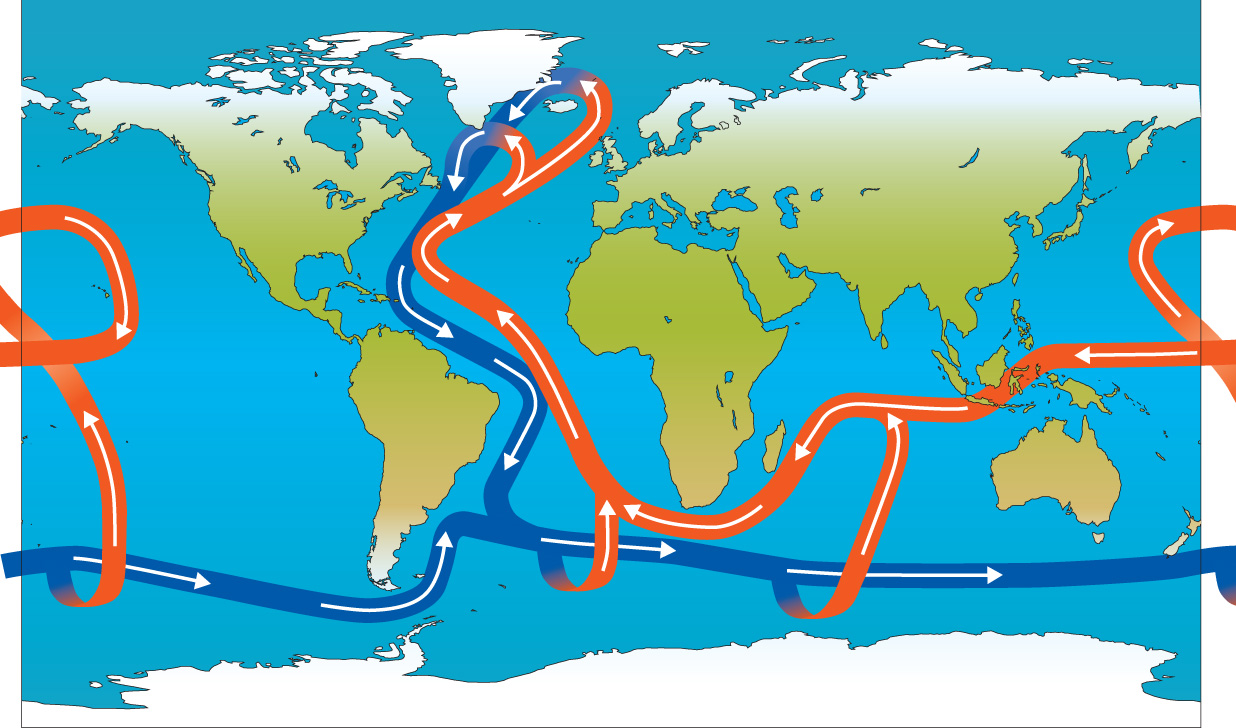
A vital Atlantic Ocean current system that affects weather around the world could collapse as early as the late 2030s, scientists argue in a new study – a planetary-scale catastrophe that would transform weather and climate. Probably all over the world, as weather events are often interconnected.
Several studies in recent years have suggested that the critical system – the Atlantic Meridional Overturning Circulation, or AMOC – could be on the verge of collapse, weakened by warmer ocean temperatures and disrupted salinity caused by anthropogenic climate change (please read the analysis titled (“Years Without Summer” for the Northern Hemisphere)).
But the new research, which is under review and has yet to be published in a journal, uses a state-of-the-art model to estimate when it could break down, suggesting that disruption could occur between 2037 and 2064. This research shows that it is very likely to collapse by 2050.
Water recycling cools Southern Hemisphere and warms North Atlantic
Like a (airport) conveyor belt, the AMOC pulls warm surface water from the Southern Hemisphere and the tropics and distributes it into the cold North Atlantic. The cooler, saltier water then sinks and flows south. This mechanism prevents parts of the Southern Hemisphere from overheating and parts of the Northern Hemisphere from freezing, while distributing life-sustaining nutrients to marine ecosystems.
The effects of an AMOC collapse would be “catastrophic.” In the decades after the collapse, the Arctic ice would begin to creep south, and after 100 years it would reach as far as the southern coast of England. Europe’s average temperature would plummet, as would North America’s – including parts of the US. The Amazon rainforest would see a complete reversal of its seasons – the current dry season would become the rainy months and vice versa.
An AMOC collapse “is a really big risk that we have to do everything we can to avoid.
To reach their conclusions, the scientists from Utrecht used state-of-the-art models and for the first time identified an area of the South Atlantic Ocean as the best place to monitor changes in circulation and use observational data. There they looked at ocean temperatures and salinity to confirm earlier predictions about when the AMOC might reach its tipping point.
While advances in research into the AMOC have been rapid and models trying to predict its collapse have progressed at lightning speed, they are still not without problems.
For example, the models do not take into account a critical factor in the collapse of the AMOC – the melting of the Greenland ice sheet. Huge amounts of fresh water are breaking off from the ice sheet and flowing into the North Atlantic, disrupting one of the circulation’s driving forces: salt. This research gap means that forecasts could underestimate how soon or quickly a collapse will occur.
