



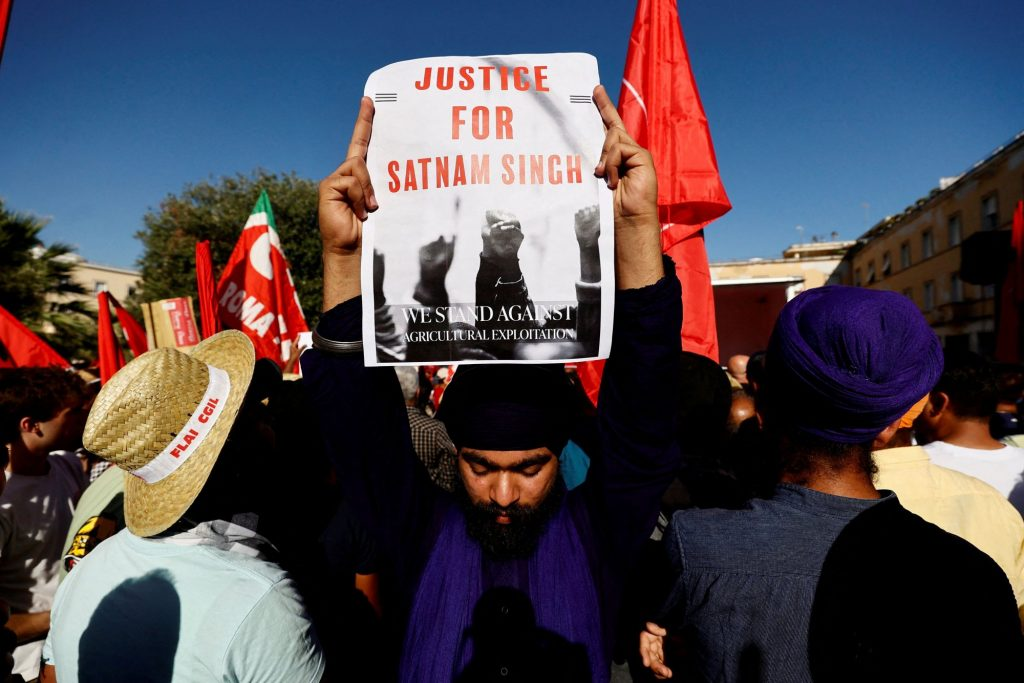
As every day for the past two years, on June 17, 31-year-old Satnam Singh from Punjab, India, was working for a handful of euros under the hot sun in fields in his informal new homeland of Italy, one of hundreds of thousands of land workers without papers.
An irregular immigrant, he sought a better future there with his wife. However, his story was to make headlines that day in the most tragic way.
During a peak harvest season, Satnam Singh’s post was at a machine that wrapped packets of fresh-cut vegetables in plastic wrap at the farm he worked in, in Latina, just outside Rome. In a horrific work accident, his hand was amputated.
But instead of his employer taking care of the immediate transport to a hospital, he assigned his associates to load the undeclared worker into a vehicle and leave him covered in blood outside his farmhouse. They left his severed arm roughly on a cage.
It took an hour and a half after his wife alerted the authorities before he was given first aid and airlifted to a hospital in Rome. There he cooled off two days later. He didn’t just die from uncontrollable bleeding.
Moreover, it does not only concern his Italian employer – who is facing charges of manslaughter – but also the Italian authorities.
The government of the post-fascist Giorgia Meloni is fully aware of exactly what is happening with “black” work and the relentless exploitation – especially of undocumented immigrants – in Italy.
But it conveniently turns a blind eye to the flourishing industry of the underground economy and human exploitation, while in the foreground it adopts an increasingly hard line on immigration.
A recurring horror story
The Satnam Singh incident was not another industrial accident in the fields and orchards of Italy. Of course, not only her…
It’s a recurring horror story, with different protagonists each time.
Deaths terrible in their own circumstances, which have as a common denominator toxic racism, an uncontrolled delinquency and ultimately the devaluing of human life. It is a frequent phenomenon in the fertile lands of Latina.
The area with large arable lands and farms is not even remote. It is about 50 kilometers from the center of Rome and the centers of power and control.
It is under the “nose” of the government, that is. But this does not prevent the infamous Capolarato.
Widespread practice in Italy, in the agricultural and construction sectors, involves the criminal exploitation of cheap labor. Although it is a criminal offence, it is flourishing.
Based on middlemen, who are primarily connected to the mafia, it consists of the “recruitment” of workers from the ranks of irregular immigrants and sometimes from the poorest strata of society.
By city and by region, they are collected in trucks from specific meeting points by the local gang leader, usually at dawn.
He then makes distributions to the fields to work without a contract or even rudimentary safety measures. A few have “seasonal work” visas in low-paying sectors such as agriculture.
Most, like Satnam, come to the country irregularly and are the most vulnerable victims at the hands of exploiters. Traffickers and employers. The latter have a common address. They call them “Padrone”. Greek “boss”.
They are not all the same. But many operate in terms of modern slavery. They withhold documents from workers to ensure they don’t leave the fields. They are paid birr for endless hours of work under the sun, without water, food and breaks.
They threaten them that if they protest they will hand them over to the police.
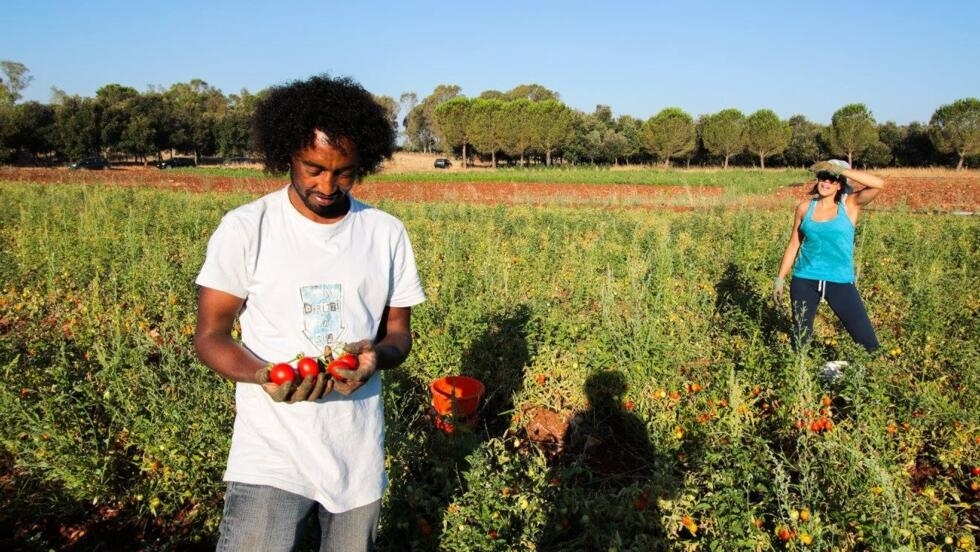
Land workers: a modern day slavery
On a sunny day in late June, in the wake of the shock of Satnam’s gruesome death and in the midst of harvest, most of the farm laborers – especially those who are immigrants from India – did not show up for work in Latina’s fields.
They had called a rare strike, taking part in a protest march towards the city centre. They chanted slogans such as “give permits” and “settle illegal immigrants”.
Under other circumstances, this would have infuriated the “bosses”. This time, however, they did not produce any kich. On the one hand, because Caporalato has been banned since 2016 – the reason then was the death of an Italian land worker, due to a heart attack and after continuous 12-hour shifts in the collection and sorting of grapes.
On the other hand, because no one actually believes that something will actually change in this illegal practice. Although there are no official figures, it is estimated that there are at least 230,000 people who are employed in “black work”, victims of unscrupulous gangs and businessmen.
About 55,000 of them are women. They work without contracts and under extremely dangerous conditions in fields, orchards, greenhouses and vineyards, scattered throughout the country.
The inactivity of control mechanisms, the absence of work inspections and interventions by law enforcement agencies, local or even central competent authorities creates fertile ground.
In the mobilization in Latina, many of those gathered denounced the fact that while they are forced to live illegally in Italy, they contribute as workers – namely “black” and underpaid – to its development.
Their request, common. They want to legitimize themselves. “If we become taxpayers, we will contribute more,” said one.
But these modern slaves remain systemically invisible. They temporarily emerge from obscurity when one of them is seriously injured or dies.
“The death of Satnam Singh was horrible and inhuman,” commented Giorgia Meloni in the Italian Parliament. Although he did not announce any action, he was applauded.
