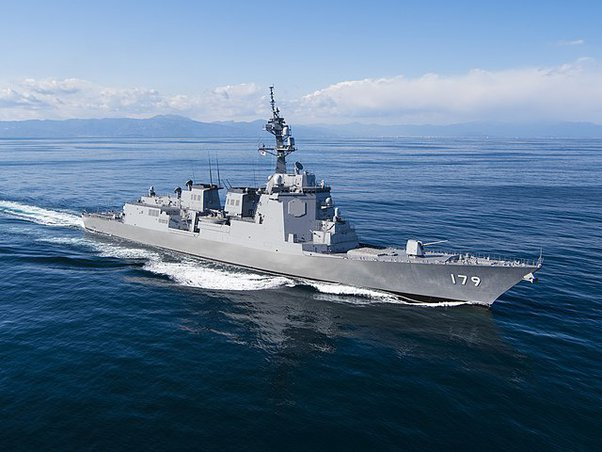
The F-123 Brandenburg class of frigates was designed as a replacement for the four Hamburg class destroyers. A consortium of shipyards was established in 1988 under the leadership of Blohm & Voss Hamburg for the new frigate program. This also included Howaldswerke Deutsche Werft AG Kiel and Tyssen Nordseewerke Emden. Opposite them was the design of the Bremen Vulkan shipyard. The contract was finally awarded to the consortium in October 1988 and on 28 June 1989 the construction contracts were awarded. The plans came from Blohm & Voss and the price of the ship was estimated at 585 million dollars. The total financial outlay ultimately amounted to $2.42 billion, and each of the four shipyards received an order for one ship. All ships were delivered to the German Navy (Deutsche Marine) between 1994 and 1996.
Design-wise the F-123s follow the MEKO standard but were a completely new design of greater displacement and performance compared to the same company’s MEKO 200 class, which was procured by several navies at the time. It is a general duty frigate with balanced equipment and greatly enhanced armament compared to other frigates of the 1990s.
The main dimensions of the ship are: length overall 138.85 meters and waterline length 126.9 meters, beam overall 16.7 meters and width at the waterline 15.74 meters, draft to main deck 9.5 meters, mean draft at 4.35 meters and 6.30 meters at the bow bulb. Standard displacement is 3600 tons and full 4900 tons.
The hull is made of high strength steel and is divided into 15 watertight compartments and three decks. There are 14 watertight bulkheads of which six are double-walled for extra fire resistance and to limit the effects of an anti-ship missile strike. Amidships and at the outer upper corners of the main deck, independent Box Girder beams of 16 mm steel extend aft, starting from the helicopter hangar, to the forward part of Section XII. These give the ships additional longitudinal stiffness and accommodate significant sections of cables and conduits. Accordingly the superstructure and masts are also made of high strength steel. The superstructure has two decks (Main & B) and the bridge on level C. The design of the frigate follows the MEKO philosophy and special care has been taken to limit the acoustic, thermal and electromagnetic footprint.
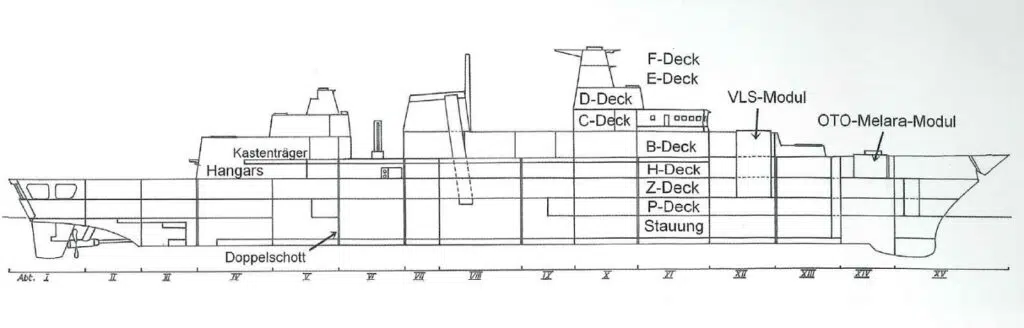
The ship’s main crew consists of 199 people plus 20 additional people for helicopter service. Apart from the captain, the second in command and the ship’s doctor the rest of the 199 people are divided into two shifts. Apart from the captain who has a two-compartment large cabin on C-Deck for the rest of the crew there are accommodations for two, four and ten people depending on the rank.
The ship’s main propulsion system is a combination of air turbines or diesel engines (CODOG, Combination of Diesel or Gas) which drive two shafts, through two Renk BGS 178 Lo gearboxes, which terminate in two five-bladed variable pitch propellers. With the economic speed of 18 knots the ship achieves a sailing range of approximately 4000 nm. while the maximum speed is of the order of more than 29 knots. The power plant consists of two LM2500 SA-ML marine turbines delivering 19000kW at 3600 rpm. each and two MTU 20V 956 TB92 diesel engines producing 8140kW each at 1500 rpm. All the above machines are placed inside special sound-insulating and anti-vibration modules to reduce noise. The ship’s fuel tanks have a total capacity of 520 m3 and the average consumption at 21 knots with the two diesel engines in operation is 3-4 m3 of fuel per hour. The capacity of the aviation fuel tank for the helicopter is 85m3.

For power generation the ship has four “EdiMot” diesel electric engines type KHDMWM TBD 602V 16/K which deliver 1030kW and drive a 440V-60Hz three-phase generator from A. V. Kaick. They are placed in pairs in compartments IV and IX of the ship. Each diesel generator is inside a special soundproof and anti-vibration module. Their exhaust outlets are located on the sides of the ship just above the waterline. The exhaust gases pass through a cooling unit and leave the ship at a temperature of 50-70 °C with cooling water vapour.
The ship is steered by a single rudder while for increased stability the ship has paratropides as well as an active stability system with two fins placed on either side aft from the middle of the ship.
Armor
The main armament consists of one Compatto 76/62 gun in the bow. The Compatto gun is dual-role, 76 mm caliber and fires 6.5 kg projectiles at a maximum distance of 16,000 meters. Two Mk41 Mod 3 vertical rocket launchers with 16 bays for ESSM medium-range anti-aircraft missiles. ESSMs have a maximum range of 50 km and a speed of mach 4+. For incoming missile defense the frigate has two CIWS Mk49 RAM systems of 21 missiles each mounted, one between the main gun and MK41 launchers in the bow and the other above the helicopter hangar. Against surface ships it has two quadruple MK141 launchers for AGM-84D Harpoon missiles which replaced the two twin launchers for MM38 Exocet missiles mounted in the middeck. The German Navy is investigating replacing the AGM-84D Harpoon with SAAB’s newer and more capable RBS-15 MK3s during a mid-life upgrade the ships are currently undergoing. Two twin Mk32 torpedo tubes for MK46 or MU-90 light anti-submarine torpedoes are located starboard and port amidships on “B” Deck. It also has two Mauser 27mm gun stations. The last line of defense is the MASS airfoil launcher systems.
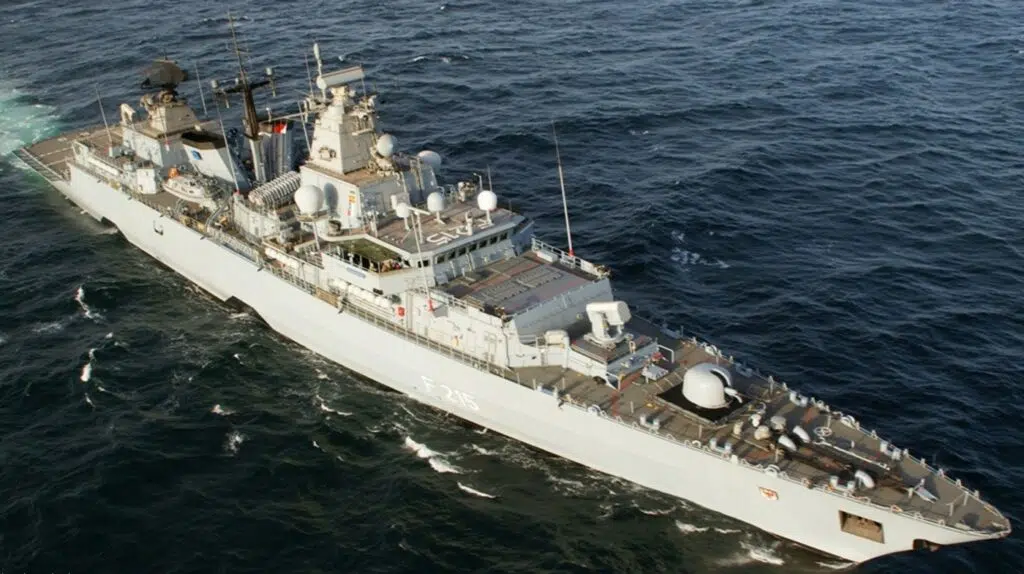
Finally, the frigate has a helipad with the capacity to float and service a helicopter of up to 15 tons. The helicopter hangar is two-compartment capable of servicing two NH-90 size A/V helicopters and is separated by a corridor. This arrangement helps to prevent the helicopters from hitting the sides of the hangar and the non-spreading of the fire.
Electronics
The ship’s primary sensors are 3D Smart S radars on the main mast and 2D MW 08 D-band long-range survey radars on the secondary mast above the helicopter hangar. Two STIR 180 fire control systems mounted one forward of the main mast and the second above the helicopter hangar covering 360 degrees. All sensors and weapons are integrated into the ship’s combat system. During the upgrade of the ships, worth 450 million euros, which was signed in 2021 and is expected to be completed in 2030, the two radars of the ship will be replaced by Sea Giraffe 4A and Sea Giraffe 1X, as well as the STIR 180 by CEROS 200 all of SAAB which will be integrated into the new 9LV combat control system also of SAAB. A new IFF system will also be installed. In addition, the ship has two Sperry Bridge Master E surface radars.

For anti-submarine warfare the ships carry Atlas Elektronik’s DSQS-23BZ bow bulb mounted hull sonar and towed low frequency sonar at the stern. Atlas Elektronik MES mine detection sonar is also installed. The ECM/ESM electronic warfare system is the EADS FL 1800S. Finally, it has full communications with Link 11 / 16 data link systems, SatCom SCOT 3 antenna, Inmarsat antennas, UHF, HF, VHF, SHF and VLF.